What does Mark 9:23 mean?
“Jesus said unto him, If thou canst believe, all things are possible to him that believeth.” — Mark 9:23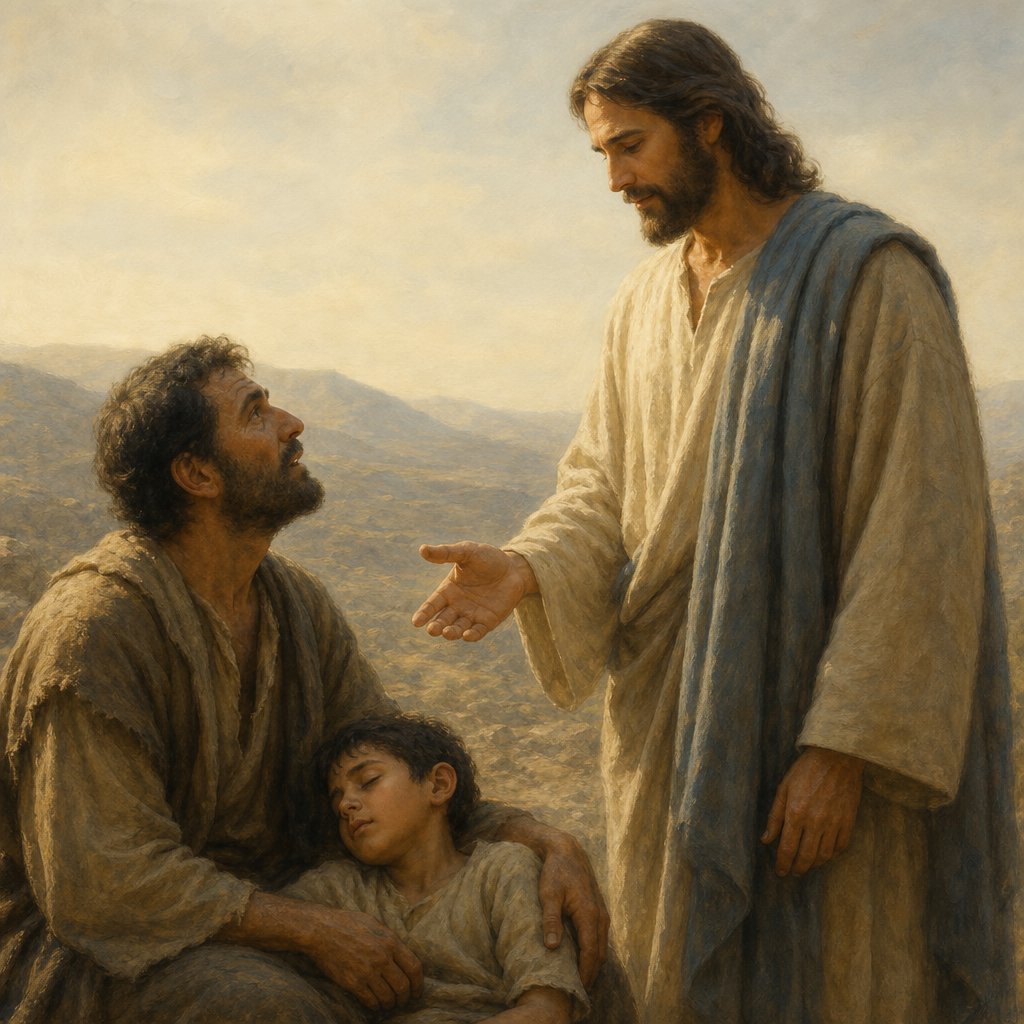
Mark 9:23 in the King James Version reads, “Jesus said unto him, If thou canst believe, all things are possible to him that believeth.” The sentence is brief, but it sits at the emotional and theological center of one of the most revealing scenes in Mark’s Gospel, and its meaning becomes clearer when it is heard inside its moment rather than as a detached slogan.
The setting is a crisis of helplessness. A father has brought his son to the disciples, and the boy is described as being grievously tormented: he is seized, thrown down, and left as one “pining away.” The father’s hope has already been wounded, because the disciples “could not” cast the spirit out. When Jesus arrives, the situation exposes the limits of human strength and even the limits of secondhand faith. The father voices a plea that is both desperate and guarded: “If thou canst do any thing, have compassion on us, and help us.” That “if” is not merely a word; it is the father’s uncertainty, shaped by disappointment and fear. Mark 9:23 is Jesus’ answer to that uncertainty. Jesus takes the father’s “if” and turns it back upon him, not as a cold rebuke but as a decisive correction of where the real question lies. “If thou canst believe” shifts the focus away from doubting Christ’s ability and toward the posture of the one asking.
This is not Jesus teaching that faith is a kind of magic by which any desire becomes reality. The verse speaks inside the immediate purpose of Christ’s presence: he has come with authority over unclean spirits and with mercy toward the suffering, and he is drawing this man out of paralyzing doubt into living trust. The phrase “all things are possible” does not mean that believers become omnipotent; it means that no situation is beyond the reach of Christ when met with faith. In the story, the impossible thing is not a vague ambition but the deliverance of a child from bondage that no one else could break. The “possible” is grounded in who Jesus is, not in who the father is. Faith is the open hand that receives; the power remains Christ’s.
The verse also reveals a theme that runs through Mark: the conflict between fear and faith, and the way Jesus continually calls people from one to the other. Over and over, Mark sets scenes of inability, danger, and bafflement against Jesus’ authority. Here, the father’s inability is mirrored by the disciples’ inability, and both are answered by Jesus’ word. Yet Jesus does not treat belief as mere intellectual agreement. The father’s next words, which immediately follow, show belief as something painfully real, contested, and honest: “Lord, I believe; help thou mine unbelief.” That response matters for understanding Mark 9:23, because it shows that Jesus’ call to believe is not a demand for flawless confidence. The man’s faith is mixed, trembling, incomplete, yet it is faith directed toward Christ. The verse therefore carries a compassionate realism: it summons belief, and it makes room for the fact that belief may begin in weakness.
In symbolism and spiritual significance, the afflicted child can be seen as an image of human helplessness under powers that cannot be mastered by willpower alone. The “spirit” that tears, casts down, and seeks destruction resembles sin’s enslaving and dehumanizing force, and the father’s exhausted plea resembles the condition of those who have tried every remedy and found none. In that darkness, Jesus’ words are like a door opening. Faith, in this scene, is not self-generated optimism; it is the turning of the soul toward Christ’s compassion and authority. When Jesus says, “to him that believeth,” the stress is not on the believer’s greatness but on the believer’s relationship to the One who can act. The man is invited into that relationship. He is no longer merely a spectator of religious power; he is called to trust the living Christ.
The verse also carries a corrective against misdirected doubt. The father’s “If thou canst do any thing” assumes that the uncertainty is in Jesus. Jesus’ “If thou canst believe” exposes that the real crisis is not Christ’s ability but the man’s wavering trust. This is not shaming; it is healing. Christ is dismantling the father’s false “if,” because that “if” keeps the man trapped between hope and resignation. Jesus replaces it with a different “if,” one that invites the father to move from testing God to trusting God. The compassion of Jesus is implied in the fact that he engages the father at all, drawing him into faith rather than dismissing him for his weakness.
Finally, the significance of Mark 9:23 is that it reveals how the kingdom of God meets human need. It is not that faith earns miracles as a wage; it is that faith is the fitting response to the presence of the King. Where Christ is, impossibility is not the final word. The verse teaches that faith connects the sufferer to the sufficiency of Jesus, and that even a faith that must cry, “help thou mine unbelief,” is still faith reaching toward the right object. Mark 9:23 therefore stands as both an invitation and a lens: an invitation to trust Christ amid what cannot be fixed by human hands, and a lens through which suffering, prayer, and deliverance are interpreted—not by the measure of human strength, but by the boundless authority and mercy of Jesus Christ.
Get our apps


Artwork for Mark 9:23

Mark 9:23 - "Jesus said unto him, If thou canst believe, all things are possible to him that believeth."

"Jesus said unto him, If thou canst believe, all things are possible to him that believeth." - Mark 9:23
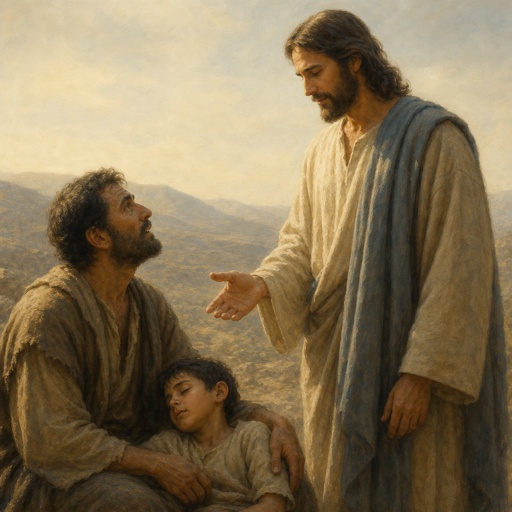
"Jesus said unto him, If thou canst believe, all things are possible to him that believeth." - Mark 9:23

"Jesus said unto him, If thou canst believe, all things are possible to him that believeth." - Mark 9:23

Mark 9:2 Show only 4 people Show a mountain area According to Mark 9:2

Mark 2:9

Mark 9:2 Show only 4 people and one of them is Jesus Show a mountain area According to Mark 9:2

Mark 9:38

Mark 2:9

Mark 1:23 - "And there was in their synagogue a man with an unclean spirit; and he cried out,"

Mark 15:23 - "And they gave him to drink wine mingled with myrrh: but he received it not."

Mark 7:23 - "All these evil things come from within, and defile the man."

Mark 4:23 - "If any man have ears to hear, let him hear."

Mark 9:36-37

Mark 13:23 - "But take ye heed: behold, I have foretold you all things."

Mark 9:48 - "Where their worm dieth not, and the fire is not quenched."

Mark 6:9 - "But be shod with sandals; and not put on two coats."

Mark 9:40 - "For he that is not against us is on our part."

Mark 9:46 - "Where their worm dieth not, and the fire is not quenched."

Mark 9:44 - "Where their worm dieth not, and the fire is not quenched."
"And the Jews undertook to do as they had begun, and as Mordecai had written unto them;" - Esther 9:23

Mark 9:32 - "But they understood not that saying, and were afraid to ask him."

Genesis 23-9

african american mary magdalene, mark 16: 9

Mark 14:23 - "And he took the cup, and when he had given thanks, he gave it to them: and they all drank of it."

Mark 9:16 - "And he asked the scribes, What question ye with them?"

Mark 9:6 - "For he wist not what to say; for they were sore afraid."

Mark 12:23 - "In the resurrection therefore, when they shall rise, whose wife shall she be of them? for the seven had her to wife."

Mark 9:4 - "And there appeared unto them Elias with Moses: and they were talking with Jesus."

Mark 9:2 Do not show Jesus' face Show only 4 people including Jesus Show a mountain area therefore, show only 4 people in a mountain area and for one of them don't show the face. Mark 9:2