What does Mark 9:24 mean?
“And straightway the father of the child cried out, and said with tears, Lord, I believe; help thou mine unbelief.” — Mark 9:24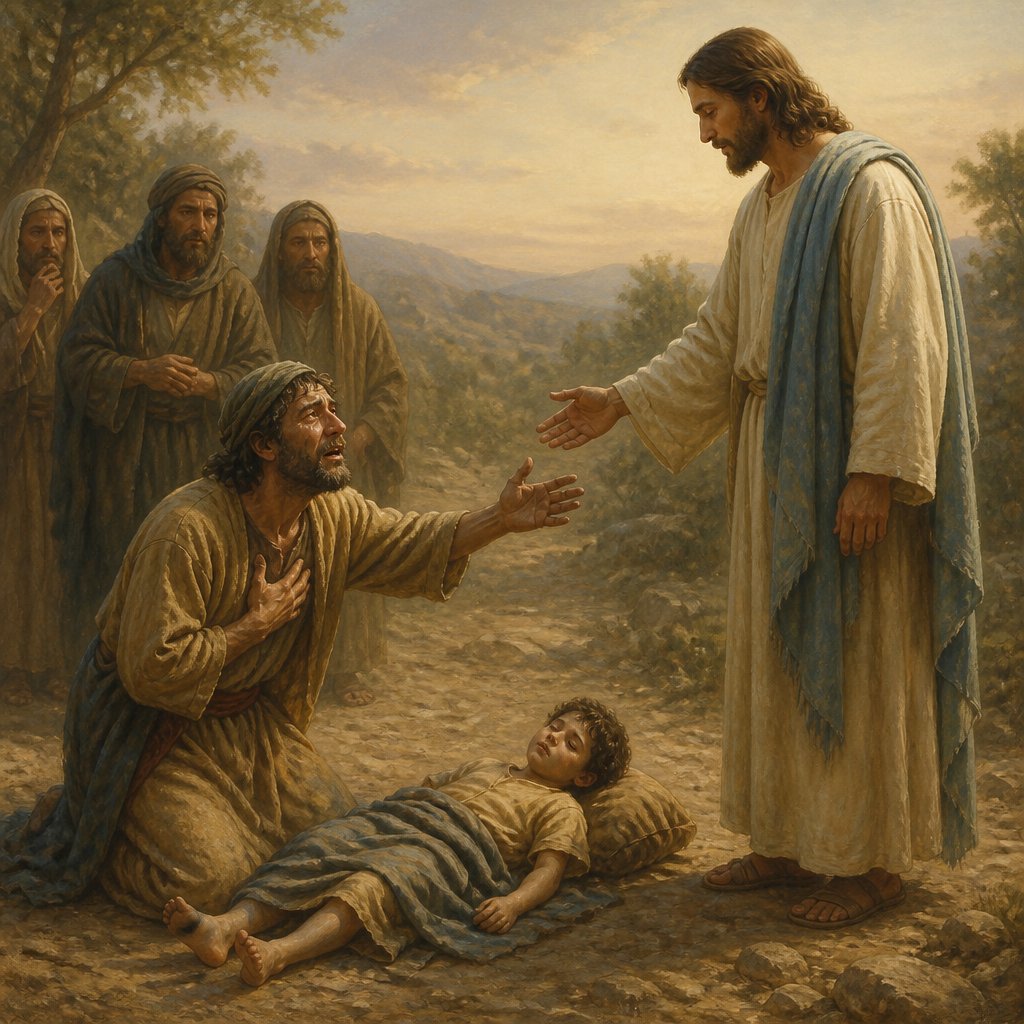
Mark 9:24 in the King James Version (KJV) of the Bible reads, "And straightway the father of the child cried out, and said with tears, Lord, I believe; help thou mine unbelief."
This verse is part of a larger passage in the Gospel of Mark that recounts the story of a man who brings his demon-possessed son to Jesus for healing. The man had previously asked Jesus's disciples to cast the demon out of his son, but they were unable to do so. When Jesus arrives on the scene, he asks the man about the situation, and the man responds with the plea expressed in Mark 9:24.
The theme of faith is central to this verse and the broader passage it is a part of. The man's cry to Jesus reflects a tension between belief and unbelief that resonates with many people's experiences of faith. His plea for help in overcoming his unbelief demonstrates a deep sense of longing for spiritual connection and the recognition of his own limitations. In this way, the verse speaks to the complex and evolving nature of faith, as well as the struggles that individuals may face in maintaining or deepening their belief in God.
The context of this passage is also significant for understanding the depth of the man's plea. When the man brings his son to Jesus, he is desperate for help. His son is suffering greatly, and the man has already sought help from the disciples without success. In this moment of desperation, the man approaches Jesus with a raw and emotional expression of his faith. His tears, along with his declaration of belief and request for help in overcoming his unbelief, reveal the depth of his need and the sincerity of his appeal to Jesus for assistance.
The symbolic significance of this verse lies in the contrast between belief and unbelief. The man's cry to Jesus embodies a profound human struggle with faith and doubt. In his acknowledgment of both his belief and unbelief, the man demonstrates a humility and vulnerability that are essential to spiritual growth. His willingness to confront his own doubts and seek help from Jesus exemplifies the complex interplay of trust and uncertainty that characterizes the faith journey for many people.
Furthermore, the response of Jesus to the man's plea provides a powerful demonstration of the transformative power of faith. After the man's emotional exclamation, Jesus goes on to heal his son, thereby affirming the man's belief and addressing his unbelief. This act of healing serves as a validation of the man's faith and a reminder of the capacity for divine intervention in response to sincere and earnest appeals for help.
In conclusion, Mark 9:24 in the King James Version of the Bible encapsulates the profound themes of faith, doubt, and divine intervention. The context of the passage adds depth to the man's plea for help, highlighting his desperation and emotional vulnerability. The symbolic significance of the verse lies in its portrayal of the complex nature of belief and unbelief and the transformative power of faith. Ultimately, this verse serves as a poignant reminder of the human struggle with faith and the possibility of finding resolution through a sincere and earnest appeal to God.
Get our apps


Artwork for Mark 9:24

Mark 9:24 - "And straightway the father of the child cried out, and said with tears, Lord, I believe; help thou mine unbelief."
"And straightway the father of the child cried out, and said with tears, Lord, I believe; help thou mine unbelief." - Mark 9:24

Mark 9:2 Show only 4 people Show a mountain area According to Mark 9:2

Mark 2:9

Mark 9:2 Show only 4 people and one of them is Jesus Show a mountain area According to Mark 9:2

Mark 9:38

Mark 2:9

Mark 3:24 - "And if a kingdom be divided against itself, that kingdom cannot stand."

Mark 8:24 - "And he looked up, and said, I see men as trees, walking."

Mark 5:24 - "And Jesus went with him; and much people followed him, and thronged him."

Mark 9:36-37

Mark 14:24 - "And he said unto them, This is my blood of the new testament, which is shed for many."

Mark 9:48 - "Where their worm dieth not, and the fire is not quenched."

Mark 6:9 - "But be shod with sandals; and not put on two coats."

Mark 2:24 - "And the Pharisees said unto him, Behold, why do they on the sabbath day that which is not lawful?"

Mark 9:40 - "For he that is not against us is on our part."

Mark 9:46 - "Where their worm dieth not, and the fire is not quenched."

Mark 9:44 - "Where their worm dieth not, and the fire is not quenched."

Mark 13:24 - "¶ But in those days, after that tribulation, the sun shall be darkened, and the moon shall not give her light,"

Mark 9:32 - "But they understood not that saying, and were afraid to ask him."

Genesis 24-9

african american mary magdalene, mark 16: 9

Mark 9:16 - "And he asked the scribes, What question ye with them?"

Mark 9:6 - "For he wist not what to say; for they were sore afraid."

Mark 9:4 - "And there appeared unto them Elias with Moses: and they were talking with Jesus."

Mark 9:2 Do not show Jesus' face Show only 4 people including Jesus Show a mountain area therefore, show only 4 people in a mountain area and for one of them don't show the face. Mark 9:2

Genesis 9:24-25

Exodus 24:9-11

Jude 9:22-24

Mark 9:27 - "But Jesus took him by the hand, and lifted him up; and he arose."