What does Mark 9:29 mean?
“And he said unto them, This kind can come forth by nothing, but by prayer and fasting.” — Mark 9:29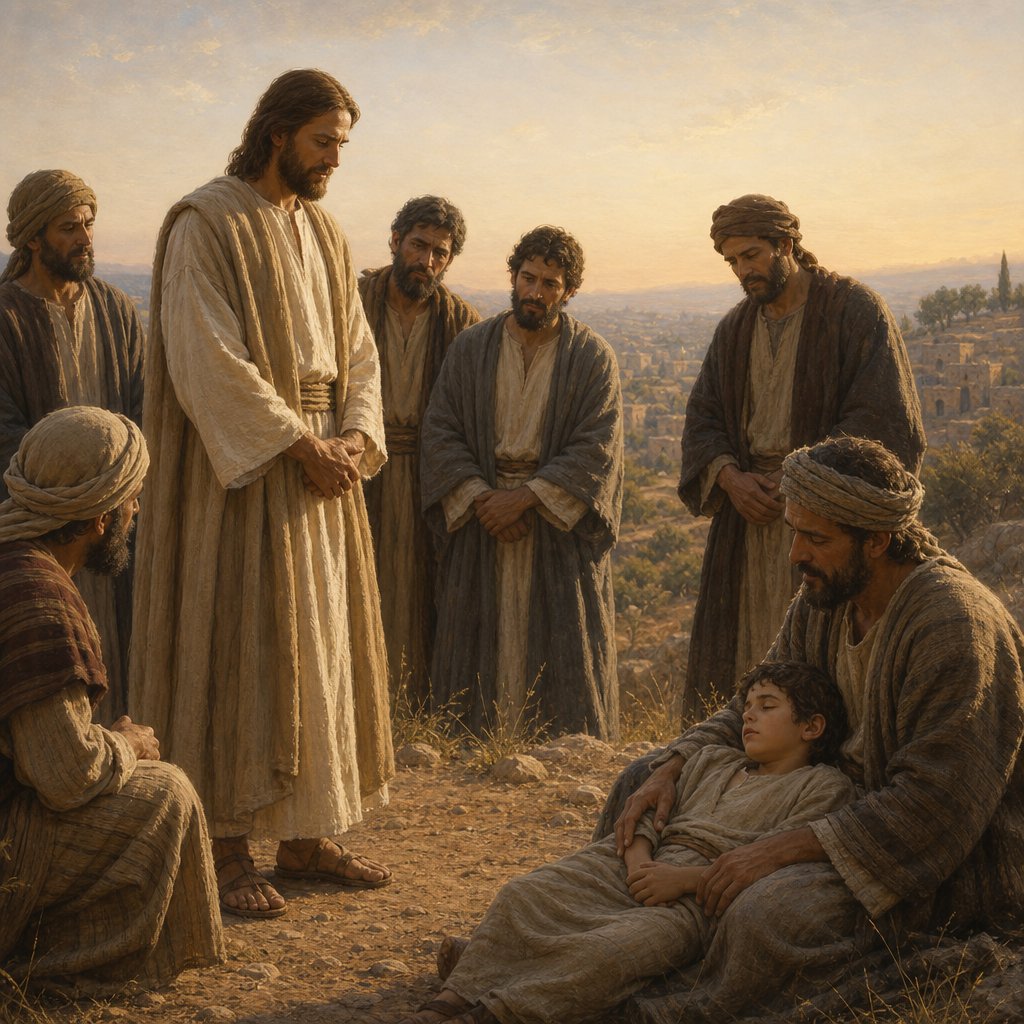
In Mark 9:29, the Lord answers the disciples’ private question about their failure to deliver a child from an unclean spirit: “And he said unto them, This kind can come forth by nothing, but by prayer and fasting.” In the King James Bible, those few words sit at the end of a scene that is charged with urgency and grief, and they explain not only why the disciples failed in that moment, but what sort of spiritual posture the work of deliverance requires.
The context begins on the heels of the transfiguration. Jesus descends from the mount and immediately meets a crowd, scribes disputing, and a father desperate for his son’s life. The boy is afflicted by a “dumb spirit,” a spiritual bondage that manifests in terrible physical and mental convulsions, self-destruction, and helplessness. The father says he brought the child to the disciples, “and they could not.” That failure is not treated as a minor embarrassment; it becomes the setting for a revelation about faith, prayer, the reality of spiritual conflict, and the difference between spiritual words and spiritual power. Jesus’ lament—“O faithless generation, how long shall I be with you?”—places the episode within a broader diagnosis: Israel has the Scriptures, the promises, and even the immediate presence of the Messiah, yet is repeatedly marked by unbelief and spiritual dullness.
Mark records a sharp exchange between Jesus and the father that frames the meaning of verse 29. When the father says, “if thou canst do any thing,” Jesus answers, “If thou canst believe, all things are possible to him that believeth.” The father responds with one of the most honest prayers in Scripture: “Lord, I believe; help thou mine unbelief.” In that cry the story shows that faith is not a self-generated confidence or a mere mental assent; it is dependence that turns toward Christ even while trembling. Jesus then rebukes the foul spirit, commands it to come out and not enter again, and the child appears as one dead until Jesus takes him by the hand and lifts him up. Deathlike collapse followed by being raised is not accidental. It is a small picture of what Christ does in the larger work of redemption: He brings life where the power of evil has driven a person toward ruin, and He does it by His own authority, not by human technique.
It is after this public victory that the disciples ask the crucial question in private: “Why could not we cast him out?” Mark 9:29 is Jesus’ answer. “This kind” acknowledges that spiritual opposition is not uniform. The verse assumes discernment: there are degrees of entanglement, varieties of uncleanness, and encounters that expose the insufficiency of casual religion. The disciples had previously been given authority to cast out devils (Mark 6), so their inability here points to something more than a lack of permission. It points to a lack of preparedness in the inward life. Jesus is not introducing a magical formula; He is exposing that the power to confront darkness is not carried in self-assurance, argument, or mere past experience, but in living dependence upon God.
The theme of prayer in this verse is not simply “saying prayers,” but communion with God that recognizes utter need. Prayer is the posture of faith turned into supplication. In the story, the father’s plea, the disciples’ question, and Jesus’ action all converge to show that the battle is spiritual before it is outward. Prayer also signals that deliverance is God’s work, not ours. When Jesus says such a spirit comes forth “by nothing, but by prayer,” He teaches the disciples that spiritual victory is not extracted from the situation by force of will or spiritual reputation; it is sought from God. Prayer re-centers the servant: it moves the heart from presumption to dependence, from performance to petition, from self to the Lord.
The addition of “and fasting” in the KJV presses the point further. Fasting, in biblical symbolism, is a voluntary laying aside of lawful comforts in order to seek God with focused humility. It is not a bribe to make God act; it is an embodied confession that bread is not our true life, and that the servant must be mastered by God rather than by appetite, distraction, or self-indulgence. In the landscape of Scripture, fasting is often connected to mourning, repentance, urgency, and the recognition that the matter at hand exceeds ordinary resources. Here, it underscores that some spiritual conflicts expose not only the enemy’s malice but the disciple’s need for deeper consecration. Fasting therefore symbolizes seriousness before God. It is a way of saying, in the language of the body, what the heart must mean: “Lord, I cannot; thou must.”
This makes Mark 9:29 a corrective to two opposite errors. On one side is the error of unbelieving skepticism, represented in the wider “faithless generation” and in the scribes’ contentious atmosphere. On the other side is the error of self-reliant ministry, where a disciple assumes yesterday’s authority guarantees today’s success. The disciples’ failure shows that participation in Jesus’ work cannot be reduced to a technique. Christ’s answer shows that effective spiritual service flows from ongoing dependence, cultivated in prayer and, when God so calls, deepened by fasting. The verse also guards against a shallow view of faith. The father’s mixture of belief and unbelief, met by Christ’s compassion and power, shows that saving dependence is real even when imperfect, but the disciples’ lack in the moment suggests that active ministry can be hindered when faith is not being exercised through prayerful reliance.
Symbolically, the scene also portrays the human condition under the tyranny of sin and the devil. The boy’s mute bondage mirrors how evil silences true confession and worship; it renders a person unable to speak rightly, and it drives toward self-destruction. Jesus’ command that the spirit “enter no more into him” highlights the completeness of Christ’s deliverance. Yet the pathway to that deliverance, as taught to the disciples, is not bravado but prayer and fasting. The kingdom of God advances by the power of God, and God trains His servants to live as dependent people.
The significance of Mark 9:29, then, is that it locates spiritual authority not in the servant as an independent source, but in God as the only source. It teaches that there are moments when the reality of evil is so pressing that only a life shaped by prayer—and humbled by fasting—can stand faithful and effective. It calls the reader to a kind of religion that is not merely public and verbal, but inward, disciplined, and God-dependent. And it quietly exalts Jesus Himself: the One who needs no preparation to command unclean spirits, yet who teaches His disciples that if they would share in His work, they must learn to live on their knees, with hearts set upon God.
Get our apps


Artwork for Mark 9:29

Mark 9:29 - "And he said unto them, This kind can come forth by nothing, but by prayer and fasting."

"And he said unto them, This kind can come forth by nothing, but by prayer and fasting." - Mark 9:29
"And he said unto them, This kind can come forth by nothing, but by prayer and fasting." - Mark 9:29

Mark 14:29 - "But Peter said unto him, Although all shall be offended, yet will not I."

Mark 9:2 Show only 4 people Show a mountain area According to Mark 9:2

Mark 6:29 - "And when his disciples heard of it, they came and took up his corpse, and laid it in a tomb."

Mark 2:9

Mark 9:2 Show only 4 people and one of them is Jesus Show a mountain area According to Mark 9:2

Mark 4:29 - "But when the fruit is brought forth, immediately he putteth in the sickle, because the harvest is come."

Mark 9:38

Mark 2:9

Mark 1:29 - "And forthwith, when they were come out of the synagogue, they entered into the house of Simon and Andrew, with James and John."

Mark 5:29 - "And straightway the fountain of her blood was dried up; and she felt in her body that she was healed of that plague."

Mark 7:29 - "And he said unto her, For this saying go thy way; the devil is gone out of thy daughter."

Mark 15:29 - "And they that passed by railed on him, wagging their heads, and saying, Ah, thou that destroyest the temple, and buildest it in three days,"

Mark 9:36-37

Mark 12:29 - "And Jesus answered him, The first of all the commandments is, Hear, O Israel; The Lord our God is one Lord:"

luke 9:29- 30

Mark 13:29 - "So ye in like manner, when ye shall see these things come to pass, know that it is nigh, even at the doors."

Mark 9:48 - "Where their worm dieth not, and the fire is not quenched."

Mark 6:9 - "But be shod with sandals; and not put on two coats."

Mark 9:40 - "For he that is not against us is on our part."

Mark 9:46 - "Where their worm dieth not, and the fire is not quenched."

Mark 9:44 - "Where their worm dieth not, and the fire is not quenched."

Mark 9:32 - "But they understood not that saying, and were afraid to ask him."

Mark 8:29 - "And he saith unto them, But whom say ye that I am? And Peter answereth and saith unto him, Thou art the Christ."

Job 29:9 - "The princes refrained talking, and laid their hand on their mouth."

Job 9:29 - "If I be wicked, why then labour I in vain?"

african american mary magdalene, mark 16: 9

Mark 9:16 - "And he asked the scribes, What question ye with them?"