What does Matthew 16:19 mean?
“And I will give unto thee the keys of the kingdom of heaven: and whatsoever thou shalt bind on earth shall be bound in heaven: and whatsoever thou shalt loose on earth shall be loosed in heaven.” — Matthew 16:19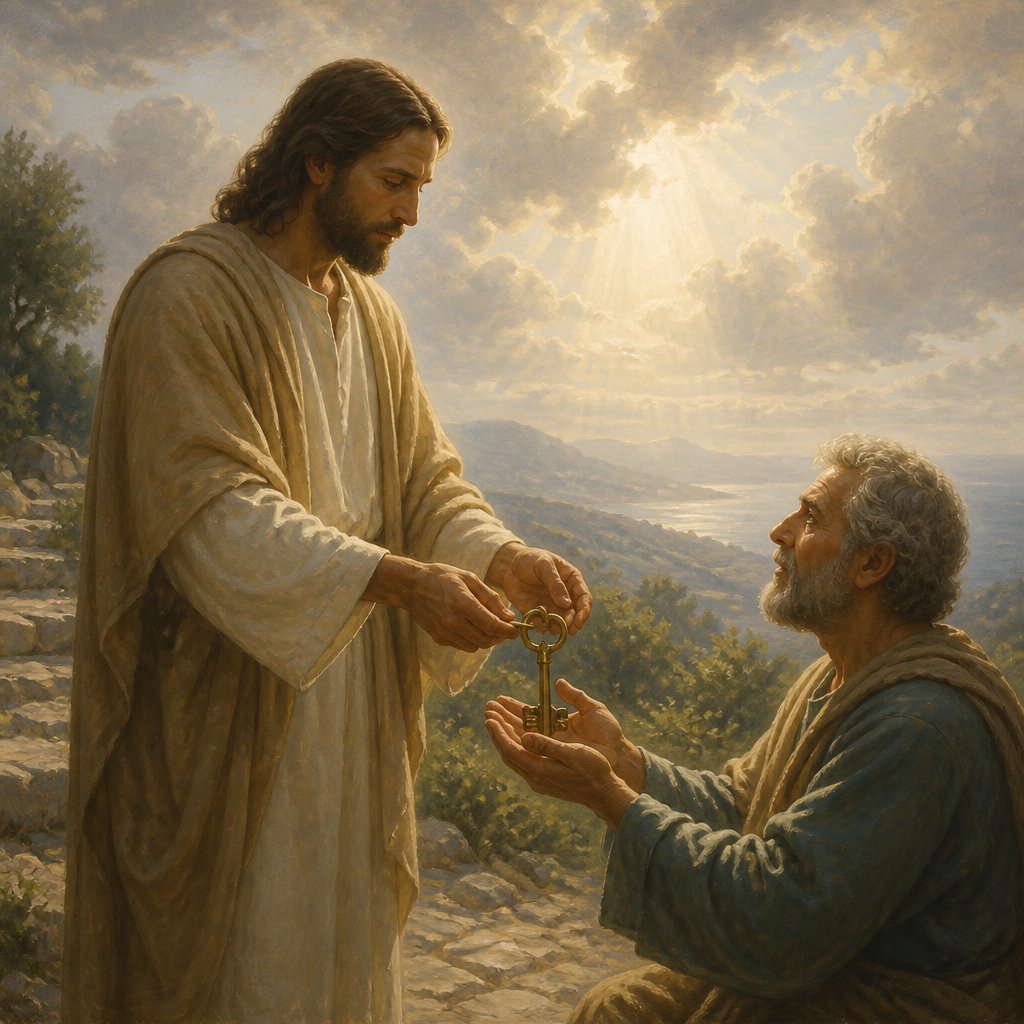
Matthew 16:19 in the King James Version reads, “And I will give unto thee the keys of the kingdom of heaven: and whatsoever thou shalt bind on earth shall be bound in heaven: and whatsoever thou shalt loose on earth shall be loosed in heaven.” Its meaning becomes clearer when it is read inside its immediate setting and alongside the Bible’s own patterns of language, authority, and covenant.
In context, Jesus has drawn his disciples away from the crowds and asked them two questions: what men say of him, and what they themselves confess. Simon Peter answers with unusual clarity, “Thou art the Christ, the Son of the living God.” Jesus then blesses him, saying that this confession is not the product of flesh and blood, but of the Father’s revelation. Only after this confession does Jesus speak the words of Matthew 16:19. The verse, therefore, is not an isolated promise of power; it is spoken as a direct consequence of a God-given recognition of who Christ is. The verse is tied to revelation, confession, and the establishment of Christ’s work in the world.
When Jesus says, “I will give unto thee the keys of the kingdom of heaven,” the chief image is authority derived from another. A key is not a trophy; it is an instrument entrusted by an owner to a steward. In Scripture, keys are linked with the right to open and to shut, to grant or deny entrance, and to act on behalf of the one who possesses the house. So the “keys of the kingdom of heaven” symbolize delegated authority within God’s reign, not ownership of it. Christ does not say Peter has the kingdom, but that Peter is given keys of it. The kingdom remains “of heaven,” and the keys come from Jesus: “I will give.”
This entrusting of keys also points to the opening of the kingdom through the proclamation of the gospel. The immediate storyline of Matthew moves toward the cross, the resurrection, and the sending of the disciples. When God’s kingdom is announced—when Christ is preached as the crucified and risen Son of God—the door is, in a sense, opened to those who receive that message in faith and closed to those who refuse it. The imagery fits the role of an appointed messenger: he does not invent the terms of entry; he declares them. The “key” is effective because it corresponds to the King’s will. Thus, Matthew 16:19 carries the theme that Christ will use his servants to publicly administer the message and claims of his kingdom in the world.
The second part of the verse explains the practical operation of the keys: “and whatsoever thou shalt bind on earth shall be bound in heaven: and whatsoever thou shalt loose on earth shall be loosed in heaven.” “Bind” and “loose” are covenantal and judicial words. They suggest decisions that identify what is held under obligation and what is released, what is regarded as forbidden and what is permitted, what is retained and what is remitted. The language evokes a courtroom and a community at the same time: judgments made on earth that correspond to heaven. Yet the verse is careful in how that correspondence is understood. The authority is not portrayed as independent power to force heaven’s hand; rather, it is an authority meant to harmonize earth with heaven. The purpose is alignment: heaven’s rule expressed on earth through Christ’s appointed means.
This is why the verse cannot be separated from the confession that precedes it. The foundation is not Peter’s personality but the revealed truth of Christ’s identity, because the kingdom is inseparable from the King. The significance of Matthew 16:19 is therefore deeply Christ-centered: the authority given to Peter is meaningful only insofar as it serves the reality Peter confessed, “Thou art the Christ.” In other words, the keys operate rightly when they are used in fidelity to Christ’s person and words.
The verse also participates in a larger Matthean theme: Jesus is forming a people who will bear his authority in the world. Just before Matthew 16:19, Jesus speaks of “my church,” indicating a gathered community belonging to him. Immediately after, he begins to speak openly of his suffering, death, and resurrection, showing that kingdom authority is not separated from the cross. The one who gives keys is the one who will lay down his life. That proximity matters: the kingdom is advanced not by earthly domination but by Christ’s redemptive victory, and those who act in his name are meant to do so under his lordship and in the spirit of his mission.
Symbolically, the keys suggest access, stewardship, and responsibility. A key-holder is accountable to the one who gave the keys. The language of binding and loosing suggests discernment and governance, yet always under heaven’s verdict. The result is a verse that carries both dignity and warning: dignity, because Christ involves his servants in the administration of his kingdom; warning, because to misuse entrusted authority is to act out of step with the very heaven one claims to represent.
Matthew 16:19 is significant, then, because it portrays Christ establishing an authorized witness on earth that corresponds to heaven’s rule. It is about the kingdom of heaven breaking into the present world through Christ, confessed and proclaimed, and about the serious stewardship given to those who speak and act in his name. It invites the reader to see that the kingdom is not merely an inward idea, but a real reign with real entry, real claims, and real accountability—administered on earth by delegated authority, yet originating in heaven and remaining under the Lordship of Jesus Christ.
Get our apps


Artwork for Matthew 16:19

"And I will give unto thee the keys of the kingdom of heaven: and whatsoever thou shalt bind on earth shall be bound in heaven: and whatsoever thou shalt loose on earth shall be loosed in heaven." - Matthew 16:19

Matthew 16:19 - "And I will give unto thee the keys of the kingdom of heaven: and whatsoever thou shalt bind on earth shall be bound in heaven: and whatsoever thou shalt loose on earth shall be loosed in heaven."
"And I will give unto thee the keys of the kingdom of heaven: and whatsoever thou shalt bind on earth shall be bound in heaven: and whatsoever thou shalt loose on earth shall be loosed in heaven." - Matthew 16:19

Matthew 19:16-17

Matthew 19:16 - "¶ And, behold, one came and said unto him, Good Master, what good thing shall I do, that I may have eternal life?"

Matthew 3:16

matthew 28:19

Matthew 19:26

matthew 28:19

Matthew 3:16

Matthew 3:16

Matthew 19:13

Matthew 19:19 - "Honour thy father and thy mother: and, Thou shalt love thy neighbour as thyself."

Matthew 16:25

Matthew 19:16-17 - "Just then a man came up to Jesus and asked, “Teacher, what good thing must I do to get eternal life?” “Why do you ask me about what is good?” Jesus replied. “There is only One who is good. If you want to enter life, keep the commandments.”"

Matthew 28:19-20

Matthew 16:16 - "And Simon Peter answered and said, Thou art the Christ, the Son of the living God."

Matthew 28: 19-20

Matthew 28:19-20

Matthew 28:19-20

Genesis 19-16

Matthew 27:16 - "And they had then a notable prisoner, called Barabbas."

Matthew 19:2 - "And great multitudes followed him; and he healed them there."

Matthew 19:30 - "But many that are first shall be last; and the last shall be first."

Matthew 12:16 - "And charged them that they should not make him known:"

Matthew 24:16 - "Then let them which be in Judaea flee into the mountains:"

Exodus 19:16-20

Matthew 9:19 - "And Jesus arose, and followed him, and so did his disciples."

Matthew 19:15 - "And he laid his hands on them, and departed thence."
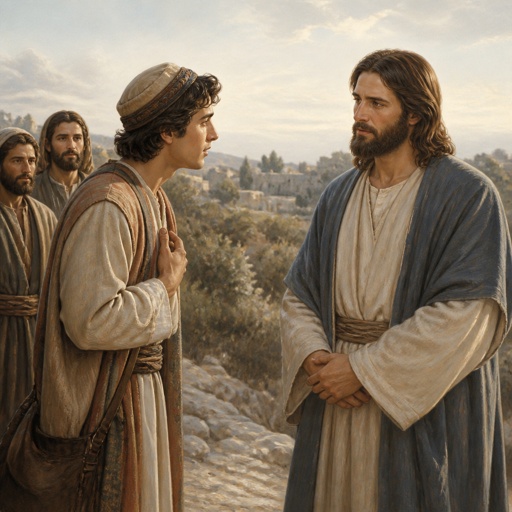
"¶ And, behold, one came and said unto him, Good Master, what good thing shall I do, that I may have eternal life?" - Matthew 19:16