What does Matthew 20:2 mean?
"And when he had agreed with the labourers for a penny a day, he sent them into his vineyard." - Matthew 20:2
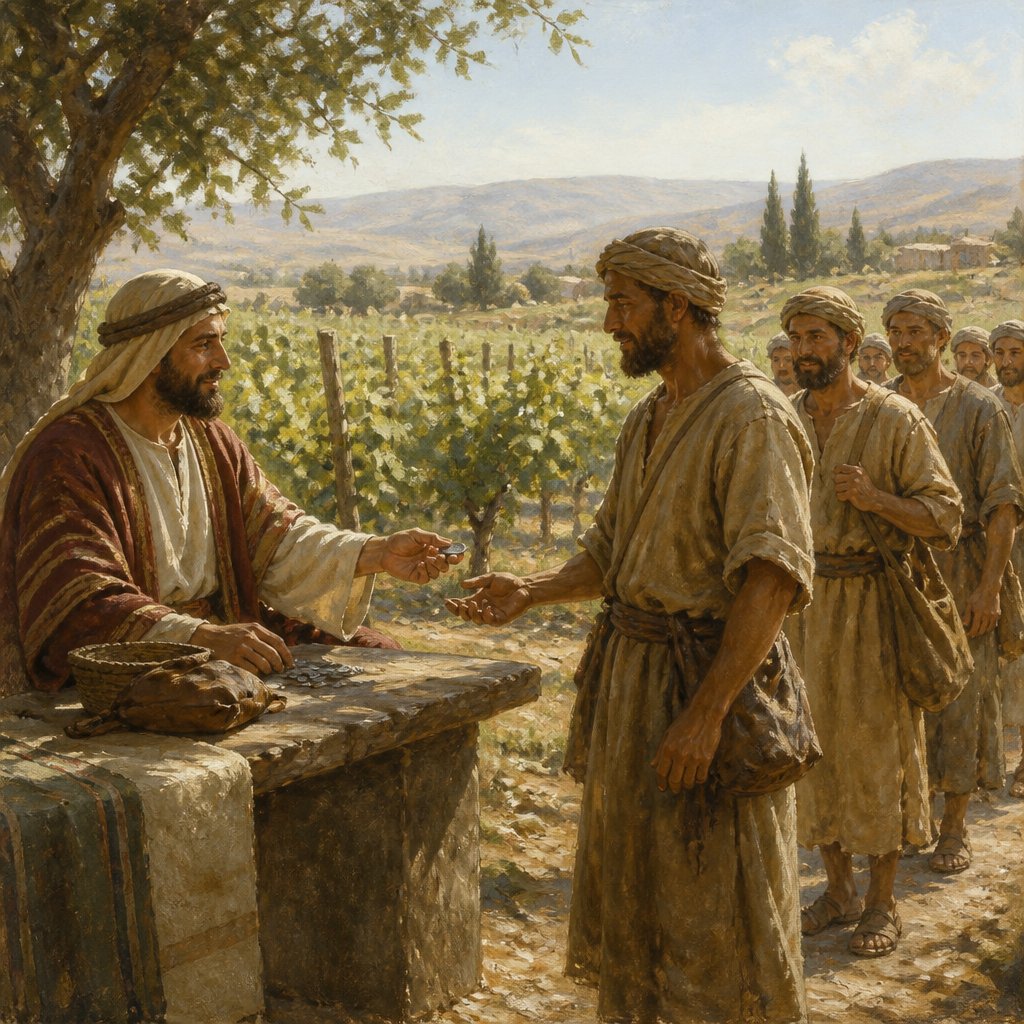
Matthew 20:2 (KJV) reads, "And when he had agreed with the labourers for a penny a day, he sent them into his vineyard."
This verse is part of a parable told by Jesus to illustrate the kingdom of heaven. In this parable, a landowner goes to hire laborers for his vineyard at various times throughout the day. He agrees to pay each laborer a denarius, which was the typical wage for a day's work at the time.
The context of this parable is important for understanding its meaning. In the preceding chapter, Jesus has just finished explaining to his disciples that those who are first will be last, and the last will be first. This concept is echoed in the parable of the laborers in the vineyard, as the laborers who were hired first complain when they see that those who were hired later in the day are paid the same wage as they were.
One of the key themes of this parable is God's generosity and grace. The landowner represents God, and his actions demonstrate God's willingness to offer salvation and reward to all who come to him, regardless of when they come. The landowner's decision to pay the laborers who were hired later in the day the same wage as those who were hired first reflects the idea that God's grace is available to all, regardless of their past or present circumstances.
Another important theme in this parable is the concept of fairness. The laborers who were hired first feel that they deserve more than those who were hired later, simply because they worked longer. However, the landowner's response challenges this idea and emphasizes that his actions are not unfair, but rather a demonstration of his generosity and grace.
The parable also serves as a warning against envy and jealousy. The laborers who were hired first become envious when they see that those who were hired later are paid the same wage. This reflects a common human tendency to compare ourselves to others and feel resentment when we perceive that others are receiving more than we are. Jesus uses this parable to teach that we should focus on our own relationship with God and trust in his fairness and generosity, rather than being consumed by envy or jealousy.
The symbolism in this parable is also rich and powerful. The vineyard represents the kingdom of heaven, and the laborers represent all people who come to God seeking salvation. The denarius that the landowner pays represents the ultimate reward of eternal life in the kingdom of heaven, which is available to all who come to God, regardless of their past or present circumstances.
Overall, the parable of the laborers in the vineyard serves as a powerful reminder of God's grace and generosity, as well as a warning against envy and jealousy. It challenges us to trust in God's fairness and to focus on our own relationship with him, rather than comparing ourselves to others. It also reinforces the idea that the kingdom of heaven is available to all, regardless of when they come to God. This message is both comforting and challenging, and it continues to resonate with readers today, encouraging us to trust in God's grace and to live with gratitude for his generosity.
Have questions about Matthew 20:2?
Dive deeper into this scripture with Bible Chat — an AI-powered tool for exploring God's Word through conversation. Ask questions, get context, and grow in your understanding of the Bible.
Get Our Apps


Matthew 20:2 Artwork

Matthew 20:2 - "And when he had agreed with the labourers for a penny a day, he sent them into his vineyard."
"And when he had agreed with the labourers for a penny a day, he sent them into his vineyard." - Matthew 20:2

Matthew 2:20 - "Saying, Arise, and take the young child and his mother, and go into the land of Israel: for they are dead which sought the young child's life."

Matthew 18:20

Matthew 17:20

matthew 20:3

Matthew 18:20

Matthew 18:20

Matthew 17:20

matthew 5 13-20

Matthew 28:19-20

Matthew 20:29-34

Matthew 28:19-20

Matthew 28: 19-20

Matthew 28:19-20

Matthew 15 : 1-20

Matthew 20:20 - "¶ Then came to him the mother of Zebedee's children with her sons, worshipping him, and desiring a certain thing of him."

Matthew 4:20 - "And they straightway left their nets, and followed him."

Matthew 7:20 - "Wherefore by their fruits ye shall know them."

Matthew 20:29 - "And as they departed from Jericho, a great multitude followed him."

Matthew 22:20 - "And he saith unto them, Whose is this image and superscription?"

Matthew 20:11 - "And when they had received it, they murmured against the goodman of the house,"

Matthew 10:20 - "For it is not ye that speak, but the Spirit of your Father which speaketh in you."

Matthew 26:20 - "Now when the even was come, he sat down with the twelve."

Matthew 24:20 - "But pray ye that your flight be not in the winter, neither on the sabbath day:"

Matthew 20:27 - "And whosoever will be chief among you, let him be your servant:"

Matthew 20:33 - "They say unto him, Lord, that our eyes may be opened."

Matthew 23:20 - "Whoso therefore shall swear by the altar, sweareth by it, and by all things thereon."

Matthew 20:24 - "And when the ten heard it, they were moved with indignation against the two brethren."

Matthew 15:20 - "These are the things which defile a man: but to eat with unwashen hands defileth not a man."