What does Matthew 24:32-35 mean?
"Now learn a parable of the fig tree; When his branch is yet tender, and putteth forth leaves, ye know that summer is nigh: So likewise ye, when ye shall see all these things, know that it is near, even at the doors. Verily I say unto you, This generation shall not pass, till all these things be fulfilled. Heaven and earth shall pass away, but my words shall not pass away." - Matthew 24:32-35

Matthew 24:32-35 (KJV) reads: "Now learn a parable of the fig tree; When his branch is yet tender, and putteth forth leaves, ye know that summer is nigh: So likewise ye, when ye shall see all these things, know that it is near, even at the doors. Verily I say unto you, This generation shall not pass, till all these things be fulfilled. Heaven and earth shall pass away, but my words shall not pass away."
This passage comes from the end times discourse in the Gospel of Matthew, where Jesus teaches his disciples about the signs of the end of the age and the coming of the Son of Man. The verses focus on the parable of the fig tree and the urgency of recognizing the signs of the times.
The parable of the fig tree is a symbolic representation of being able to discern the signs of the times. In the parable, Jesus compares the budding of the fig tree to the signs of the coming of the end times. Just as the budding of the fig tree signals the arrival of summer, the signs Jesus has mentioned, such as wars, famines, and earthquakes, indicate the nearness of the end. The disciples are urged to pay attention to these signs and be prepared for the coming of the Son of Man.
The use of the fig tree in this parable is significant. The fig tree is a symbol of Israel in the Old Testament, and its budding and putting forth leaves can be interpreted as the restoration and revival of Israel leading up to the end times. This alludes to the establishment of the state of Israel in 1948 and the subsequent regathering of the Jewish people to their homeland as a significant sign of the end times.
The urgency of recognizing these signs is emphasized in verse 33, where Jesus states, "So likewise ye, when ye shall see all these things, know that it is near, even at the doors." This serves as a call to action for believers to be vigilant and watchful, being prepared for the coming of the Son of Man. The language used conveys a sense of immediacy and certainty—when these signs are seen, the end is near and is imminent.
Verse 34 brings a sense of urgency as Jesus emphasizes that "this generation shall not pass, till all these things be fulfilled." Some interpret "this generation" to refer to the generation alive at the time of these signs, while others see it as a broader reference to the Jewish people as a whole. In either case, the message is clear—the end times will come to pass within a relatively short period of time, and the disciples are to be prepared for it.
The passage concludes with a powerful statement about the enduring nature of God's word. In verse 35, Jesus declares, "Heaven and earth shall pass away, but my words shall not pass away." This statement serves as a reassurance of the reliability and eternal nature of God's promises. It conveys the idea that, despite the changing and transient nature of the world, the word of God remains steadfast and unchanging. This serves as a comfort to believers, assuring them of the certainty and reliability of God's promises.
Overall, Matthew 24:32-35 offers important teachings about recognizing the signs of the end times, being vigilant and prepared for the coming of the Son of Man, and finding comfort in the enduring nature of God's word. These themes are significant for believers as they navigate the challenges and uncertainties of the present age, and they serve as a call to faithfulness and readiness for the future.
Have questions about Matthew 24:32-35?
Dive deeper into this scripture with Bible Chat — an AI-powered tool for exploring God's Word through conversation. Ask questions, get context, and grow in your understanding of the Bible.
Get Our Apps


Matthew 24:32-35 Artwork

Matthew 24:32-35 - "Now learn a parable of the fig tree; When his branch is yet tender, and putteth forth leaves, ye know that summer is nigh: So likewise ye, when ye shall see all these things, know that it is near, even at the doors. Verily I say unto you, This generation shall not pass, till all these things be fulfilled. Heaven and earth shall pass away, but my words shall not pass away."
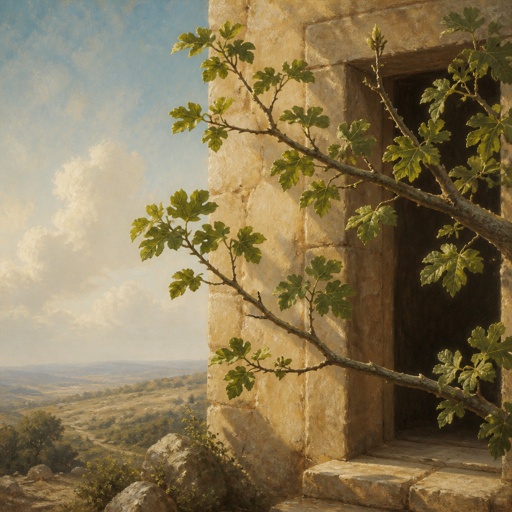
"Now learn a parable of the fig tree; When his branch is yet tender, and putteth forth leaves, ye know that summer is nigh: So likewise ye, when ye shall see all these things, know that it is near, even at the doors. Verily I say unto you, This generation shall not pass, till all these things be fulfilled. Heaven and earth shall pass away, but my words shall not pass away." - Matthew 24:32-35

Matthew 24:35

Matthew 24:35

Matthew 24:35

Matthew 24:35

Matthew 24:35

Matthew 24:35

Matthew 24:35

Matthew 24:35

Matthew 24:35

Matthew 24:35

Matthew 24:35 - "Heaven and earth shall pass away, but my words shall not pass away."

Matthew 24:32 - "Now learn a parable of the fig tree; When his branch is yet tender, and putteth forth leaves, ye know that summer is nigh:"

"Heaven and earth shall pass away, but my words shall not pass away." - Matthew 24:35

Numbers 32:35 - "And Atroth, Shophan, and Jaazer, and Jogbehah,"

Exodus 35:32 - "And to devise curious works, to work in gold, and in silver, and in brass,"

Matthew 27:35

Luke 24:35

Genesis 24-35

Matthew 8:32

Matthew 8:32

Exodus 32:35 - "And the LORD plagued the people, because they made the calf, which Aaron made."

Matthew 8:32

"And Atroth, Shophan, and Jaazer, and Jogbehah," - Numbers 32:35

Luke 24:13-35

"And Atroth, Shophan, and Jaazer, and Jogbehah," - Numbers 32:35

Gen 32:24

Genesis 35:24 - "The sons of Rachel; Joseph, and Benjamin:"

Genesis 24-32