What does Matthew 27:1-2 mean?
"When the morning was come, all the chief priests and elders of the people took counsel against Jesus to put him to death: And when they had bound him, they led him away, and delivered him to Pontius Pilate the governor." - Matthew 27:1-2
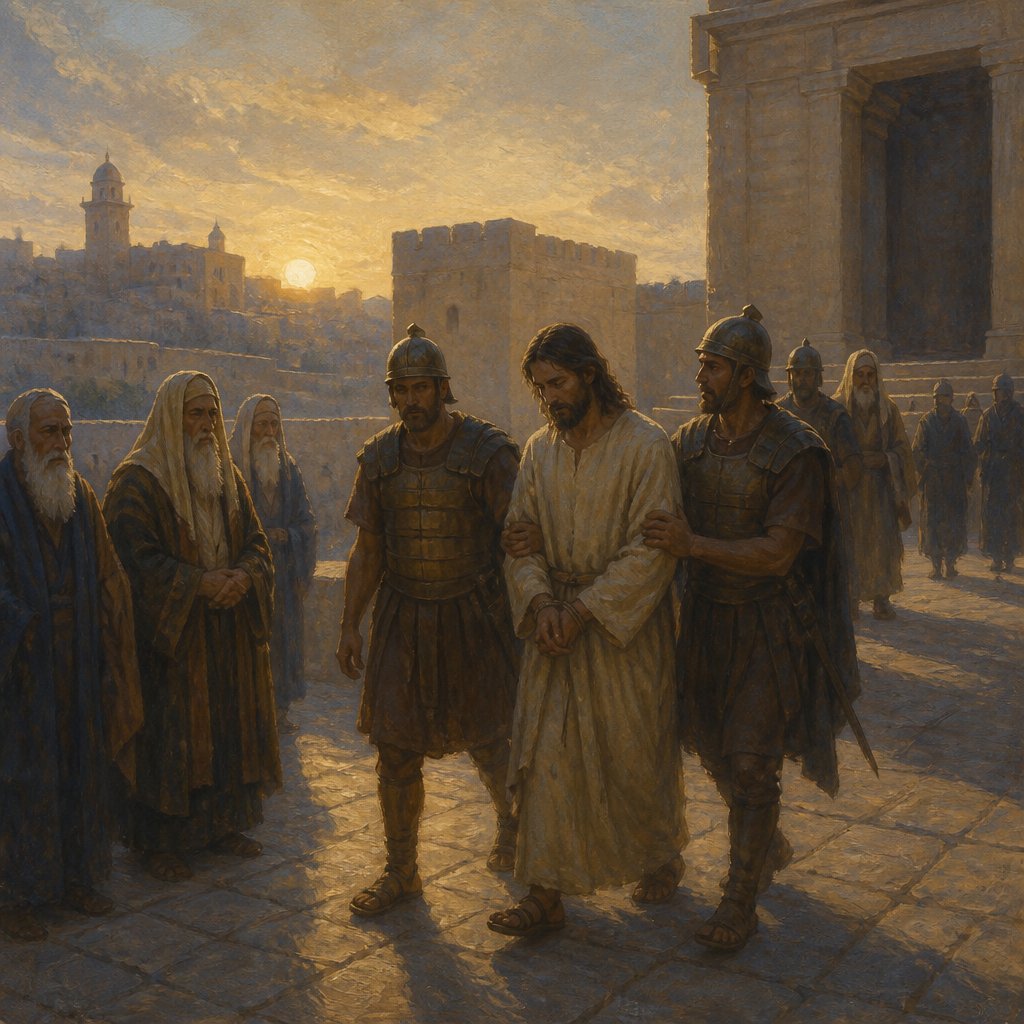
Matthew 27:1-2 from the King James Version (KJV) reads, "When the morning was come, all the chief priests and elders of the people took counsel against Jesus to put him to death: And when they had bound him, they led him away, and delivered him to Pontius Pilate the governor."
This verse marks a pivotal moment in the story of Jesus' crucifixion, as it depicts the betrayal and arrest of Jesus by the religious leaders and his subsequent delivery to the Roman governor, Pontius Pilate. In this commentary, we will explore the deeper meanings and themes present in these two verses, as well as the historical and cultural context in which they occur.
The theme of betrayal is a central element of these verses. In the preceding chapters of Matthew, Jesus is shown to have been teaching and performing miracles, gaining a following and causing concern among the religious authorities. Their decision to take counsel against Jesus and plot his death demonstrates the extent of their betrayal of him and their rejection of his teachings. This theme of betrayal is significant not only in the context of the immediate plot against Jesus, but also in the larger narrative of his ultimate sacrifice for humanity.
The arrival of morning in the passage may symbolize a new beginning or a fresh start, but in this context, it serves as a foreboding harbinger of the events to come. The religious leaders, supposedly the moral and spiritual guides of the community, are shown to be acting under the cover of darkness, illustrating the moral darkness that has taken hold of them. This underscores the themes of deception and treachery that are present throughout the narrative.
The decision to deliver Jesus to Pontius Pilate, the Roman governor, carries significant political and cultural implications. By handing Jesus over to the Roman authorities, the religious leaders are seeking to shift the responsibility for his execution onto the occupying power, thus absolving themselves of direct involvement in his death. This action highlights the complex political dynamics of first-century Judea, where religious and political power were deeply intertwined.
The passage also highlights the contrast between the religious authorities and Jesus. While the religious leaders are portrayed as conniving and determined to eliminate Jesus, Jesus himself is shown as a figure of unwavering faith and obedience to the will of God. His submission to his captors and eventual crucifixion are depicted as a selfless act of sacrifice, demonstrating his commitment to fulfilling his divine purpose.
In a broader theological context, these verses are integral to the narrative of Jesus' crucifixion and the fulfillment of Old Testament prophecies. The betrayal, arrest, and trial of Jesus represent the culmination of a series of events that were foretold by the prophets and are central to Christian beliefs about the redemptive significance of Jesus' sacrifice.
From a cultural and historical perspective, these verses provide insight into the social and political dynamics of first-century Judea. The collaboration between the religious authorities and the Roman governor reflects the complex power structures of the time, as well as the tense relationship between the Jewish population and their Roman overlords.
In conclusion, Matthew 27:1-2 from the King James Version offers a wealth of rich themes, cultural context, and theological significance. It captures a crucial moment in the narrative of Jesus' crucifixion, and the implications of this passage reverberate throughout the rest of the New Testament. The themes of betrayal, sacrifice, and political maneuvering are all at play in these verses, making them a vital component of the Christian faith and the broader biblical narrative.
Have questions about Matthew 27:1-2?
Dive deeper into this scripture with Bible Chat — an AI-powered tool for exploring God's Word through conversation. Ask questions, get context, and grow in your understanding of the Bible.
Get Our Apps


Matthew 27:1-2 Artwork

Matthew 27:1-2 - "When the morning was come, all the chief priests and elders of the people took counsel against Jesus to put him to death: And when they had bound him, they led him away, and delivered him to Pontius Pilate the governor."
"When the morning was come, all the chief priests and elders of the people took counsel against Jesus to put him to death: And when they had bound him, they led him away, and delivered him to Pontius Pilate the governor." - Matthew 27:1-2

Matthew 27:26

Matthew 24:27

Matthew 7:24-27

Matthew 27:2 - "And when they had bound him, they led him away, and delivered him to Pontius Pilate the governor."

Matthew 27:1 - "When the morning was come, all the chief priests and elders of the people took counsel against Jesus to put him to death:"

1 John 2:27

1 John 2:27

1 John 2:27

1 John 2:27

NUMBERS 27:2

Matthew 1:2

Matthew 2:1-2

Matthew 27:46

Matthew 27:35

Matthew 2:9

Matthew 27:26

Matthew 27: 38

2 Samuel 1. 17-27

Matthew 2:1-12

Matthew 2:1-12

Matthew 2:1-12

Matthew 2:1-12

2 Samuel 1:27 - "How are the mighty fallen, and the weapons of war perished!"

Matthew 27:27 - "Then the soldiers of the governor took Jesus into the common hall, and gathered unto him the whole band of soldiers."

1 Chronicles 2:27 - "And the sons of Ram the firstborn of Jerahmeel were, Maaz, and Jamin, and Eker."

Matthew 27:16 - "And they had then a notable prisoner, called Barabbas."

Matthew 27:36 - "And sitting down they watched him there;"

Matthew 27:18 - "For he knew that for envy they had delivered him."