What does Matthew 27:3 mean?
"Then Judas, which had betrayed him, when he saw that he was condemned, repented himself, and brought again the thirty pieces of silver to the chief priests and elders," - Matthew 27:3
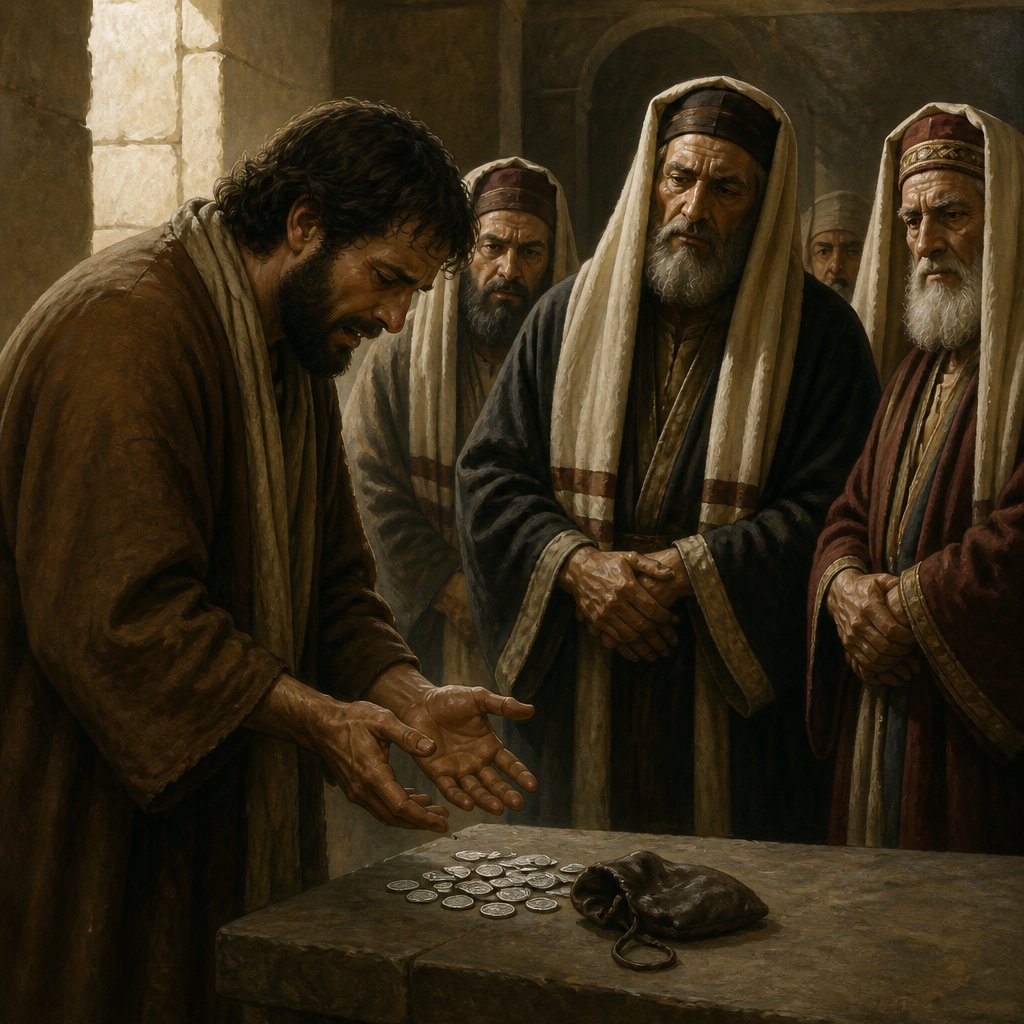
The Bible verse Matthew 27:3 in the King James Version (KJV) states, "Then Judas, which had betrayed him, when he saw that he was condemned, repented himself, and brought again the thirty pieces of silver to the chief priests and elders." This verse occurs in the context of the betrayal of Jesus by Judas Iscariot and his subsequent remorse.
The theme of betrayal and repentance is central to this verse. Judas, one of the twelve disciples, betrayed Jesus by leading the chief priests and elders to him in exchange for thirty pieces of silver. However, when he saw that Jesus was condemned to death, he experienced deep regret and repented his actions. This verse serves as a powerful example of the complexity of human emotions and the need for repentance and forgiveness.
The context of this verse is set within the events leading to the crucifixion of Jesus. Judas’ betrayal is a significant part of the narrative, as it ultimately leads to Jesus’ arrest and crucifixion. The remorse and repentance of Judas provide a moment of reflection on the consequences of one’s actions and the capacity for redemption, even in the face of grave mistakes.
The symbolism in this verse is profound and multi-layered. Firstly, the thirty pieces of silver symbolize the price for which Judas betrayed Jesus. This echoes the betrayal of Joseph in the Old Testament, who was sold into slavery by his brothers for twenty pieces of silver (Genesis 37:28). The echo of this betrayal highlights the universal nature of betrayal and the enduring relevance of its consequences.
Additionally, Judas’ act of returning the silver to the chief priests and elders carries symbolic weight. By returning the payment for his betrayal, Judas seeks to rectify his wrong and atone for his actions. This act symbolizes the desire for repentance and the hope for redemption, even in the face of irreversible consequences.
The theme of repentance and forgiveness is central to the Christian faith. The verse in Matthew 27:3 serves as a powerful reminder of the capacity for remorse and the possibility of redemption, even in the midst of betrayal and wrongdoing. Judas’ act of repentance is a poignant example of the transformative power of acknowledging one’s mistakes and seeking forgiveness.
Overall, Matthew 27:3 in the King James Version encapsulates a poignant moment in the biblical narrative, depicting the complexity of human emotions, the consequences of betrayal, and the enduring themes of repentance and forgiveness. This verse continues to resonate with readers, serving as a timeless reminder of the universal human experience and the enduring hope for redemption.
Have questions about Matthew 27:3?
Dive deeper into this scripture with Bible Chat — an AI-powered tool for exploring God's Word through conversation. Ask questions, get context, and grow in your understanding of the Bible.
Get Our Apps


Matthew 27:3 Artwork

Matthew 27:3 - "¶ Then Judas, which had betrayed him, when he saw that he was condemned, repented himself, and brought again the thirty pieces of silver to the chief priests and elders,"
"¶ Then Judas, which had betrayed him, when he saw that he was condemned, repented himself, and brought again the thirty pieces of silver to the chief priests and elders," - Matthew 27:3

Matthew 27:46

Matthew 27:35

Matthew 24:27

Matthew 27:26

Matthew 27:26

Matthew 27: 38

Matthew 27:27 - "Then the soldiers of the governor took Jesus into the common hall, and gathered unto him the whole band of soldiers."

Matthew 7:24-27

Matthew 27:36 - "And sitting down they watched him there;"

Matthew 27:16 - "And they had then a notable prisoner, called Barabbas."

Matthew 22:27 - "And last of all the woman died also."

Matthew 27:39 - "¶ And they that passed by reviled him, wagging their heads,"

Matthew 27:18 - "For he knew that for envy they had delivered him."

Matthew 27:28 - "And they stripped him, and put on him a scarlet robe."

Matthew 27:8 - "Wherefore that field was called, The field of blood, unto this day."

Matthew 27:10 - "And gave them for the potter's field, as the Lord appointed me."

Matthew 27:7 - "And they took counsel, and bought with them the potter's field, to bury strangers in."

Matthew 27:61 - "And there was Mary Magdalene, and the other Mary, sitting over against the sepulchre."

Matthew 20:27 - "And whosoever will be chief among you, let him be your servant:"

Matthew 27:30 - "And they spit upon him, and took the reed, and smote him on the head."

Matthew 18:27 - "Then the lord of that servant was moved with compassion, and loosed him, and forgave him the debt."

Matthew 27:41 - "Likewise also the chief priests mocking him, with the scribes and elders, said,"

Matthew 27:52 - "And the graves were opened; and many bodies of the saints which slept arose,"

Matthew 27:12 - "And when he was accused of the chief priests and elders, he answered nothing."

Matthew 27:25 - "Then answered all the people, and said, His blood be on us, and on our children."

Matthew 27:47 - "Some of them that stood there, when they heard that, said, This man calleth for Elias."

Matthew 27:14 - "And he answered him to never a word; insomuch that the governor marvelled greatly."

Matthew 27:66 - "So they went, and made the sepulchre sure, sealing the stone, and setting a watch."