What does Matthew 7:14 mean?
"Because strait is the gate, and narrow is the way, which leadeth unto life, and few there be that find it." - Matthew 7:14
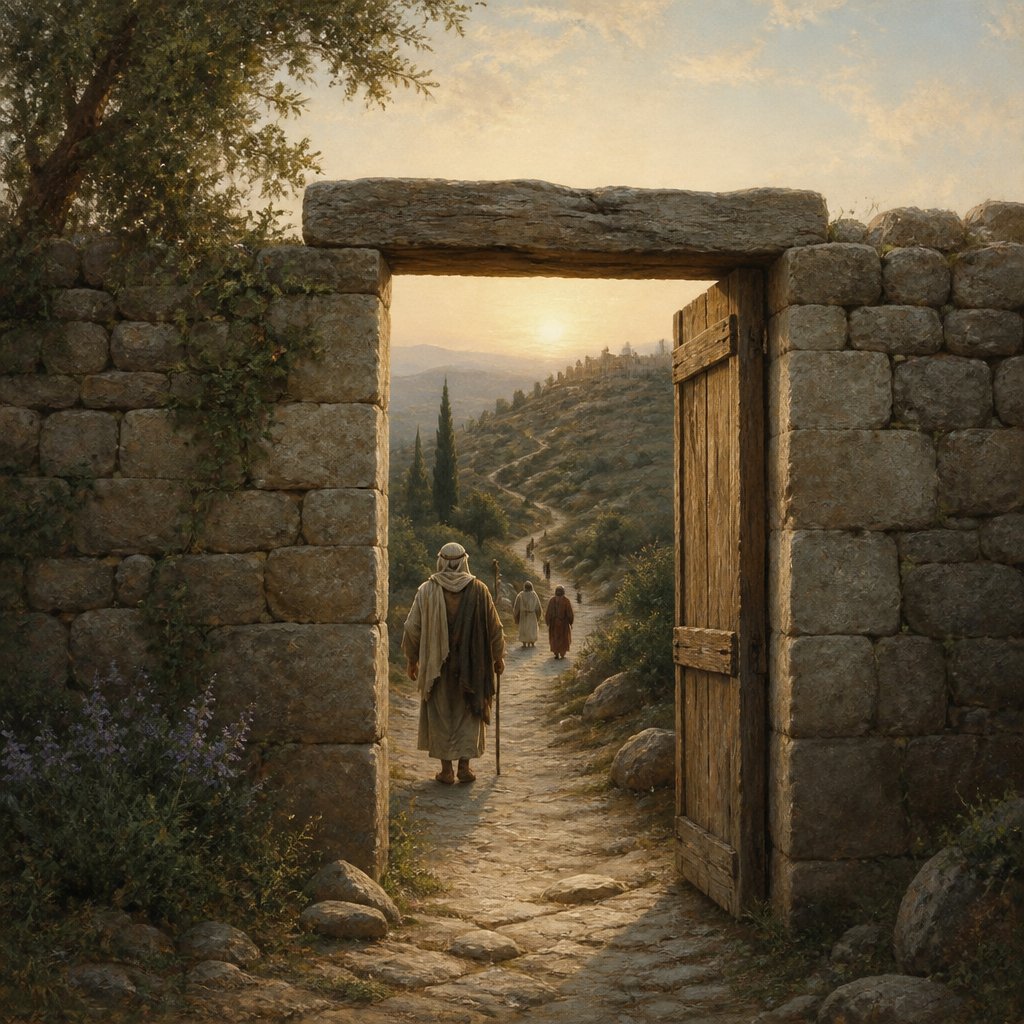
“Because strait is the gate, and narrow is the way, which leadeth unto life, and few there be that find it.” (Matthew 7:14, KJV). In the KJV, Matthew 7:14 comes near the close of what is commonly called the Sermon on the Mount (Matthew 5–7). By this point Jesus has already spoken of the inward righteousness God requires, of prayer and trust, of judging oneself honestly, and of discerning true and false teachers. The verse therefore functions as a solemn conclusion and a demand for decision. It is not offered as a detached proverb, but as part of a closing appeal: after hearing Christ’s words, every hearer must choose how to respond, and that choice has ultimate consequences.
The language of “strait” and “narrow” is central to its meaning. In the KJV, “strait” does not mean “straight” in the modern sense of merely not curved; it means constrained, pressed in, or difficult to enter. The “gate” is “strait” because it is not entered casually, by crowds, or while carrying whatever one pleases. A gate is an entry point; it marks a threshold. Jesus’ imagery presents life as something entered, not drifted into. One does not simply wake up already in the way that “leadeth unto life”; one must pass through a gate. That gate is not broad enough to admit the self-directed life unchanged. It implies repentance, submission, and the relinquishing of what cannot go through.
The “way” is described as “narrow,” and this continues the same thought. A way is a road, a course, a manner of life. A narrow way suggests limitation and definition: it is not a road where every desire and opinion can be indulged without restraint, nor a path that conforms itself to the traveler. It is a way with boundaries. In the context of the Sermon on the Mount, those boundaries are shaped by the will of God as Jesus has just taught it: truthfulness of heart, purity, reconciliation, integrity, sincere piety rather than public display, dependence on the Father, and obedience that is more than mere words. The narrowness, then, is not an arbitrary harshness; it is the moral and spiritual specificity of God’s kingdom, which does not expand to fit human pride, hypocrisy, or self-justification.
When Jesus says this way “leadeth unto life,” “life” is more than biological existence. In the sermon’s horizon it is the true life of God’s kingdom—life under God’s rule now and consummated in the end. It is the opposite of ruin, emptiness, and final loss. The verse is therefore deeply eschatological: it speaks with the end in view. It tells the hearer that present choices have eternal weight, and that not every path ends at the same destination.
The clause “few there be that find it” adds both realism and warning. Jesus does not flatter the crowd, nor does he measure truth by popularity. In the immediate context, he has just contrasted two ways and two destinies (the surrounding verses speak of the “wide” gate and the “broad” way). The statement that few find the narrow way underlines that the life of the kingdom is not entered by default, by cultural momentum, or by merely being near religious things. “Find it” implies that the narrow way must be sought, recognized, and chosen. It is not hidden because God is unwilling to reveal it, but because the human heart so easily prefers the broadness of self-rule and the ease of conformity. The fewness also prepares the listener for resistance and loneliness: the path may not be affirmed by the majority, yet it remains the path that leads to life.
Symbolically, the verse sets up a stark picture: two gates, two roads, two ends. The gate symbolizes entry—conversion, turning, the decisive movement from one realm to another. The way symbolizes ongoing discipleship—daily walking, continuing obedience, perseverance. This matters because it guards against two opposite misunderstandings. The first is reducing faith to a single moment with no ensuing path; the second is treating the path as mere moral effort without an entrance through the gate. Jesus’ image holds both together: there is a real beginning and a real continuance, and both belong to the journey that ends in life.
Within Matthew 7, this saying also stands alongside the warnings about false prophets and false profession. Immediately after these verses, Jesus speaks of “false prophets” and later of those who say “Lord, Lord” while not doing the Father’s will. The narrow way, in that light, is not merely “religion” as an external identity; it is a lived obedience flowing from a true relationship to God. The narrowness is thus also a matter of truth versus counterfeit, reality versus appearance. Many may claim the name, but the path that leads to life is found where Christ’s words are heard and done.
The significance of Matthew 7:14, read in its KJV phrasing and in its setting, is that it confronts the reader with the costly clarity of discipleship. It teaches that the kingdom of heaven is not entered on human terms, that genuine life is found through a constrained gate and a bounded path, and that the decisive question is not how many walk a road, but where that road leads. It is a verse meant to awaken sobriety and hope at once: sobriety, because the way is narrow and not found by the many; hope, because there is in fact a gate and a way that “leadeth unto life,” and Christ sets it before his hearers so that they may find it.
Have questions about Matthew 7:14?
Dive deeper into this scripture with Bible Chat — an AI-powered tool for exploring God's Word through conversation. Ask questions, get context, and grow in your understanding of the Bible.
Get Our Apps


Matthew 7:14 Artwork

Matthew 7:14 - "Because strait is the gate, and narrow is the way, which leadeth unto life, and few there be that find it."
!["Because strait [is] the gate, and narrow [is] the way, which leadeth unto life, and few there be that find it." - Matthew 7:14](https://media.bible.art/5857a9ab-2f89-47b8-972f-0e8f69787885-thumbnail.jpg)
"Because strait [is] the gate, and narrow [is] the way, which leadeth unto life, and few there be that find it." - Matthew 7:14
"Because strait is the gate, and narrow is the way, which leadeth unto life, and few there be that find it." - Matthew 7:14

Matthew 7:13-14

Matthew 7:13-14

Matthew 7:13-14

Matthew 7:13-14

Matthew 7:13-14

Matthew 7:13-14

Matthew 7:13-14

Matthew 7:13-14

Matthew 7:13-14

Matthew 7:13-14

Matthew 7:13-14

Matthew 7:13-14

Matthew 7:13-14

Matthew 7:13-14

Matthew 7:13-14

Matthew 7:13-14

Matthew 7:13-14

Matthew 7:13-14

Matthew 7:13-14

Matthew 7:13-14

Matthew 7:13-14

Matthew 7:13-14

Matthew 7:13-14

Matthew 7:13-14

Matthew 7:13-14

Matthew 7:13-14

Matthew 7:13-14