What does Nehemiah 11:19 mean?
“Moreover the porters, Akkub, Talmon, and their brethren that kept the gates, were an hundred seventy and two.” — Nehemiah 11:19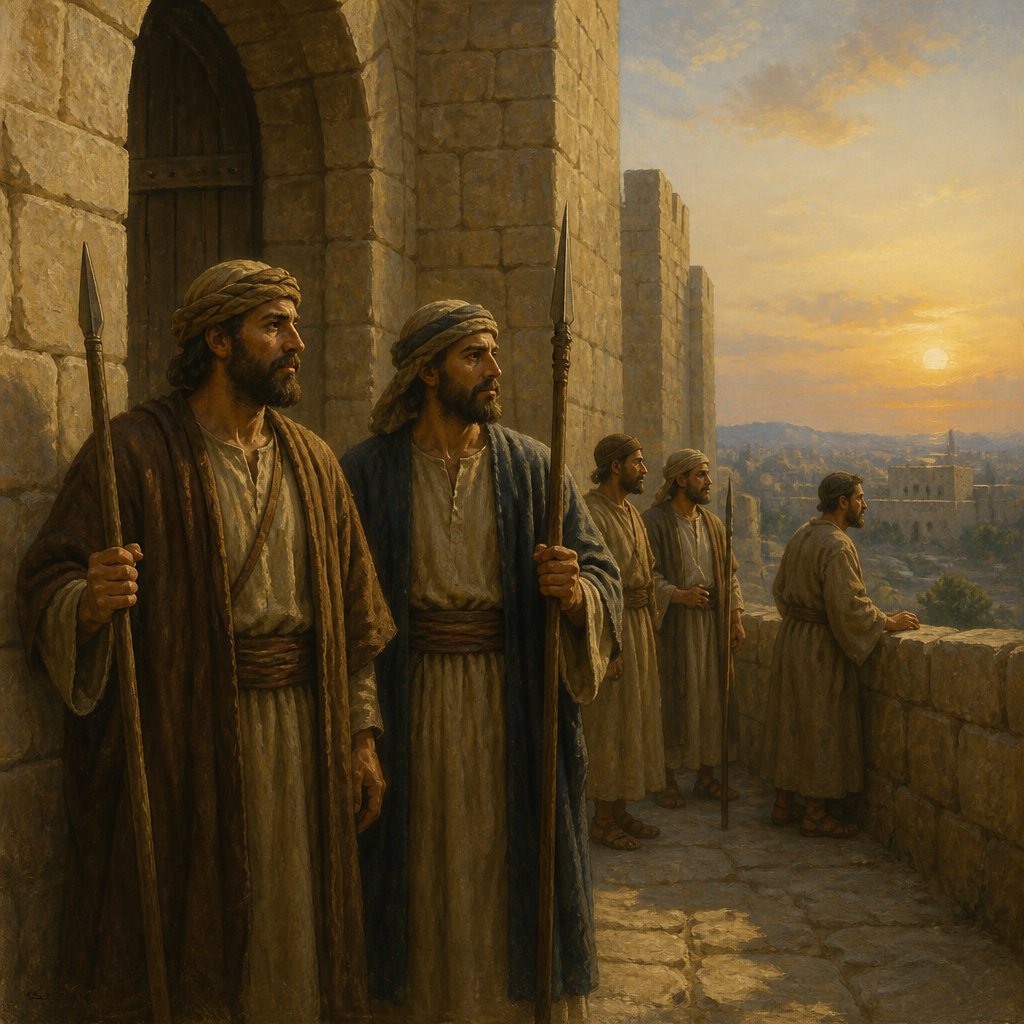
“Moreover the porters, Akkub, Talmon, and their brethren that kept the gates, were a hundred seventy and two.”
The book of Nehemiah is a historical account of the efforts made by Nehemiah, a cupbearer to the Persian king, to rebuild the walls of Jerusalem and restore the city after the Babylonian exile. In chapter 11, the inhabitants of Jerusalem are listed, including the priests, Levites, and other leaders who would dwell in the city.
This specific verse, Nehemiah 11:19, mentions the porters, Akkub, Talmon, and their brethren, who were responsible for keeping the gates of the city. The inclusion of their number, 172, is a testament to the meticulous record-keeping of the time. However, this verse goes beyond simple record-keeping; it highlights the importance of the gatekeepers in protecting the city and ensuring its security.
The gatekeepers were not merely responsible for opening and closing the gates; they were tasked with guarding the city against external threats. In ancient times, the city gates were vulnerable points that could be attacked by enemies. Therefore, the gatekeepers played a crucial role in the defense and security of the city. Their diligence and faithfulness were vital to the well-being of the inhabitants within the walls.
Symbolically, the gatekeepers can be seen as guardians not only of the physical city but also of the spiritual and moral integrity of the community. Their vigilance represents the importance of upholding righteousness and keeping out anything that could potentially harm the people within. This verse reminds us of the need for watchfulness and discernment in our own lives, as well as the responsibility we have to protect and nurture the spiritual well-being of our communities.
Furthermore, the mention of specific individuals, Akkub and Talmon, along with their brethren, emphasizes the individual contribution of each person in the functioning and safeguarding of the city. Every member of the community had a role to play, whether it was a prominent leader like Nehemiah or a gatekeeper like Akkub and Talmon. This highlights the principle of unity and collaboration, as well as the value of every person’s contribution, no matter how seemingly small or insignificant.
In a broader context, the book of Nehemiah serves as a testament to the faithfulness of God in fulfilling his promises. Despite the challenges and opposition faced by Nehemiah and the people of Jerusalem, they were able to complete the reconstruction of the city walls. This was a tangible manifestation of God’s faithfulness and provision for his people.
The inclusion of seemingly mundane details such as the number of gatekeepers reminds us that God is concerned with every aspect of our lives, no matter how insignificant it may seem. This attention to detail underscores the divine order and purpose in even the most routine tasks. It also serves as a reminder that every individual has a part to play in God’s grand design, no matter how seemingly small or insignificant their role may appear.
In conclusion, Nehemiah 11:19 may seem like a simple record of the number of gatekeepers in Jerusalem, but it holds deeper significance in terms of the themes of vigilance, unity, and the faithfulness of God. It serves as a reminder of the importance of upholding righteousness and guarding against external threats, both physical and spiritual. It also emphasizes the value of every individual’s contribution and the divine order in even the smallest details of our lives.
Get our apps


Artwork for Nehemiah 11:19

Nehemiah 11:19 - "Moreover the porters, Akkub, Talmon, and their brethren that kept the gates, were an hundred seventy and two."
"Moreover the porters, Akkub, Talmon, and their brethren that kept the gates, were an hundred seventy and two." - Nehemiah 11:19

Nehemiah 11:1-19

Nehemiah 11:11-14

Nehemiah 11:13

Nehemiah 10:19 - "Hariph, Anathoth, Nebai,"

Nehemiah 12:19 - "And of Joiarib, Mattenai; of Jedaiah, Uzzi;"

Nehemiah 11:34 - "Hadid, Zeboim, Neballat,"

Nehemiah 10:11 - "Micha, Rehob, Hashabiah,"

Nehemiah 7:19 - "The children of Bigvai, two thousand threescore and seven."

Nehemiah 11:33 - "Hazor, Ramah, Gittaim,"

Nehemiah 11:32 - "And at Anathoth, Nob, Ananiah,"

Nehemiah 11:26 - "And at Jeshua, and at Moladah, and at Beth-phelet,"

Nehemiah 11:29 - "And at En-rimmon, and at Zareah, and at Jarmuth,"

Nehemiah 11:35 - "Lod, and Ono, the valley of craftsmen."

Nehemiah 11:28 - "And at Ziklag, and at Mekonah, and in the villages thereof,"
"Hariph, Anathoth, Nebai," - Nehemiah 10:19

Nehemiah 11:36 - "And of the Levites were divisions in Judah, and in Benjamin."

Nehemiah 11:10 - "Of the priests: Jedaiah the son of Joiarib, Jachin."

Nehemiah 12:11 - "And Joiada begat Jonathan, and Jonathan begat Jaddua."

Nehemiah 11:27 - "And at Hazar-shual, and at Beer-sheba, and in the villages thereof,"

Nehemiah 2:11 - "So I came to Jerusalem, and was there three days."

Nehemiah 11:11 - "Seraiah the son of Hilkiah, the son of Meshullam, the son of Zadok, the son of Meraioth, the son of Ahitub, was the ruler of the house of God."
"And of Joiarib, Mattenai; of Jedaiah, Uzzi;" - Nehemiah 12:19

"And at Anathoth, Nob, Ananiah," - Nehemiah 11:32

"Hadid, Zeboim, Neballat," - Nehemiah 11:34

"Hazor, Ramah, Gittaim," - Nehemiah 11:33

"Micha, Rehob, Hashabiah," - Nehemiah 10:11

Nehemiah 11:21 - "But the Nethinims dwelt in Ophel: and Ziha and Gispa were over the Nethinims."

Nehemiah 11:8 - "And after him Gabbai, Sallai, nine hundred twenty and eight."