What does Nehemiah 3:7 mean?
“And next unto them repaired Melatiah the Gibeonite, and Jadon the Meronothite, the men of Gibeon, and of Mizpah, unto the throne of the governor on this side the river.” — Nehemiah 3:7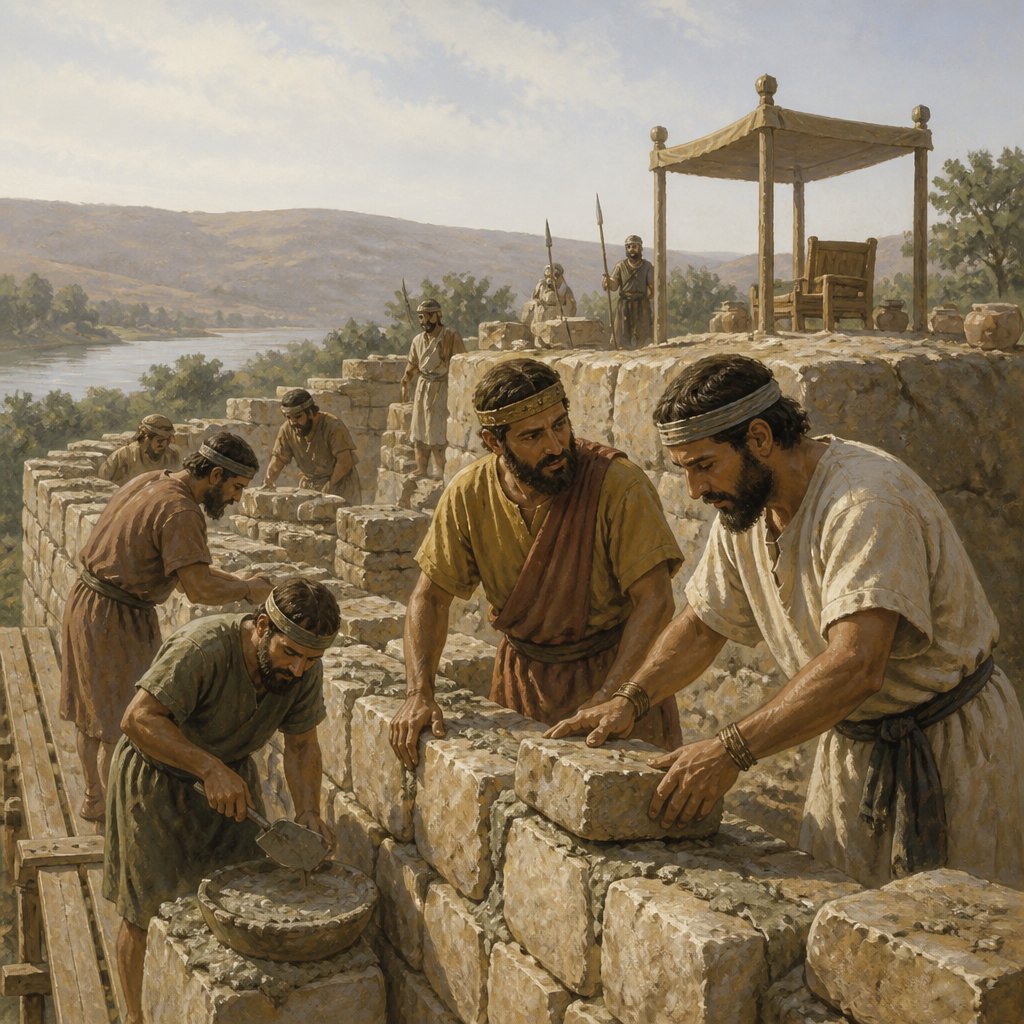
Nehemiah 3:7 (KJV) says, "And next unto them repaired Melatiah the Gibeonite, and Jadon the Meronothite, the men of Gibeon, and of Mizpah, unto the throne of the governor on this side the river." This verse is part of the book of Nehemiah in the Old Testament, and it is situated within a larger context of the Israelites rebuilding the walls of Jerusalem after their return from exile in Babylon.
In order to understand the deeper meaning and significance of this verse, it is important to consider the historical and cultural context in which it was written. The book of Nehemiah describes the efforts of Nehemiah, a Jewish cupbearer to the Persian king Artaxerxes, to rebuild the walls of Jerusalem, which had been destroyed during the Babylonian conquest. The rebuilding of the walls was not only a physical endeavor but also a spiritual and communal one, as it represented a restoration of the city and a renewal of the covenant between God and His people.
The specific verse, Nehemiah 3:7, focuses on the individuals who were involved in the reconstruction efforts. Melatiah and Jadon, along with the other inhabitants of Gibeon and Mizpah, are mentioned as being instrumental in the repair of the walls up to the throne of the governor on the eastern bank of the Jordan River. The names and locations mentioned in this verse may seem obscure and insignificant at first glance, but they hold deeper symbolic and thematic significance.
One of the overarching themes in the book of Nehemiah is the importance of communal effort and collaboration in accomplishing significant tasks. Each individual and group mentioned in the book played a crucial role in the rebuilding process, and their contributions were essential for the successful completion of the project. This reinforces the idea that the community of believers must work together in unity to achieve a common goal, whether it be the physical restoration of a city or the spiritual renewal of a people.
Furthermore, the mention of the specific individuals and their respective locations serves as a reminder of the diverse and inclusive nature of God's kingdom. The fact that Melatiah and Jadon are identified by their ancestral roots in Gibeon and Meronoth highlights the idea that God's work encompasses people from all backgrounds and origins. This inclusivity and diversity are consistent with the broader biblical message of God's love and salvation being available to all, regardless of nationality, ethnicity, or social status.
Moreover, the mention of the repair work extending "unto the throne of the governor on this side the river" can be interpreted as a symbol of the divine authority and governance that governs the lives of God's people. The completion of the wall up to this point represents the restoration of order and protection, both physically and spiritually, under the sovereignty of God. It demonstrates that the rebuilding efforts were not merely for security against earthly threats but also for the establishment of God's rule and protection over His people.
In conclusion, Nehemiah 3:7, like the rest of the book of Nehemiah, conveys powerful themes of communal effort, diversity, inclusivity, and divine governance. It serves as a testament to the interconnectedness of God's people in working towards a common purpose and the universality of His love and authority. This verse encourages believers to engage in collaborative efforts for the betterment of their communities and to recognize the significance of each individual's contributions to the larger mission of God's kingdom.
Get our apps


Artwork for Nehemiah 3:7

Nehemiah 3:7 - "And next unto them repaired Melatiah the Gibeonite, and Jadon the Meronothite, the men of Gibeon, and of Mizpah, unto the throne of the governor on this side the river."
"And next unto them repaired Melatiah the Gibeonite, and Jadon the Meronothite, the men of Gibeon, and of Mizpah, unto the throne of the governor on this side the river." - Nehemiah 3:7

Nehemiah 7:7 - "Who came with Zerubbabel, Jeshua, Nehemiah, Azariah, Raamiah, Nahamani, Mordecai, Bilshan, Mispereth, Bigvai, Nehum, Baanah. The number, I say, of the men of the people of Israel was this;"

Nehemiah 10:7 - "Meshullam, Abijah, Mijamin,"

Nehemiah 7:42 - "The children of Harim, a thousand and seventeen."

Nehemiah 7:24 - "The children of Hariph, an hundred and twelve."

Nehemiah 7:56 - "The children of Neziah, the children of Hatipha."

Nehemiah 7:25 - "The children of Gibeon, ninety and five."

Nehemiah 12:3 - "Shechaniah, Rehum, Meremoth,"

Nehemiah 10:3 - "Pashur, Amariah, Malchijah,"

Nehemiah 7:40 - "The children of Immer, a thousand fifty and two."

Nehemiah 7:31 - "The men of Michmas, an hundred and twenty and two."

Nehemiah 7:33 - "The men of the other Nebo, fifty and two."

Nehemiah 7:21 - "The children of Ater of Hezekiah, ninety and eight."

Nehemiah 7:28 - "The men of Beth-azmaveth, forty and two."

Nehemiah 7:14 - "The children of Zaccai, seven hundred and threescore."

Nehemiah 7:27 - "The men of Anathoth, an hundred twenty and eight."

Nehemiah 7:35 - "The children of Harim, three hundred and twenty."

Nehemiah 7:16 - "The children of Bebai, six hundred twenty and eight."

Nehemiah 7:58 - "The children of Jaala, the children of Darkon, the children of Giddel,"

Nehemiah 7:9 - "The children of Shephatiah, three hundred seventy and two."

Nehemiah 7:48 - "The children of Lebana, the children of Hagaba, the children of Shalmai,"

Nehemiah 7:19 - "The children of Bigvai, two thousand threescore and seven."

Nehemiah 7:15 - "The children of Binnui, six hundred forty and eight."

Nehemiah 7:44 - "¶ The singers: the children of Asaph, an hundred forty and eight."

Nehemiah 7:18 - "The children of Adonikam, six hundred threescore and seven."

Nehemiah 7:13 - "The children of Zattu, eight hundred forty and five."

Nehemiah 7:49 - "The children of Hanan, the children of Giddel, the children of Gahar,"

Nehemiah 7:55 - "The children of Barkos, the children of Sisera, the children of Tamah,"

Nehemiah 7:20 - "The children of Adin, six hundred fifty and five."