What does Nehemiah 9:8 mean?
“And foundest his heart faithful before thee, and madest a covenant with him to give the land of the Canaanites, the Hittites, the Amorites, and the Perizzites, and the Jebusites, and the Girgashites, to give it, I say, to his seed, and hast performed thy words; for thou art righteous:” — Nehemiah 9:8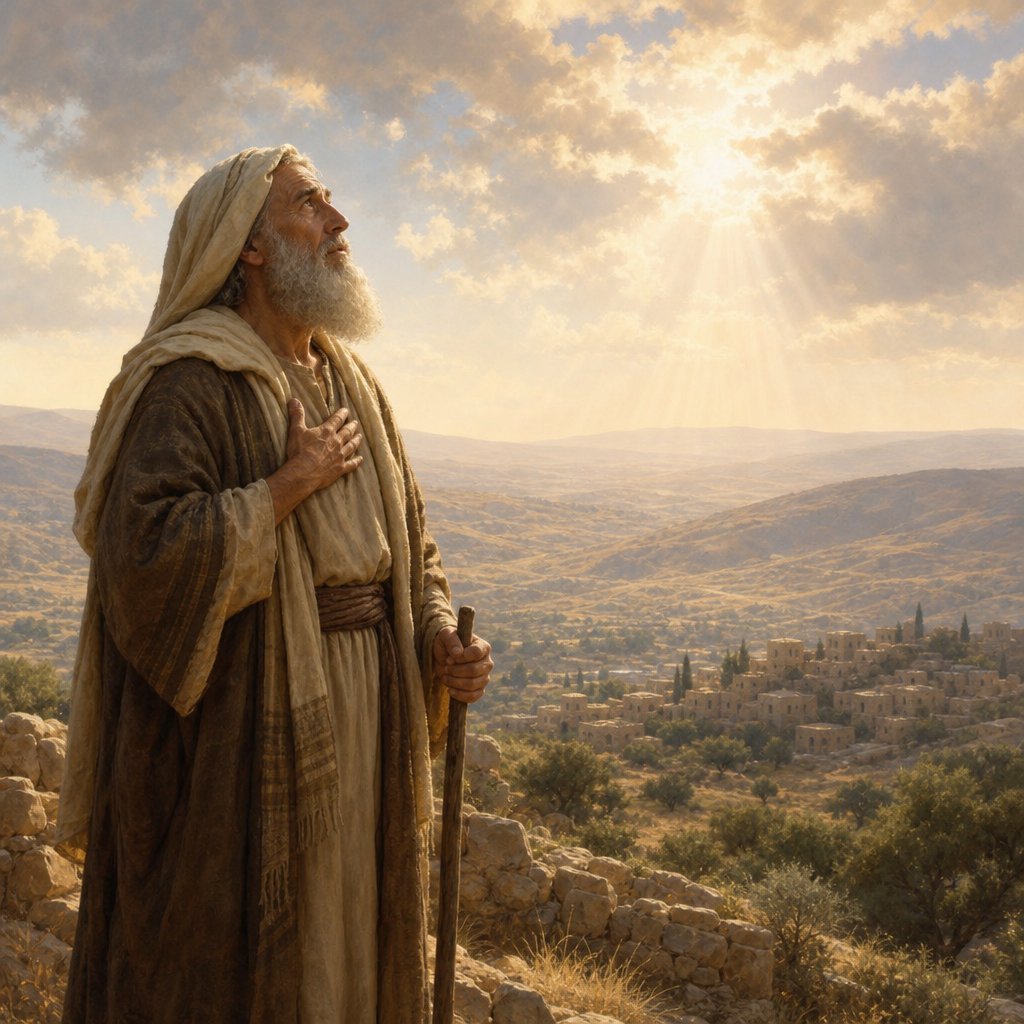
Nehemiah 9:8 in the KJV reads, “And foundest his heart faithful before thee, and madest a covenant with him to give the land of the Canaanites, the Hittites, the Amorites, and the Perizzites, and the Jebusites, and the Girgashites, to give it, I say, to his seed, and hast performed thy words; for thou art righteous.”
This verse stands inside a long prayer of confession and worship offered by the returned Jewish community after the rebuilding of the wall of Jerusalem. In Nehemiah 9 the people separate themselves from strangers, confess their sins, and listen as the Levites rehearse Israel’s whole story from creation onward. Nehemiah 9:8 sits early in that historical rehearsal, where the prayer turns from God’s greatness to God’s dealings with Abraham. The speakers are not merely recounting facts; they are building an argument for hope and humility. They confess that their history has been marked by unfaithfulness, yet God has been marked by faithfulness. Verse 8 functions as a foundational example: before Israel even existed as a nation, God bound himself by promise, and God kept that promise.
The first weighty phrase is “foundest his heart faithful before thee.” “His” refers to Abram, later named Abraham in the narrative immediately around this verse. The emphasis is not that Abraham earned God’s favor by perfect merit, but that God, who searches hearts, recognized a genuine posture of trust and allegiance “before thee,” meaning in God’s sight, not merely in public reputation. In the context of a communal confession, this is significant: the people are not claiming that Israel’s standing rests on national virtue. They are pointing to the kind of heart God honors, and they are implicitly measuring themselves against it. The “heart” here symbolizes the inner person—the seat of trust, intention, and covenant loyalty. By highlighting the heart, the prayer points to a spiritual reality deeper than external identity. It is a reminder that God’s dealings are moral and relational, not mechanical.
Next comes covenant language: “madest a covenant with him.” In Scripture, a covenant is more than a contract; it is a binding commitment that establishes a relationship with promised obligations. In this verse, God is the active party: he makes the covenant, he defines its content, and later he performs it. That divine initiative matters in Nehemiah 9, because the people are confessing the collapse of their own obedience. Their hope cannot be grounded in their performance; it must be grounded in God’s covenant faithfulness. The covenant with Abraham is presented as a decisive moment when God pledged a future that Israel could not manufacture: a people (“his seed”) and a place (“the land”).
The land promise is described in a strikingly specific way: “to give the land of the Canaanites, the Hittites, the Amorites, and the Perizzites, and the Jebusites, and the Girgashites.” The listing of nations does not exist merely to supply geographic detail. It symbolizes the concreteness of God’s promise and the real obstacles it overcame. Those names represent entrenched powers and settled inhabitants; the promise required God’s intervention in history. By naming them, the prayer acknowledges that Israel’s possession of the land was never simply a natural migration or a political achievement; it was the outworking of a divine pledge in the face of formidable realities. It also underscores that the land was not abstract “blessing” but a particular inheritance promised to a particular “seed.” In the context of Nehemiah, where the returned community is small, vulnerable, and living under imperial rule, this detailed land language reminds them that their identity and calling are rooted in God’s long-term purposes, not their present weakness.
The phrase “to his seed” carries its own theme of continuity. The covenant is not only for Abraham personally but for generations. That matters profoundly in Nehemiah 9, because the people praying are centuries downstream from Abraham, and they have just endured exile. By invoking “his seed,” they are claiming continuity with the original covenant story: despite judgment, dispersion, and return, they still understand themselves as heirs of what God promised long ago. The verse thus ties the present community to the deep past and frames their current reforms—not intermarrying with “strangers,” renewing obedience, rebuilding Jerusalem—as part of a larger covenant narrative.
Then the prayer makes its central confession of God’s integrity: “and hast performed thy words.” This is the hinge of the verse. God not only spoke; God acted. The faith of Abraham and the covenant promise are answered by God’s fulfillment. In Nehemiah 9’s larger logic, this becomes a template: God’s track record is proof of his trustworthiness. The people can repent with confidence, because the God who “performed” before is able to perform again. The implied contrast is also sharp: Israel repeatedly failed to perform; God “hast performed.” The verse quietly reinforces a theme that runs through the whole chapter: human unfaithfulness versus divine faithfulness.
Finally, the verse ends with the reason for God’s fulfillment: “for thou art righteous.” Here “righteous” is not limited to punitive justice; it includes God’s rightness, reliability, and covenant faithfulness. God keeps his word because he is the kind of God who cannot betray his own promises. In the setting of national confession, calling God “righteous” is also an admission that the hardships Israel has faced are not evidence of divine fickleness but of divine justice. The people are acknowledging that God has been right in all his ways—both in giving and in disciplining—while also affirming that his righteousness includes steadfast adherence to his covenant word.
So the significance of Nehemiah 9:8 is that it anchors Israel’s present repentance and rebuilding effort in God’s ancient promise and proven faithfulness. It uses Abraham’s “faithful” heart to spotlight the inward reality God values, it presents the covenant as God’s initiated bond of commitment, it treats the land and the named nations as concrete proof that God’s word confronts real history, it connects the community to Abraham’s “seed” across generations, and it culminates in a simple theological conclusion: God has fulfilled what he said “for thou art righteous.” In a chapter that lays bare Israel’s failures, this verse stands as a pillar: God’s righteousness means his promises are not empty, and his covenant purposes do not collapse when his people do.
Get our apps


Artwork for Nehemiah 9:8

"And foundest his heart faithful before thee, and madest a covenant with him to give the land of the Canaanites, the Hittites, the Amorites, and the Perizzites, and the Jebusites, and the Girgashites, to give it, I say, to his seed, and hast performed thy words; for thou art righteous:" - Nehemiah 9:8

Nehemiah 9:8 - "And foundest his heart faithful before thee, and madest a covenant with him to give the land of the Canaanites, the Hittites, the Amorites, and the Perizzites, and the Jebusites, and the Girgashites, to give it, I say, to his seed, and hast performed thy words; for thou art righteous:"

"And foundest his heart faithful before thee, and madest a covenant with him to give the land of the Canaanites, the Hittites, the Amorites, and the Perizzites, and the Jebusites, and the Girgashites, to give it, I say, to his seed, and hast performed thy words; for thou art righteous:" - Nehemiah 9:8
"And foundest his heart faithful before thee, and madest a covenant with him to give the land of the Canaanites, the Hittites, the Amorites, and the Perizzites, and the Jebusites, and the Girgashites, to give it, I say, to his seed, and hast performed thy words; for thou art righteous:" - Nehemiah 9:8

Nehemiah 8:9 - "¶ And Nehemiah, which is the Tirshatha, and Ezra the priest the scribe, and the Levites that taught the people, said unto all the people, This day is holy unto the LORD your God; mourn not, nor weep. For all the people wept, when they heard the words of the law."

Nehemiah 8:10

Nehemiah 6:9

Nehemiah 8:10

Nehemiah 8:10

Nehemiah 9:9 - "And didst see the affliction of our fathers in Egypt, and heardest their cry by the Red sea;"

Nehemiah 8:8 - "So they read in the book in the law of God distinctly, and gave the sense, and caused them to understand the reading."

Nehemiah 10:8 - "Maaziah, Bilgai, Shemaiah: these were the priests."

Nehemiah 7:9 - "The children of Shephatiah, three hundred seventy and two."

Nehemiah 7:8 - "The children of Parosh, two thousand an hundred seventy and two."

Nehemiah 11:8 - "And after him Gabbai, Sallai, nine hundred twenty and eight."

Nehemiah 9:16 - "But they and our fathers dealt proudly, and hardened their necks, and hearkened not to thy commandments,"

Nehemiah 4:8 - "And conspired all of them together to come and to fight against Jerusalem, and to hinder it."

Nehemiah 12:9 - "Also Bakbukiah and Unni, their brethren, were over against them in the watches."

Nehemiah 10:9 - "And the Levites: both Jeshua the son of Azaniah, Binnui of the sons of Henadad, Kadmiel;"

Nehemiah 11:9 - "And Joel the son of Zichri was their overseer: and Judah the son of Senuah was second over the city."

Nehemiah 3:9 - "And next unto them repaired Rephaiah the son of Hur, the ruler of the half part of Jerusalem."
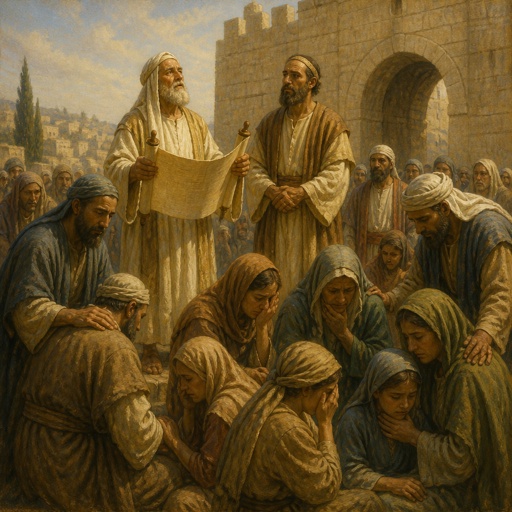
"¶ And Nehemiah, which is the Tirshatha, and Ezra the priest the scribe, and the Levites that taught the people, said unto all the people, This day is holy unto the LORD your God; mourn not, nor weep. For all the people wept, when they heard the words of the law." - Nehemiah 8:9

Nehemiah 9:2 - "And the seed of Israel separated themselves from all strangers, and stood and confessed their sins, and the iniquities of their fathers."
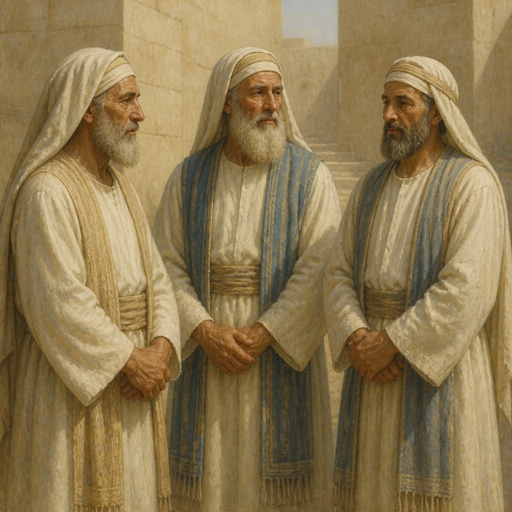
"Maaziah, Bilgai, Shemaiah: these were the priests." - Nehemiah 10:8

Nehemiah 13:8 - "And it grieved me sore: therefore I cast forth all the household stuff of Tobiah out of the chamber."

Nehemiah 9:38 - "And because of all this we make a sure covenant, and write it; and our princes, Levites, and priests, seal unto it."

"And didst see the affliction of our fathers in Egypt, and heardest their cry by the Red sea;" - Nehemiah 9:9

Nehemiah 13:9 - "Then I commanded, and they cleansed the chambers: and thither brought I again the vessels of the house of God, with the meat offering and the frankincense."

"The children of Shephatiah, three hundred seventy and two." - Nehemiah 7:9

Nehemiah 9:1 - "Now in the twenty and fourth day of this month the children of Israel were assembled with fasting, and with sackclothes, and earth upon them."