What does Numbers 19:19 mean?
“And the clean person shall sprinkle upon the unclean on the third day, and on the seventh day: and on the seventh day he shall purify himself, and wash his clothes, and bathe himself in water, and shall be clean at even.” — Numbers 19:19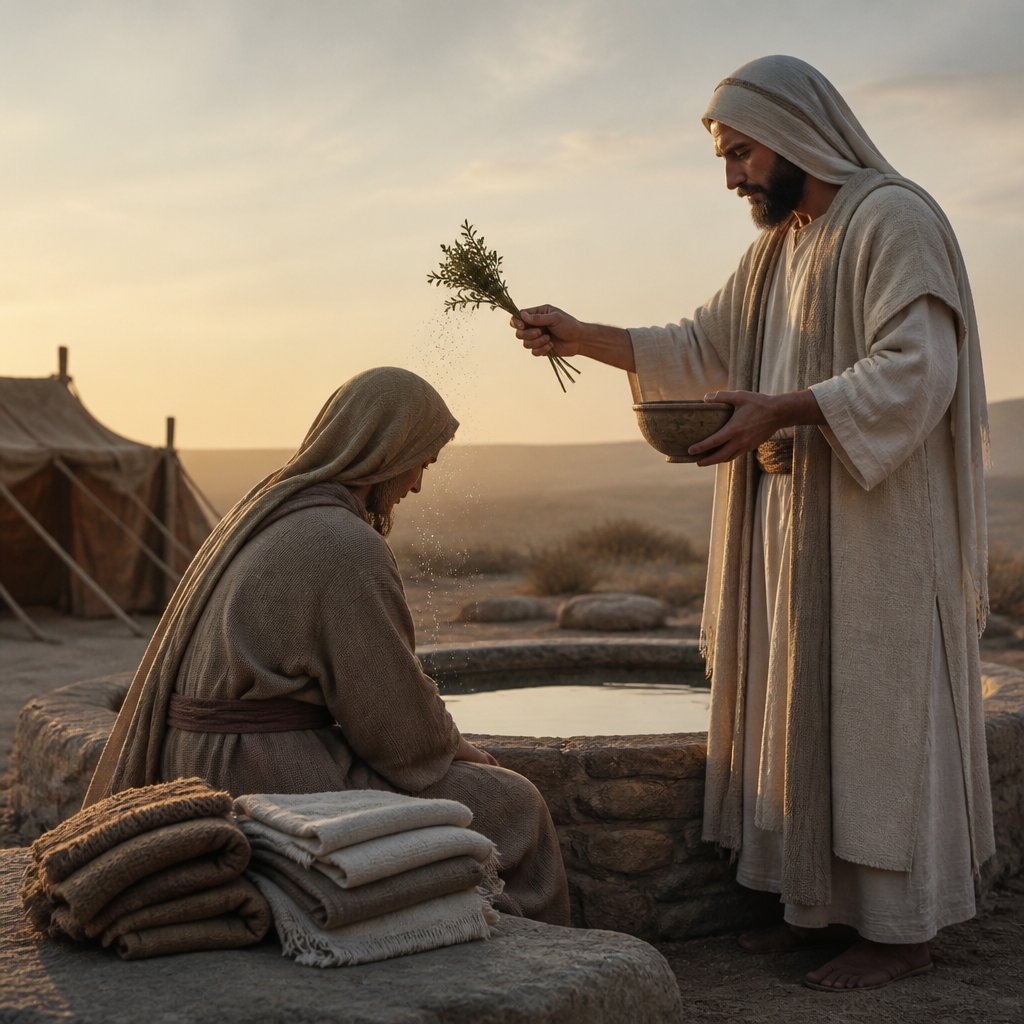
Numbers 19:19 in the King James Version of the Bible reads, "And the clean person shall sprinkle upon the unclean on the third day, and on the seventh day: and on the seventh day he shall purify himself, and wash his clothes, and bathe himself in water, and shall be clean at even."
This particular verse comes from a section of the Bible known as the Book of Numbers, which is the fourth book of the Pentateuch, the first five books of the Hebrew Bible. The Book of Numbers primarily focuses on the Israelites' journey from Sinai to the Promised Land, as well as their experiences and struggles along the way.
In this specific verse, the focus is on purification and cleanliness. The passage outlines a ritual for purification that involves the clean person sprinkling water on the unclean person on the third and seventh days, after which the unclean person must wash his clothes and bathe in water to become clean. This purification process was a crucial aspect of ancient Jewish religious practices and was intended to cleanse individuals of impurities and allow them to fully participate in religious rituals and community life.
One of the key themes of Numbers 19:19 is the concept of ritual purity and impurity. In ancient Jewish culture, certain actions or conditions were considered impure, and individuals who were in such a state were not permitted to participate in religious activities. The ritual described in this verse was a means of addressing these impurities and allowing individuals to reintegrate into the community.
Another important aspect of this verse is the emphasis on the passage of time. The requirement to wait until the third and seventh days before the purification is completed indicates a deliberate and structured approach to the process. This emphasis on the passage of time underscores the importance of patience and adherence to religious guidelines in the pursuit of purity.
Symbolism also plays a significant role in this verse. Water is often used symbolically in the Bible to represent purification, renewal, and spiritual cleansing. In this context, the act of sprinkling water on the unclean person and bathing in water serves as a powerful symbol of the process of purification and the removal of spiritual impurities.
The broader context of Numbers 19:19 is also important for a full understanding of its meaning. The entire chapter of Numbers 19 deals with the purification of individuals who have come into contact with a dead body, which was considered a significant source of impurity in ancient Jewish law. The specific purification ritual outlined in verse 19 is part of a larger set of instructions for addressing this particular form of impurity.
Overall, Numbers 19:19 is a powerful reminder of the importance of ritual purity and the process of cleansing in ancient Jewish religious practices. The verse emphasizes the need for individuals to address impurities in order to fully participate in their religious community and serve as a reminder of the significance of water as a symbol of spiritual cleansing. It also highlights the structured and deliberate approach to purification, as well as the importance of patience and adherence to religious guidelines. Through its themes, context, and symbolism, Numbers 19:19 offers valuable insights into the religious practices and beliefs of ancient Jewish culture.
Get our apps


Artwork for Numbers 19:19

Numbers 19:19 - "And the clean person shall sprinkle upon the unclean on the third day, and on the seventh day: and on the seventh day he shall purify himself, and wash his clothes, and bathe himself in water, and shall be clean at even."
"And the clean person shall sprinkle upon the unclean on the third day, and on the seventh day: and on the seventh day he shall purify himself, and wash his clothes, and bathe himself in water, and shall be clean at even." - Numbers 19:19

Numbers 19:14-19 Touching a dead is unclean

Numbers 21:19 - "And from Mattanah to Nahaliel: and from Nahaliel to Bamoth:"

Numbers 33:19 - "And they departed from Rithmah, and pitched at Rimmon-parez."

Numbers 1:19 - "As the LORD commanded Moses, so he numbered them in the wilderness of Sinai."

Numbers 3:19 - "And the sons of Kohath by their families; Amram, and Izehar, Hebron, and Uzziel."

Numbers 34:19 - "And the names of the men are these: Of the tribe of Judah, Caleb the son of Jephunneh."

Numbers 19:1 - "And the LORD spake unto Moses and unto Aaron, saying,"

Numbers 10:19 - "And over the host of the tribe of the children of Simeon was Shelumiel the son of Zurishaddai."

Numbers 2:19 - "And his host, and those that were numbered of them, were forty thousand and five hundred."

Joshua 1:9

Daniel 1:9

James 1:9

Jude 1:9

Numbers 19:15 - "And every open vessel, which hath no covering bound upon it, is unclean."

Isaiah 11:1-9

Numbers 7:1-9

Isaiah 11:1-9

Isiah 42 1-9

Numbers 19:11 - "¶ He that toucheth the dead body of any man shall be unclean seven days."

Numbers 26:19 - "¶ The sons of Judah were Er and Onan: and Er and Onan died in the land of Canaan."

Numbers 19:6 - "And the priest shall take cedar wood, and hyssop, and scarlet, and cast it into the midst of the burning of the heifer."

Isaiah 11:1-9

mat 17:1-9

1 John 1:9

Job 1:9 no words

Ezequiel 47, 1-9. 12

Numbers 19:22 - "And whatsoever the unclean person toucheth shall be unclean; and the soul that toucheth it shall be unclean until even."

Numbers 27:19 - "And set him before Eleazar the priest, and before all the congregation; and give him a charge in their sight."