What does Numbers 4:16 mean?
“And to the office of Eleazar the son of Aaron the priest pertaineth the oil for the light, and the sweet incense, and the daily meat offering, and the anointing oil, and the oversight of all the tabernacle, and of all that therein is, in the sanctuary, and in the vessels thereof.” — Numbers 4:16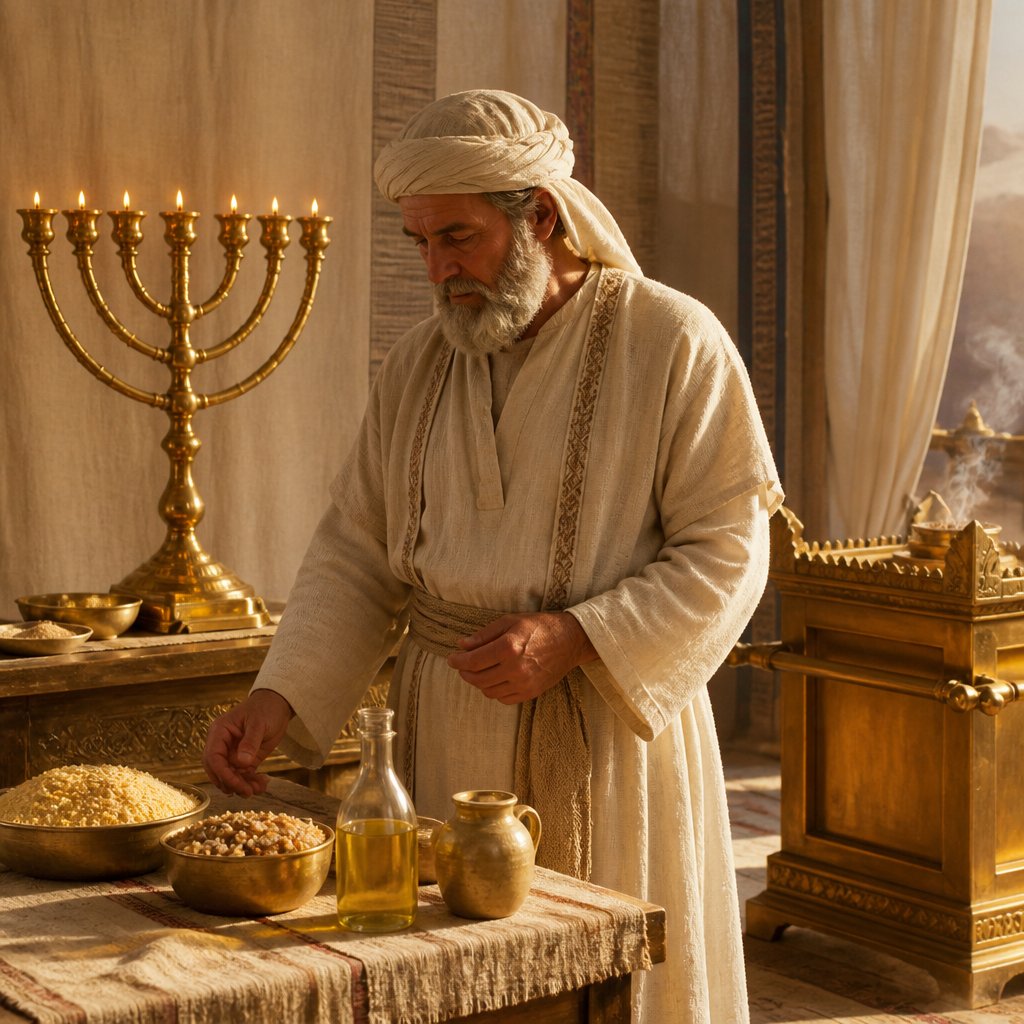
Numbers 4:16 (KJV) states, "And to the office of Eleazar the son of Aaron the priest pertaineth the oil for the light, and the sweet incense, and the daily meat offering, and the anointing oil, and the oversight of all the tabernacle, and of all that therein is, in the sanctuary, and in the vessels thereof."
This verse is found in the Old Testament, specifically in the book of Numbers. It is part of a passage in which the Lord gives Moses specific instructions for the responsibilities of the Levites in the care and transport of the tabernacle and its furnishings. The Levites were a tribe of Israel set apart for the service of the tabernacle and, later, the temple.
In this particular verse, the specific responsibilities of Eleazar, the son of Aaron, are outlined. As the high priest's son, Eleazar held a position of great importance and was responsible for several key aspects of the tabernacle's operation.
The verse begins with a list of the items for which Eleazar is responsible: the oil for the light, the sweet incense, the daily meat offering, and the anointing oil. Each of these items had a specific purpose within the tabernacle's sacrificial system. The oil for the light was used to keep the lamp burning continually in the tabernacle (Exodus 27:20-21), symbolizing God's presence and guidance. The sweet incense was burned on the golden altar as a pleasing aroma to the Lord (Exodus 30:34-38). The daily meat offering, or grain offering, was a symbol of thanksgiving and dedication to the Lord (Leviticus 2:1-16). The anointing oil was used to consecrate the priests and certain items for holy use (Exodus 30:22-33).
Furthermore, Eleazar was responsible for the oversight of all the tabernacle and its contents, as well as the vessels within it. This meant he had the authority to ensure that everything related to the tabernacle was handled properly and maintained according to God's instructions.
The significance of this verse lies in the understanding that Eleazar's role as high priest was one of stewardship and service to the Lord. The items he was responsible for symbolize important aspects of the Israelites' relationship with God—His presence, their worship, their gratitude, and their consecration to Him. By overseeing these elements, Eleazar played a crucial role in facilitating the people's connection to God through their worship and sacrifices.
In a broader context, this verse underscores the importance of order, responsibility, and reverence in the worship of God. The tabernacle was a physical manifestation of God's presence among His people, and it was essential that all aspects of its care and operation were carried out in accordance with God's commands. Eleazar, as the high priest, held a position of great authority and was entrusted with ensuring that the sacred rites and rituals were conducted with reverence and precision.
Symbolically, Eleazar's role can be seen as a precursor to the role of Jesus Christ as the ultimate high priest. In the New Testament, Hebrews 4:14-16 describes Jesus as our great high priest who sympathizes with our weaknesses and intercedes for us before God. Like Eleazar, Jesus is responsible for overseeing the spiritual well-being of His people and ensuring the efficacy of their worship and sacrifice.
In conclusion, Numbers 4:16 (KJV) serves as a reminder of the importance of reverence and responsibility in our worship of God. It highlights the significance of the various elements of worship and the need for faithful stewardship of these gifts. Eleazar's duties symbolize the connection between the physical and the spiritual aspects of worship, as well as the important role of those called to lead and serve in the worship of God. Ultimately, the verse points to the reverence and order that should characterize our worship, as well as the ultimate responsibility of the high priest—Jesus Christ—to intercede for us and ensure our access to God.
Get our apps


Artwork for Numbers 4:16

Numbers 4:16 - "¶ And to the office of Eleazar the son of Aaron the priest pertaineth the oil for the light, and the sweet incense, and the daily meat offering, and the anointing oil, and the oversight of all the tabernacle, and of all that therein is, in the sanctuary, and in the vessels thereof."
"¶ And to the office of Eleazar the son of Aaron the priest pertaineth the oil for the light, and the sweet incense, and the daily meat offering, and the anointing oil, and the oversight of all the tabernacle, and of all that therein is, in the sanctuary, and in the vessels thereof." - Numbers 4:16

Numbers 16:4 - "And when Moses heard it, he fell upon his face:"

"And when Moses heard it, he fell upon his face:" - Numbers 16:4

Numbers 16:18

Numbers 11:16-26
Numbers 32:16-18
Numbers 32:16-18

Numbers 16:16 - "And Moses said unto Korah, Be thou and all thy company before the LORD, thou, and they, and Aaron, to morrow:"

Numbers 25:16 - "¶ And the LORD spake unto Moses, saying,"

Numbers 7:16 - "One kid of the goats for a sin offering:"

Numbers 34:16 - "And the LORD spake unto Moses, saying,"

Numbers 3:16 - "And Moses numbered them according to the word of the LORD, as he was commanded."

Numbers 16:36 - "¶ And the LORD spake unto Moses, saying,"

Numbers 16:23 - "¶ And the LORD spake unto Moses, saying,"

Numbers 16:44 - "¶ And the LORD spake unto Moses, saying,"

Numbers 16:43 - "And Moses and Aaron came before the tabernacle of the congregation."

Numbers 26:16 - "Of Ozni, the family of the Oznites: of Eri, the family of the Erites:"

Numbers 28:16 - "And in the fourteenth day of the first month is the passover of the LORD."

Numbers 4:7

Numbers 4:8

Numbers 16:20 - "And the LORD spake unto Moses and unto Aaron, saying,"

Numbers 16:48 - "And he stood between the dead and the living; and the plague was stayed."
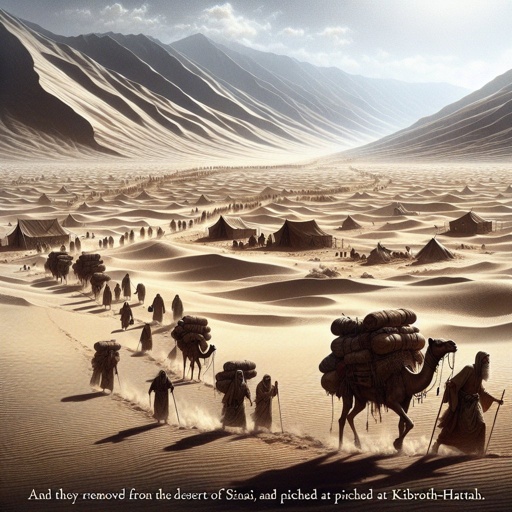
Numbers 33:16 - "And they removed from the desert of Sinai, and pitched at Kibroth-hattaavah."

Be hostile to the medianites numbers 25:16-18

Numbers 10:16 - "And over the host of the tribe of the children of Zebulun was Eliab the son of Helon."

Numbers 12:16 - "And afterward the people removed from Hazeroth, and pitched in the wilderness of Paran."

Numbers 4:4 - "This shall be the service of the sons of Kohath in the tabernacle of the congregation, about the most holy things:"

Numbers 9:16 - "So it was alway: the cloud covered it by day, and the appearance of fire by night."

Numbers 16:6 - "This do; Take you censers, Korah, and all his company;"