What does Philemon 1:8 mean?
“Wherefore, though I might be much bold in Christ to enjoin thee that which is convenient,” — Philemon 1:8
The Bible verse Philemon 1:8 in the King James Version (KJV) states: "Wherefore, though I might be much bold in Christ to enjoin thee that which is convenient."
This verse is part of a letter written by the apostle Paul to Philemon, a wealthy Christian who lived in Colossae. The letter is a personal appeal from Paul to Philemon on behalf of Onesimus, a runaway slave who had become a Christian under Paul's ministry. In this verse, Paul is declaring his authority in Christ to instruct Philemon on what is right and proper.
The theme of this verse is the Christian's authority in Christ and the responsibility to act in love and righteousness. Paul, as an apostle and a leader in the early church, is expressing his confidence in his ability to speak boldly to Philemon because of his position in Christ. The phrase "much bold in Christ" indicates Paul's assurance that his words are not his own, but are empowered by the Spirit of Christ.
The context of this verse is crucial for understanding its significance. In the letter to Philemon, Paul is making a plea for Philemon to receive Onesimus, his runaway slave, not as a slave, but as a beloved brother in Christ. Paul is appealing to Philemon's compassion and urging him to forgive Onesimus and welcome him back with open arms. The letter is a powerful display of the transformative power of the gospel in reconciling relationships and breaking down social barriers.
The use of the word "enjoin" in the verse signifies Paul's call to Philemon to do what is right and proper in the sight of God. It carries the connotation of commanding or directing with authority. Paul is reminding Philemon of his duty as a Christian to act justly and mercifully towards Onesimus. The phrase "that which is convenient" suggests that Paul is urging Philemon to do what is fitting and appropriate in the situation.
Symbolism in this verse is seen in the authority of Christ vested in Paul as an apostle. The phrase "in Christ" emphasizes the source of Paul's boldness and authority. It signifies his unity with Christ and his submission to the will of God. Paul's confidence in Christ empowers him to speak with boldness and conviction, calling Philemon to act in line with the teachings of Christ.
Overall, Philemon 1:8 carries a strong message of Christian love, reconciliation, and the responsibility to act in accordance with the principles of the gospel. It highlights the transformative power of the gospel in breaking down social barriers and reshaping relationships. Paul's authority in Christ serves as a reminder to all believers of their responsibility to act in love and righteousness, even in difficult circumstances. This verse challenges us to consider how we exercise our authority as Christians and how we treat others in light of the gospel.
Get our apps


Artwork for Philemon 1:8

Philemon 1:8 - "Wherefore, though I might be much bold in Christ to enjoin thee that which is convenient,"

"Wherefore, though I might be much bold in Christ to enjoin thee that which is convenient," - Philemon 1:8

Philemon 1:8-20 - "Therefore, although in Christ I could be bold and order you to do what you ought to do, yet I prefer to appeal to you on the basis of love. It is as none other than Paul—an old man and now also a prisoner of Christ Jesus— that I appeal to you for my son Onesimus, who became my son while I was in chains. Formerly he was useless to you, but now he has become useful both to you and to me. I am sending him—who is my very heart—back to you. I would have liked to keep him with me so that he could take your place in helping me while I am in chains for the gospel. But I did not want to do anything without your consent, so that any favor you do would not seem forced but would be voluntary. Perhaps the reason he was separated from you for a little while was that you might have him back forever— no longer as a slave, but better than a slave, as a beloved brother. He is very dear to me but even dearer to you, both as a fellow man and as a brother in the Lord. So if you consider me a partner, welcome him as you would welcome me. If he has done you any wrong or owes you anything, charge it to me. I, Paul, am writing this with my own hand. I will pay it back—not to mention that you owe me your very self."
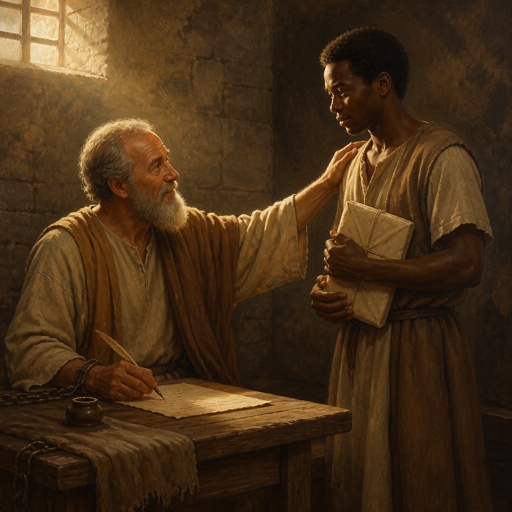
"Therefore, although in Christ I could be bold and order you to do what you ought to do, yet I prefer to appeal to you on the basis of love. It is as none other than Paul—an old man and now also a prisoner of Christ Jesus— that I appeal to you for my son Onesimus, who became my son while I was in chains. Formerly he was useless to you, but now he has become useful both to you and to me. I am sending him—who is my very heart—back to you. I would have liked to keep him with me so that he could take your place in helping me while I am in chains for the gospel. But I did not want to do anything without your consent, so that any favor you do would not seem forced but would be voluntary. Perhaps the reason he was separated from you for a little while was that you might have him back forever— no longer as a slave, but better than a slave, as a beloved brother. He is very dear to me but even dearer to you, both as a fellow man and as a brother in the Lord. So if you consider me a partner, welcome him as you would welcome me. If he has done you any wrong or owes you anything, charge it to me. I, Paul, am writing this with my own hand. I will pay it back—not to mention that you owe me your very self." - Philemon 1:8-20

Philemon 1:1 - "Paul, a prisoner of Jesus Christ, and Timothy our brother, unto Philemon our dearly beloved, and fellowlabourer, 2 And to our beloved Apphia, and Archippus our fellowsoldier, and to the church in thy house:"

Philemon 1:4-7

Philemon 1:24 - "Marcus, Aristarchus, Demas, Lucas, my fellowlabourers."

Philemon 1:23 - "There salute thee Epaphras, my fellowprisoner in Christ Jesus;"

Philemon 1:17 - "If thou count me therefore a partner, receive him as myself."

Philemon 1:25 - "The grace of our Lord Jesus Christ be with your spirit. Amen."

Philemon 1:11 - "Which in time past was to thee unprofitable, but now profitable to thee and to me:"

Philemon 1:15 - "For perhaps he therefore departed for a season, that thou shouldest receive him for ever;"

Philemon 1:3 - "Grace to you, and peace, from God our Father and the Lord Jesus Christ."

Philemon 1:4 - "I thank my God, making mention of thee always in my prayers,"

Philemon 1:18 - "If he hath wronged thee, or oweth thee ought, put that on mine account;"

Philemon 1:10 - "I beseech thee for my son Onesimus, whom I have begotten in my bonds:"

Philemon 1:12 - "Whom I have sent again: thou therefore receive him, that is, mine own bowels:"

Philemon 1:20 - "Yea, brother, let me have joy of thee in the Lord: refresh my bowels in the Lord."

Philemon 1:5 - "Hearing of thy love and faith, which thou hast toward the Lord Jesus, and toward all saints;"

Philemon 1:14 - "But without thy mind would I do nothing; that thy benefit should not be as it were of necessity, but willingly."

Philemon 1:7 - "For we have great joy and consolation in thy love, because the bowels of the saints are refreshed by thee, brother."

"Marcus, Aristarchus, Demas, Lucas, my fellowlabourers." - Philemon 1:24

Philemon 1:6 - "That the communication of thy faith may become effectual by the acknowledging of every good thing which is in you in Christ Jesus."

"Paul, a prisoner of Jesus Christ, and Timothy our brother, unto Philemon our dearly beloved, and fellowlabourer, 2 And to our beloved Apphia, and Archippus our fellowsoldier, and to the church in thy house:" - Philemon 1:1

Philemon 1:22 - "But withal prepare me also a lodging: for I trust that through your prayers I shall be given unto you."

Philemon 1:16 - "Not now as a servant, but above a servant, a brother beloved, specially to me, but how much more unto thee, both in the flesh, and in the Lord?"

"There salute thee Epaphras, my fellowprisoner in Christ Jesus;" - Philemon 1:23

Philemon 1:9 - "Yet for love's sake I rather beseech thee, being such an one as Paul the aged, and now also a prisoner of Jesus Christ."

Philemon 1:13 - "Whom I would have retained with me, that in thy stead he might have ministered unto me in the bonds of the gospel:"

Philemon 1:21 - "Having confidence in thy obedience I wrote unto thee, knowing that thou wilt also do more than I say."