What does Philippians 1:20-21 mean?
“According to my earnest expectation and my hope, that in nothing I shall be ashamed, but that with all boldness, as always, so now also Christ shall be magnified in my body, whether it be by life, or by death. For to me to live is Christ, and to die is gain.” — Philippians 1:20-21
Philippians 1:20–21 in the King James Version stands as Paul’s compressed confession of what governs his life and what gives shape to his suffering: “According to my earnest expectation and my hope, that in nothing I shall be ashamed, but that with all boldness, as always, so now also Christ shall be magnified in my body, whether it be by life, or by death. For to me to live is Christ, and to die is gain.” These words come from a prison setting. Paul is restrained in body, yet his inner aim is unrestrained: he is watching his own circumstances—trial, uncertainty, the possibility of execution—and interpreting them through one overriding desire, that Christ should be made great.
The immediate context in Philippians 1 is that Paul is explaining to the believers at Philippi how his “bonds” have “fallen out rather unto the furtherance of the gospel” (Philippians 1:12, KJV). Instead of reading imprisonment as defeat, he sees it as a stage on which God advances the message of Christ. Even the mixed motives of other preachers cannot rob him of joy, because “Christ is preached” (1:18). It is in that flow of thought—gospel progress despite hardship, joy despite opposition—that Paul turns to his own personal horizon. He does not pretend he knows whether he will be released or condemned. Yet he does know what he wants his outcome to mean. That is the force of “According to my earnest expectation and my hope.” The phrase conveys a forward-leaning, intent watchfulness, like a man straining his neck toward what is coming, and it is joined with “hope,” not as wishful thinking, but as confident expectation anchored in God. Paul’s outlook is not centered on escape, vindication, or comfort; it is centered on faithfulness.
His first concern is moral and spiritual integrity: “that in nothing I shall be ashamed.” In the world’s eyes, chains can be shameful. In the believer’s eyes, the real shame would be to deny Christ, to shrink back from confession, to compromise under pressure, or to respond to suffering in a way that dishonors the Lord. Paul’s words recall the Bible’s broader theme that shame is not merely embarrassment but the exposure of misplaced trust and failed allegiance. If his life is examined publicly—by courts, by guards, by congregations, by enemies—he longs that there will be no moment where fear or self-preservation makes him act as though Christ is not worthy.
Against that possibility he sets a different posture: “but that with all boldness, as always, so now also Christ shall be magnified in my body.” “Boldness” here is not recklessness; it is Spirit-enabled frankness and courage. He asks not simply for some boldness, but “all boldness,” and he ties it to his lifelong pattern: “as always, so now also.” Chains have not changed the calling. The continuity matters. Paul does not want a heroic “final scene” if he has lived timidly, nor does he want a timid ending after a courageous life. He wants consistency: Christ-honoring speech, Christ-honoring endurance, Christ-honoring conduct, whether watched or unwatched.
The phrase “Christ shall be magnified in my body” is rich with symbolism and theology. “Magnified” evokes the making of something great in the sight of others, like a lens bringing an object into clearer view. Paul does not mean that Christ becomes greater in Himself, as though the Lord needed enlargement, but that Christ becomes more visible and weighty to observers through Paul’s embodied life. The “body” is crucial: Christianity is not merely an inward belief but an embodied witness. In Paul’s situation, his body is confined, exposed to hardship, possibly threatened with death; yet that very vulnerability can become the medium through which Christ’s worth is displayed. The believer’s body, with its limitations and sufferings, becomes a place where Christ’s strength, patience, and lordship can be seen. This is deeply in line with the biblical pattern that God often displays His glory through human weakness.
Then Paul adds the line that makes the passage unforgettable: “whether it be by life, or by death.” He sees two possible outcomes, and he deliberately refuses to let the meaning of his situation depend on which one occurs. If he lives, Christ can be magnified through continued ministry, endurance, and faithful labor. If he dies, Christ can be magnified through steadfast confession to the end, showing that Christ is valued above physical life itself. In either case, Paul refuses to grant death the power to define the narrative as loss, and he refuses to make life the ultimate good as though survival were the highest aim. His body, living or dying, is meant to serve the magnifying of Christ.
Philippians 1:21 grounds this in the most personal way: “For to me to live is Christ, and to die is gain.” The words “to me” matter; Paul is describing the controlling principle of his own life, his settled valuation. “To live is Christ” means that Christ is not merely a part of life, or a helper alongside other aims, but the very content and purpose of living. Life’s meaning is gathered up into Christ: knowing Him, serving Him, obeying Him, making Him known, becoming like Him. Christ is both the goal and the sphere of Paul’s existence. Living is not primarily about comfort, reputation, achievement, or self-expression; it is about Christ.
“And to die is gain” follows as the logical consequence of that valuation. Death is normally counted as loss because it ends earthly goods and severs earthly ties. But if Christ Himself is the meaning of life, then death cannot steal the ultimate treasure; it brings the believer into nearer communion with the One who is already life’s supreme value. Paul’s statement does not romanticize death or treat the body as worthless. Rather, it redefines “gain” in terms of proximity to Christ and freedom from the burdens and conflicts of the present age. The verse also carries an implicit challenge to the world’s systems of fear. If death is “gain,” then threats lose their leverage, and the believer is liberated to speak and live with “all boldness.”
Within the wider themes of Philippians, these verses contribute to the epistle’s portrait of joy and steadfastness in suffering. Paul’s joy is not denial of hardship; it is the fruit of a life ordered around Christ’s supremacy. His “earnest expectation and…hope” show that Christian hope is not passive optimism but active orientation toward faithful witness. His refusal to be “ashamed” shows that Christian honor is determined by loyalty to Christ, not by social status or circumstance. His desire that Christ be “magnified in my body” shows that the Christian life is incarnational in its witness: the gospel is displayed through real decisions, real endurance, real bodies, and real costs. And his confession “to live is Christ, and to die is gain” reveals a spiritual arithmetic in which Christ outweighs all else, so thoroughly that the two great human boundaries—life and death—are both pressed into His service.
The significance of Philippians 1:20–21, then, is that it presents a single-hearted vision: Paul measures every outcome by whether Christ is made great. It is a portrait of courage that does not depend on controlling circumstances, a theology of suffering that turns the body’s weakness into a platform for Christ’s honor, and a definition of life and death that overturns ordinary fears. In prison and under threat, Paul articulates the Christian center: Christ magnified, Christ as life’s meaning, and Christ as the believer’s gain beyond death.
Get our apps


Artwork for Philippians 1:20-21

Philippians 1:20-21 - "I eagerly expect and hope that I will in no way be ashamed, but will have sufficient courage so that now as always Christ will be exalted in my body, whether by life or by death. For to me, to live is Christ and to die is gain."

"I eagerly expect and hope that I will in no way be ashamed, but will have sufficient courage so that now as always Christ will be exalted in my body, whether by life or by death. For to me, to live is Christ and to die is gain." - Philippians 1:20-21

Philippians 1:19-21

Philippians 1:19-21

Philippians 4: 10-20

Philippians 1:19-21

Philippians (1:21) For to me, living is Christ and dying is gain.

Philippians 1:21 - "For to me to live is Christ, and to die is gain."

Philippians 3:15-21 mature spirituality

Luke 2:1-20

"For to me to live is Christ, and to die is gain." - Philippians 1:21

Philippians 4:14-20

Philippians 4:14-20

Philippians 4:14-20

Philippians 4:14-20

Philippians 3:20-21 - "For our citizenship is in heaven, from which we also eagerly wait for the Savior, the Lord Jesus Christ, who will transform our lowly body that it may be conformed to His glorious body, according to the working by which He is able even to subdue all things to Himself."

Philippians 2:21 - "For all seek their own, not the things which are Jesus Christ's."

Matthew 21:21 Philippians 4:6-7 Ephesians 6:10-18 Put the words on the photo

Matthew 21:21 Philippians 4:6-7 Ephesians 6:10-18

Philippians 4:20 - "Now unto God and our Father be glory for ever and ever. Amen."

1 Peter 2:20-21
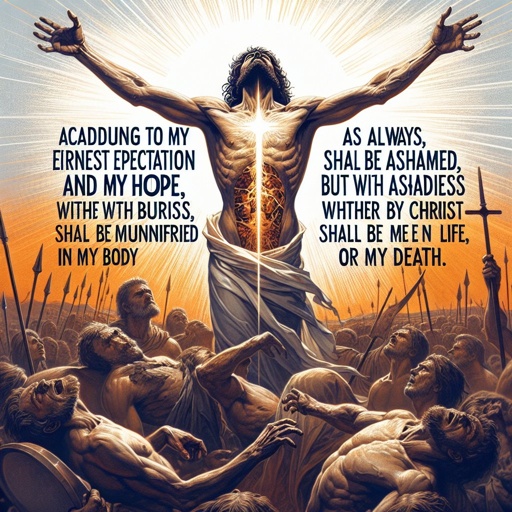
Philippians 1:20 - "According to my earnest expectation and my hope, that in nothing I shall be ashamed, but that with all boldness, as always, so now also Christ shall be magnified in my body, whether it be by life, or by death."
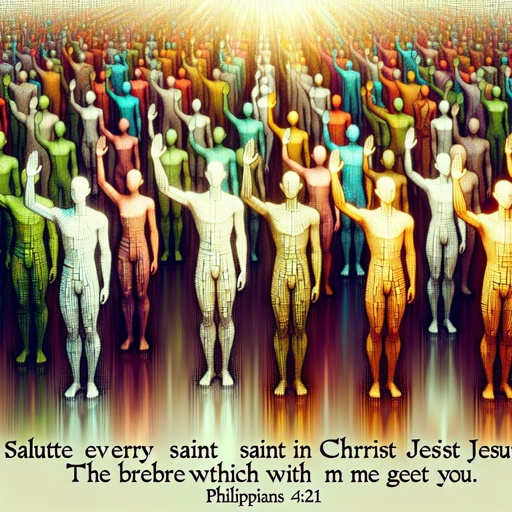
Philippians 4:21 - "Salute every saint in Christ Jesus. The brethren which are with me greet you."

Philippians 2:20 - "For I have no man likeminded, who will naturally care for your state."

Philippians 3:20 - "For our conversation is in heaven; from whence also we look for the Saviour, the Lord Jesus Christ:"

Philippians 1:3

Philippians 1:27

Philippians 4:1

philippians 4:7

philippians 4:4