What does Psalms 118:5 mean?
“I called upon the LORD in distress: the LORD answered me, and set me in a large place.” — Psalms 118:5
Psalm 118:5 in the KJV reads, “I called upon the LORD in distress: the LORD answered me, and set me in a large place.” The verse is a compact testimony that moves from pressure to deliverance, from confinement to freedom, and it does so by tracing the change not to human strength but to the LORD’s direct response to a cry.
Its first movement is inward and urgent: “I called upon the LORD in distress.” The speaker is not merely thinking about God or speaking into the air; he is calling upon the LORD, invoking the covenant name of God, the One known for faithful mercy and steadfast help. “In distress” suggests being hemmed in, pressed, or constrained, as though circumstances have narrowed life down to a tight and fearful space. The verse does not specify the nature of the trouble, which is part of its power: it can gather into itself many forms of affliction—persecution, danger, guilt, national crisis, personal sorrow—while still being concrete about the experience of being trapped. Distress here also exposes the spiritual truth that need can become a doorway to prayer. The cry is not presented as an achievement but as dependence.
The second movement shifts from the speaker’s action to God’s answer: “the LORD answered me.” The verse emphasizes response. The LORD is not distant, indifferent, or slow to hear; He answers. In the larger context of Psalm 118, a psalm that repeatedly magnifies the LORD’s mercy and saving strength, this answer is consistent with the refrain of divine goodness and enduring mercy. The testimony assumes a relationship in which prayer is meaningful, where calling is met with hearing. It also implies that deliverance is not merely luck or a natural turn of events; it is the LORD’s intervention interpreted as personal and purposeful.
The final movement interprets what the answer looked like: God “set me in a large place.” The symbolism is vivid. Distress is a narrowing; deliverance is an enlarging. A “large place” is the opposite of confinement: room to breathe, room to stand, room to move forward without the walls closing in. It can signify safety from enemies, relief from oppression, and restored stability. It can also suggest the experience of being brought into openness after fear—an image of freedom granted by God, not seized by self. The phrase “set me” is important: the speaker does not wander out by his own cleverness; he is placed there by the LORD, as one led out of a tight pass into a broad plain. This makes the “large place” not merely a change of circumstance but a gift of God’s ordering and care.
Within Psalm 118’s broader flow, this verse functions as part of a larger confession of trust. The psalm as a whole is filled with the language of deliverance, confidence against opposition, and public praise for God’s saving acts. Psalm 118:5 reads like a personal summary of the psalm’s larger theme: the LORD’s mercy is not abstract; it is experienced in crisis. The verse stands at the intersection of prayer and providence: a cry rises, an answer comes, and the outcome is described as enlargement—an image that naturally leads into thanksgiving and boldness. It helps explain why the psalm repeatedly turns toward praise: the worship that follows is rooted in a remembered rescue.
The verse also carries a spiritual pattern that is often repeated in Scripture: the human condition of limitation and fear met by divine initiative that brings liberty. The “distress” can be read as any situation that exposes human helplessness; the “large place” can be read as the peace, stability, and freedom that come when God delivers. Even when the external circumstances are not fully described, the verse invites the reader to recognize the LORD as the One who hears in trouble and whose help is not merely to remove pain but to bring His servant into a widened life—one marked by breathing room, renewed footing, and the sense of being safely held in God’s care.
In that way Psalm 118:5 is significant not only as a report of what happened once, but as a theology of rescue in a single sentence: prayer born of distress, God’s living answer, and the widening grace that replaces confinement with a “large place.”
Get our apps


Artwork for Psalms 118:5

Psalms 118:5 - "I called upon the LORD in distress: the LORD answered me, and set me in a large place."

"I called upon the LORD in distress: the LORD answered me, and set me in a large place." - Psalms 118:5

"I called upon the LORD in distress: the LORD answered me, and set me in a large place." - Psalms 118:5

Psalm 118:5

Psalms 118:24 - "This is the day which the LORD hath made; we will rejoice and be glad in it."

"This is the LORD'S doing; it is marvellous in our eyes." - Psalms 118:23

Psalms 118:6 - "The LORD is on my side; I will not fear: what can man do unto me?"

Psalms 118:23 - "This is the LORD'S doing; it is marvellous in our eyes."

"This is the day which the LORD hath made; we will rejoice and be glad in it." - Psalms 118:24

"The LORD is my strength and song, and is become my salvation." - Psalms 118:14

Psalms 118:20 - "This gate of the LORD, into which the righteous shall enter."

Psalms 118:9 - "It is better to trust in the LORD than to put confidence in princes."

"Let Israel now say, that his mercy endureth for ever." - Psalms 118:2

"Let the house of Aaron now say, that his mercy endureth for ever." - Psalms 118:3

Psalms 118:14 - "The LORD is my strength and song, and is become my salvation."

Psalms 118:8 - "It is better to trust in the LORD than to put confidence in man."

Psalms 118:17 - "I shall not die, but live, and declare the works of the LORD."

Psalms 118:2 - "Let Israel now say, that his mercy endureth for ever."

Psalms 118:22 - "The stone which the builders refused is become the head stone of the corner."

Psalms 118:3 - "Let the house of Aaron now say, that his mercy endureth for ever."

Psalms 118:16 - "The right hand of the LORD is exalted: the right hand of the LORD doeth valiantly."

Psalms 118:19 - "Open to me the gates of righteousness: I will go into them, and I will praise the LORD:"

Psalms 118:4 - "Let them now that fear the LORD say, that his mercy endureth for ever."

Psalms 118:10 - "All nations compassed me about: but in the name of the LORD will I destroy them."

Psalms 118:15 - "The voice of rejoicing and salvation is in the tabernacles of the righteous: the right hand of the LORD doeth valiantly."
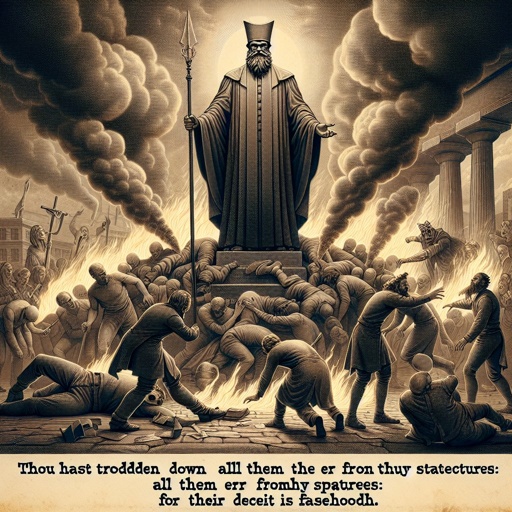
Psalms 119:118 - "Thou hast trodden down all them that err from thy statutes: for their deceit is falsehood."

Psalms 118:29 - "O give thanks unto the LORD; for he is good: for his mercy endureth for ever."

Psalms 118:13 - "Thou hast thrust sore at me that I might fall: but the LORD helped me."

Psalms 118:21 - "I will praise thee: for thou hast heard me, and art become my salvation."

Psalms 118:11 - "They compassed me about; yea, they compassed me about: but in the name of the LORD I will destroy them."