What does Psalms 119:140 mean?
“Thy word is very pure: therefore thy servant loveth it.” — Psalms 119:140
“Thy word is very pure: therefore thy servant loveth it.” (Psalm 119:140, KJV)
In Psalm 119:140 the psalmist speaks directly to God and describes God’s word as “very pure,” then draws a moral and emotional conclusion from that description: “therefore thy servant loveth it.” The verse is both a confession about the character of Scripture and a testimony about the proper response of a believing heart. It ties together what God’s word is and what God’s servant becomes in relation to it.
The immediate context is Psalm 119 as a whole, the great psalm of devotion to the law of the LORD, where the writer repeatedly returns to the same central reality: God reveals Himself, guides His people, and reforms their lives through His word. This particular statement appears in a portion of the psalm that continues to contrast the stability and truth of what God has spoken with the weakness, affliction, and opposition the psalmist experiences. Around this verse, the speaker acknowledges trouble, persecution, and smallness in the eyes of others, yet insists that God’s righteousness and testimonies remain right and trustworthy. Against that backdrop, “Thy word is very pure” functions like an anchor. If circumstances are mixed, motives in men are mixed, and the psalmist’s life feels pressed, God’s word is not mixed. It is clean, reliable, and untainted.
The phrase “very pure” is rich with meaning. Purity in Scripture carries the sense of being unmixed, undefiled, and proven genuine. In prose form, the psalmist is saying that what God speaks is not alloyed with error, not diluted by deceit, not corrupted by the shifting intentions that often mark human speech. God’s word is not merely somewhat clean; it is “very” pure—thoroughly refined. The symbolism evokes metal tested by fire, something put through trial and found sound. That image matters because the psalmist lives amid pressures that test everything else. In a world where promises fail and judgments can be crooked, the word of God is depicted as having already passed through any test that could be applied to it. Its purity is not theoretical; it is demonstrated and dependable.
This purity also speaks to holiness. The word is “pure” because it proceeds from the Holy One. It does not only convey information; it carries God’s righteous character. That means it has the power to expose impurity in the reader, to correct what is bent, and to separate truth from vanity. A “pure” word does not flatter sin or negotiate with darkness; it clarifies, rebukes, cleanses, and steadies. When the psalmist calls it “Thy word,” he is not praising a detached set of religious sayings; he is praising God’s own communication, God’s self-disclosure. The authority and purity of the word are grounded in the person of the One who speaks it.
Then comes the “therefore,” which makes the verse a piece of spiritual logic. Because the word is very pure, the servant loves it. Love here is not presented as a mere preference, as though the psalmist simply enjoys religious literature. The love is the fitting response of a servant who has learned that what God says is the safest, truest, most cleansing reality available. The verse implies that love for Scripture grows out of confidence in its character. If the word were corrupted, the servant’s devotion would be fragile. But since it is pure, the servant’s love can be whole. The purity of the word does not repel the faithful servant; it attracts him, because it means that in drawing near to the word he is drawing near to something that will not deceive him, something that will not stain him, something that will not collapse under pressure.
The word “servant” deepens the meaning as well. The speaker is not describing himself as an independent admirer but as one who belongs to God, one under God’s rule. A servant’s relationship to the master’s word is not casual; it is the channel of instruction, correction, and direction. To love the master’s word is to love the master’s will. It is to embrace obedience not as mere duty, but as devotion. In that sense, the verse suggests that holiness and affection are not enemies: the purity of God’s word does not merely command; it kindles love in the one who truly serves.
There is also an implied contrast running beneath the verse. Human words can be double, impure, or self-serving; God’s word is not. Human counsel can be flattering and destructive; God’s word is clean and life-giving. The psalmist’s love is therefore also a rejection of competing voices. He loves what is pure because he has tasted what is not. He clings to what is tested because he has seen what is unstable. The verse quietly teaches discernment: to prize God’s word is to recognize it as qualitatively different from every other source of guidance.
In significance, Psalm 119:140 presents Scripture as both trustworthy and transformative. It is trustworthy because it is “very pure,” and it is transformative because such purity draws the servant into love, reverence, and obedience. The verse captures an essential dynamic of biblical faith: God’s word is not merely to be analyzed; it is to be loved, precisely because it is pure. The psalmist’s heart rests in the conviction that what God has spoken is clean, refined, and safe, and from that resting place love becomes the natural answer.
Get our apps


Artwork for Psalms 119:140

Psalms 119:140 - "Thy word is very pure: therefore thy servant loveth it."

"Thy word is very pure: therefore thy servant loveth it." - Psalms 119:140

"Thy word is very pure: therefore thy servant loveth it." - Psalms 119:140

"Thy word is very pure: therefore thy servant loveth it." - Psalms 119:140

Psalms 140:5 - "The proud have hid a snare for me, and cords; they have spread a net by the wayside; they have set gins for me. Selah."

Psalms 140:2 - "Which imagine mischiefs in their heart; continually are they gathered together for war."

Psalms 140:12 - "I know that the LORD will maintain the cause of the afflicted, and the right of the poor."

Psalms 140:3 - "They have sharpened their tongues like a serpent; adders' poison is under their lips. Selah."
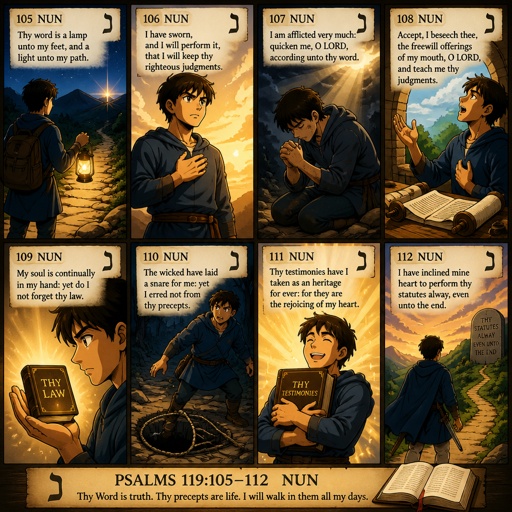
Psalms 119:105 NUN. Thy word is a lamp unto my feet, and a light unto my path. Psalms 119:106 I have sworn, and I will perform it, that I will keep thy righteous judgments. Psalms 119:107 I am afflicted very much: quicken me, O LORD, according unto thy word. Psalms 119:108 Accept, I beseech thee, the freewill offerings of my mouth, O LORD, and teach me thy judgments. Psalms 119:109 My soul is continually in my hand: yet do I not forget thy law. Psalms 119:110 The wicked have laid a snare for me: yet I erred not from thy precepts. Psalms 119:111 Thy testimonies have I taken as an heritage for ever: for they are the rejoicing of my heart. Psalms 119:112 I have inclined mine heart to perform thy statutes alway, even unto the end.

Psalms 140:1 - "Deliver me, O LORD, from the evil man: preserve me from the violent man;"

Psalms 140:9 - "As for the head of those that compass me about, let the mischief of their own lips cover them."

Psalms 140:11 - "Let not an evil speaker be established in the earth: evil shall hunt the violent man to overthrow him."

Psalms 140:7 - "O GOD the Lord, the strength of my salvation, thou hast covered my head in the day of battle."

Psalms 140:6 - "I said unto the LORD, Thou art my God: hear the voice of my supplications, O LORD."

Psalms 140:8 - "Grant not, O LORD, the desires of the wicked: further not his wicked device; lest they exalt themselves. Selah."

Psalms 140:13 - "Surely the righteous shall give thanks unto thy name: the upright shall dwell in thy presence."

Psalms 119:11

"O GOD the Lord, the strength of my salvation, thou hast covered my head in the day of battle." - Psalms 140:7

Psalms 119:153 - "Consider mine affliction, and deliver me: for I do not forget thy law."

Psalms 140:10 - "Let burning coals fall upon them: let them be cast into the fire; into deep pits, that they rise not up again."

Psalms 119:174 - "I have longed for thy salvation, O LORD; and thy law is my delight."

Psalms 119:61 - "The bands of the wicked have robbed me: but I have not forgotten thy law."

"Grant not, O LORD, the desires of the wicked: further not his wicked device; lest they exalt themselves. Selah." - Psalms 140:8

Psalms 119:32 - "I will run the way of thy commandments, when thou shalt enlarge my heart."

"Which imagine mischiefs in their heart; continually are they gathered together for war." - Psalms 140:2

Psalms 140:4 - "Keep me, O LORD, from the hands of the wicked; preserve me from the violent man; who have purposed to overthrow my goings."

Psalms 119:15

"I know that the LORD will maintain the cause of the afflicted, and the right of the poor." - Psalms 140:12

"Let burning coals fall upon them: let them be cast into the fire; into deep pits, that they rise not up again." - Psalms 140:10

"For ever, O LORD, thy word is settled in heaven." - Psalms 119:89