What does Psalms 23:4 mean?
“Yea, though I walk through the valley of the shadow of death, I will fear no evil: for thou art with me; thy rod and thy staff they comfort me.” — Psalms 23:4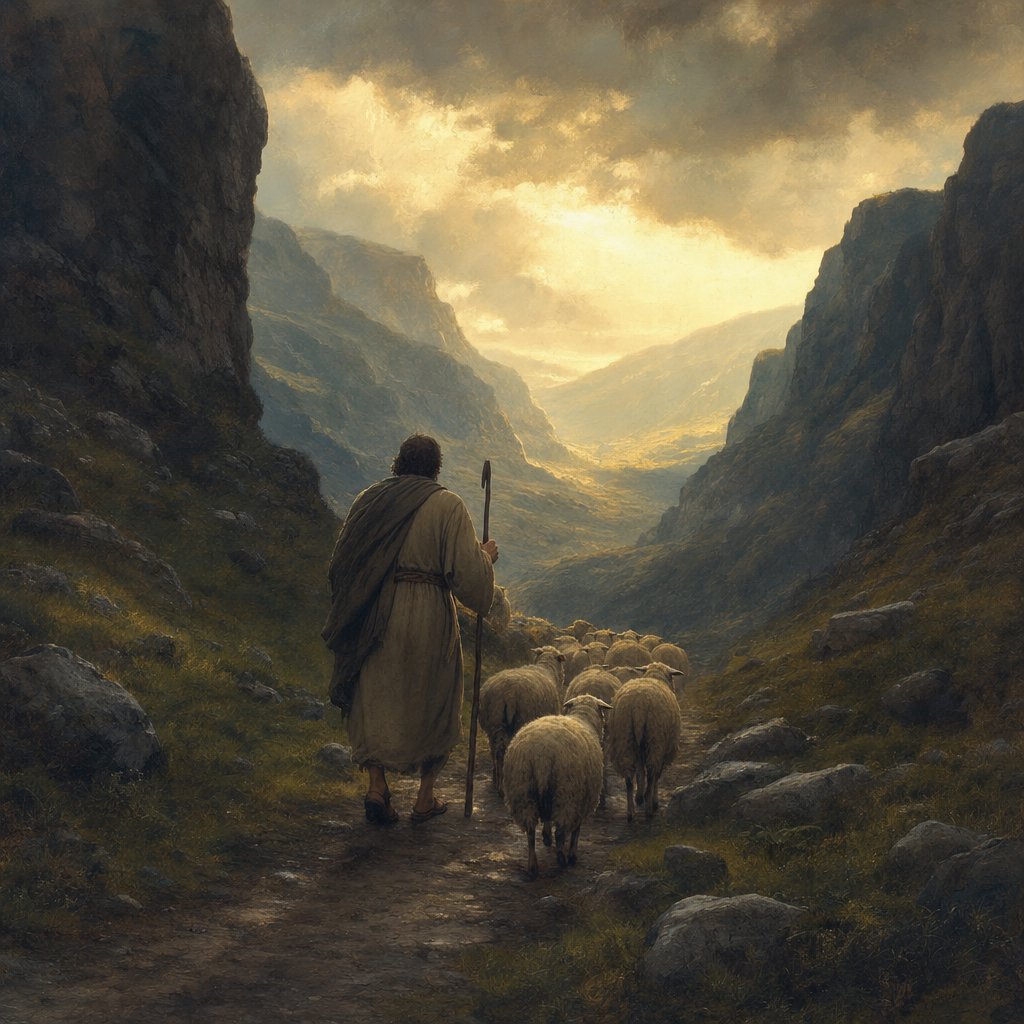
“Yea, though I walk through the valley of the shadow of death, I will fear no evil: for thou art with me; thy rod and thy staff they comfort me.” Psalm 23:4 (KJV) stands at the center of Psalm 23 and marks a turning point in the psalm’s movement from peaceful provision into threatened terrain, without losing the calm confidence that has characterized the speaker from the beginning. In the earlier lines the psalmist speaks of being led to “green pastures” and “still waters,” but here he speaks of walking through a valley, and not simply any valley, but “the valley of the shadow of death.” The verse does not deny darkness; it places darkness inside a larger reality in which the LORD’s presence governs the outcome.
In context, Psalm 23 is a psalm of trust in the LORD as Shepherd. The speaker is not describing an abstract belief but a lived pilgrimage. The phrase “though I walk” assumes motion and continuation; the faith expressed here is not that trouble never comes, but that one can keep walking when it does. The valley is not described as a destination but as a passage. “Walk through” is crucial: the psalmist is not camped in despair, nor does he speak as if the valley is the final word. The valley is a corridor on the way to something else, and the believer’s task is to keep moving under the Shepherd’s care.
“The valley of the shadow of death” uses imagery that communicates extreme peril and oppression. A valley can be a place where light is limited, where enemies can hide, where escape routes are narrow, and where one feels enclosed. The “shadow of death” language intensifies this—death’s shade falling over a person’s path, whether through the threat of actual death, the presence of violence, crushing sorrow, illness, calamity, or any situation where mortality and helplessness feel near. Yet it remains a “shadow,” not because the danger is imaginary, but because the LORD’s presence changes what that danger can finally do. A shadow is real, but it is not ultimate substance; it points to something looming, and it can terrify, but it cannot in itself destroy. The psalmist acknowledges the deepest fear humans know and then refuses to yield to it.
The response is, “I will fear no evil.” This is not bravado; it is grounded in a reason that immediately follows: “for thou art with me.” The verse shifts here from speaking about the LORD in the third person to speaking to the LORD in the second person. Earlier the psalmist says, “He leadeth me,” but now, in the valley, it becomes “thou art with me.” That change of address is part of the meaning. In the bright places, one may speak about God; in the dark places, the psalm becomes prayer, direct communion. The comfort is not first an explanation of suffering, but the nearness of the Shepherd. The logic of the verse is simple and profound: the absence of fear is not the absence of evil, but the presence of God.
The two images that follow—“thy rod and thy staff they comfort me”—are shepherding symbols that deepen what “with me” means. The rod was associated with the shepherd’s authority and protection, something used to ward off threats, to defend the flock, and to assert control against predators. The staff, commonly understood as the shepherd’s crook, evokes guidance, support, and rescue—the tool by which a sheep might be drawn back from danger or steadied on a difficult path. Together they communicate that the Shepherd’s presence is not passive companionship but active care. The believer is comforted not because the valley is harmless, but because the Shepherd is equipped. The rod speaks to the reality that evil can be confronted; the staff speaks to the reality that weakness can be helped. Comfort here is not merely emotional soothing; it is security rooted in the Shepherd’s capacity to guard and guide.
A major theme in Psalm 23:4 is courage that flows from relationship. “Thou art with me” is covenant language in effect, echoing the recurring biblical assurance that God’s people are not abandoned in trouble. The verse also carries the theme of pilgrimage: faith is a walk, and the darkest stretches are included within the Shepherd’s route. Another theme is the transformation of perception: the valley looks like death’s territory, yet the believer interprets it through the Shepherd’s companionship. The verse does not pretend that evil is unreal; it declares that evil is not sovereign.
Symbolically, the valley can represent any season in which clarity is reduced and fear is amplified, when one’s path narrows and the future is hard to see. The “shadow of death” can symbolize the closeness of loss, endings, and the limits of human power. The rod and staff symbolize God’s protective rule and tender direction—discipline and support, authority and care—held together in one Shepherd. The comfort is found in the Shepherd Himself and in the concrete expressions of His shepherding.
The significance of Psalm 23:4, especially in the KJV’s cadence, is that it offers a theology of presence in suffering. It teaches that the believer’s hope is not built on the promise of an untroubled landscape but on the promise of God’s company and competence in the troubled one. The verse gives language for facing mortality and terror without surrendering to them: walking, not collapsing; acknowledging darkness, not worshiping it; refusing fear, not because the heart is naturally fearless, but because the Shepherd is near, and His rod and staff are not absent in the valley.
Get our apps


Artwork for Psalms 23:4

Psalms 23:4

Psalms 23:4 - "Yea, though I walk through the valley of the shadow of death, I will fear no evil: for thou art with me; thy rod and thy staff they comfort me."
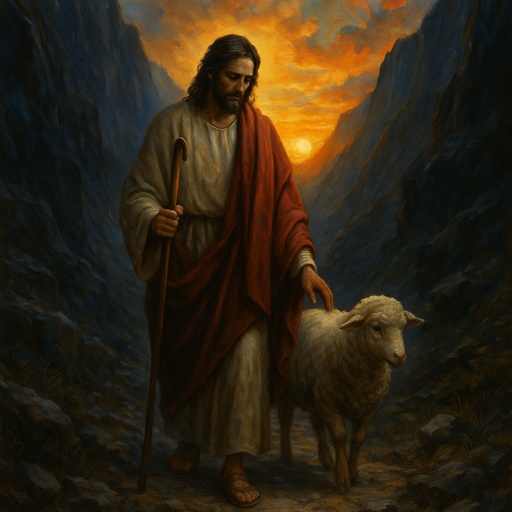
"Yea, though I walk through the valley of the shadow of death, I will fear no evil: for thou art with me; thy rod and thy staff they comfort me." - Psalms 23:4

Psalms 23:4 - "Yea, though I walk through the valley of the shadow of death, I will fear no evil: for thou art with me; thy rod and thy staff they comfort me."
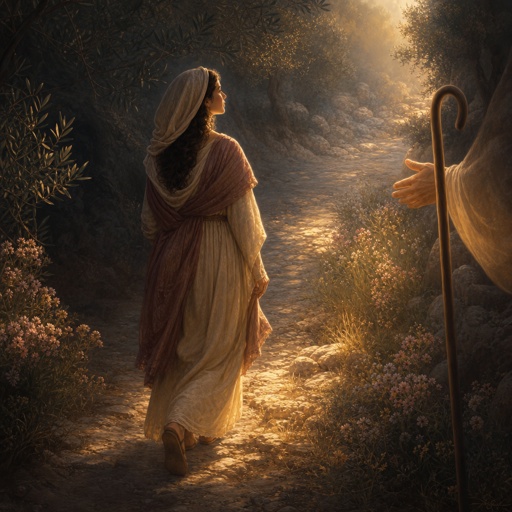
"Yea, though I walk through the valley of the shadow of death, I will fear no evil: for thou art with me; thy rod and thy staff they comfort me." - Psalms 23:4
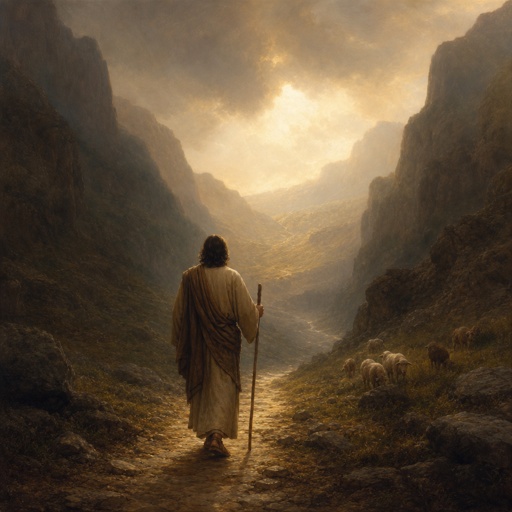
"Yea, though I walk through the valley of the shadow of death, I will fear no evil: for thou art with me; thy rod and thy staff they comfort me." - Psalms 23:4

Psalm 23:4

Psalm 23:4

Psalm 23:4

Psalms 23

"This is the LORD'S doing; it is marvellous in our eyes." - Psalms 118:23

"The LORD is my shepherd; I shall not want." - Psalms 23:1

Psalms 139:23 - "Search me, O God, and know my heart: try me, and know my thoughts:"

Psalms 114:4 - "The mountains skipped like rams, and the little hills like lambs."

"For this was a statute for Israel, and a law of the God of Jacob." - Psalms 81:4

"For there are no bands in their death: but their strength is firm." - Psalms 73:4

"Let their eyes be darkened, that they see not; and make their loins continually to shake." - Psalms 69:23

"They that go down to the sea in ships, that do business in great waters;" - Psalms 107:23

Psalms 104:4 - "Who maketh his angels spirits; his ministers a flaming fire:"

"The steps of a good man are ordered by the LORD: and he delighteth in his way." - Psalms 37:23

Psalms 118:23 - "This is the LORD'S doing; it is marvellous in our eyes."

Psalms 23:1 - "The LORD is my shepherd; I shall not want."

Psalms 63:4 - "Thus will I bless thee while I live: I will lift up my hands in thy name."

"Offer the sacrifices of righteousness, and put your trust in the LORD." - Psalms 4:5

"They wandered in the wilderness in a solitary way; they found no city to dwell in." - Psalms 107:4

"As arrows are in the hand of a mighty man; so are children of the youth." - Psalms 127:4

"He restoreth my soul: he leadeth me in the paths of righteousness for his name's sake." - Psalms 23:3

Psalms 107:23 - "They that go down to the sea in ships, that do business in great waters;"

"The mountains skipped like rams, and the little hills like lambs." - Psalms 114:4

"Man is like to vanity: his days are as a shadow that passeth away." - Psalms 144:4