What does Psalms 65:11 mean?
“Thou crownest the year with thy goodness; and thy paths drop fatness.” — Psalms 65:11
“Thou crownest the year with thy goodness; and thy paths drop fatness.” (Psalm 65:11, KJV)
In Psalm 65, David is speaking as a worshipper who looks out over the whole life of God’s people and over the whole face of the earth and sees one great truth tying everything together: the Lord is the One who hears prayer, forgives iniquity, establishes His chosen near to Himself, stills tumults like a sovereign over seas and nations, and then, with the same kingly power and care, provides for the land so that it yields abundance. Verse 11 sits inside that movement of thought. The psalm has already moved from the sanctuary—praise “in Sion,” prayer answered, sin dealt with, the blessedness of being brought near—to the wide world where God’s rule is felt “unto the ends of the earth,” and then to the fields, the rain, the rivers, and the harvest. When David says, “Thou crownest the year with thy goodness,” he is gathering the whole cycle of seasons into one completed work of God, as though the year itself were a finished story whose final and fitting adornment is the Lord’s “goodness.”
The image of a crown is not merely decoration; it is the sign of a king’s rule and the sign of honor. To say God “crownest the year” is to confess that time and seasons are under His government and that the conclusion of the year is not ultimately explained by human effort, weather patterns, or chance, but by divine bounty. In the psalm’s immediate setting, the “crown” is especially seen in harvest blessing. The year begins with need and ends with provision; it may pass through plowing, waiting, drought fears, storms, and dependence, but God brings it to a fullness that can be recognized as His kindness. The word “goodness” here is not a vague optimism; in the flow of the psalm it is God’s active beneficence—His generous dealing with His creation and His people, the same God who answers prayer and forgives also feeding the earth. The verse therefore joins spiritual mercy and material provision under one Lord: the God who removes guilt is also the God who sends fruitfulness, so that gratitude is not divided between “religious” blessings and “ordinary” life.
The second line, “and thy paths drop fatness,” deepens the picture by portraying God as moving through the land like a royal presence whose very passing leaves abundance behind. “Paths” suggests the routes of God’s providential activity—His goings forth in the world, His ordered workings through the seasons. In the verses around it, this is explained in agricultural terms: waters, showers, softened furrows, springing grain, clothed valleys, and joyful singing. When David says God’s paths “drop fatness,” he is not speaking of excess for its own sake, but of richness, fertility, and plenty—the “fatness” that in the language of Scripture commonly represents the best, the full, the well-provided portion. The symbolism is tactile: as though God’s footsteps are so laden with blessing that they spill over, leaving the earth bettered wherever He goes. It is a poetic way of saying that the abundance of harvest is not merely in the destination but along the way; God’s providence is not only an end-of-year surprise, but a steady trail of care that can be traced through the months.
Within the psalm’s wider context, this “fatness” is also a quiet rebuttal to anxiety and human boasting. The farmer may sow and labor, but cannot command rain or growth; the nation may plan and strive, but cannot guarantee peace; the worshipper may bring offerings, but cannot cleanse his own iniquity. Psalm 65 repeatedly points away from human sufficiency and toward God’s sufficiency. Verse 11, by making the year itself a recipient of God’s crowning goodness, teaches that time is not empty or self-interpreting; it is filled and interpreted by the Lord’s generosity. It invites the reader to look back over the “year” and see not merely events but a pattern of divine kindness that has brought things to ripeness—sometimes literally in fields, sometimes spiritually in the life of faith, where God matures patience, humbles pride, and teaches dependence.
There is also a worship theme woven into the imagery. A crown implies celebration, and a year crowned with goodness calls for praise. In the psalm, praise is not forced; it is the natural response when the worshipper sees that the God of the sanctuary is also the God of soil and sky. The verse therefore functions as a bridge between thanksgiving for spiritual access to God and thanksgiving for God’s sustaining care in daily life. The significance of Psalm 65:11 is that it teaches the believer to interpret prosperity, provision, and the fruitful turning of seasons as gifts that bear God’s signature. It also teaches that God’s blessings are not random drops but come along “paths”—ordered, purposeful, wise movements of providence—so that the proper response is humble gratitude, renewed trust, and praise to the Lord whose goodness can be seen crowning the whole course of the year.
Get our apps


Artwork for Psalms 65:11

Psalms 65:11

Psalms 65:11 - "Thou crownest the year with thy goodness; and thy paths drop fatness."

"Thou crownest the year with thy goodness; and thy paths drop fatness." - Psalms 65:11

"They drop upon the pastures of the wilderness: and the little hills rejoice on every side." - Psalms 65:12

"Which by his strength setteth fast the mountains; being girded with power:" - Psalms 65:6

Psalms 65:6 - "Which by his strength setteth fast the mountains; being girded with power:"

Psalms 65:12 - "They drop upon the pastures of the wilderness: and the little hills rejoice on every side."

Psalms 65:7 - "Which stilleth the noise of the seas, the noise of their waves, and the tumult of the people."

"O thou that hearest prayer, unto thee shall all flesh come." - Psalms 65:2

Psalms 65:1 - "Praise waiteth for thee, O God, in Sion: and unto thee shall the vow be performed."

Psalms 65:2 - "O thou that hearest prayer, unto thee shall all flesh come."

Psalms 119:65 - "Thou hast dealt well with thy servant, O LORD, according unto thy word."

Psalms 78:65 - "Then the Lord awaked as one out of sleep, and like a mighty man that shouteth by reason of wine."

"Iniquities prevail against me: as for our transgressions, thou shalt purge them away." - Psalms 65:3

Psalms 65:8 - "They also that dwell in the uttermost parts are afraid at thy tokens: thou makest the outgoings of the morning and evening to rejoice."

"The pastures are clothed with flocks; the valleys also are covered over with corn; they shout for joy, they also sing." - Psalms 65:13

Psalms 65:13 - "The pastures are clothed with flocks; the valleys also are covered over with corn; they shout for joy, they also sing."

"Thou crownest the year with thy goodness; and thy paths drop fatness." - Psalm 65:11
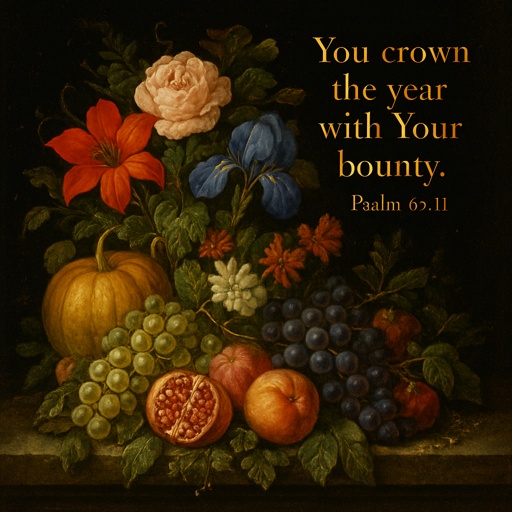
Psalms 65:11with plain dark background woth sparkles of white

"They also that dwell in the uttermost parts are afraid at thy tokens: thou makest the outgoings of the morning and evening to rejoice." - Psalms 65:8

"They also that dwell in the uttermost parts are afraid at thy tokens: thou makest the outgoings of the morning and evening to rejoice." - Psalms 65:8

Psalms 65:10 - "Thou waterest the ridges thereof abundantly: thou settlest the furrows thereof: thou makest it soft with showers: thou blessest the springing thereof."
"Which stilleth the noise of the seas, the noise of their waves, and the tumult of the people." - Psalms 65:7

"Thou waterest the ridges thereof abundantly: thou settlest the furrows thereof: thou makest it soft with showers: thou blessest the springing thereof." - Psalms 65:10

Psalms 65:5 - "By terrible things in righteousness wilt thou answer us, O God of our salvation; who art the confidence of all the ends of the earth, and of them that are afar off upon the sea:"

Psalms 65:9 - "Thou visitest the earth, and waterest it: thou greatly enrichest it with the river of God, which is full of water: thou preparest them corn, when thou hast so provided for it."

"Then the Lord awaked as one out of sleep, and like a mighty man that shouteth by reason of wine." - Psalms 78:65

Psalms 65:4 - "Blessed is the man whom thou choosest, and causest to approach unto thee, that he may dwell in thy courts: we shall be satisfied with the goodness of thy house, even of thy holy temple."
"Praise waiteth for thee, O God, in Sion: and unto thee shall the vow be performed." - Psalms 65:1
"Thou hast dealt well with thy servant, O LORD, according unto thy word." - Psalms 119:65