What does Psalms 71:22 mean?
“I will also praise thee with the psaltery, even thy truth, O my God: unto thee will I sing with the harp, O thou Holy One of Israel.” — Psalms 71:22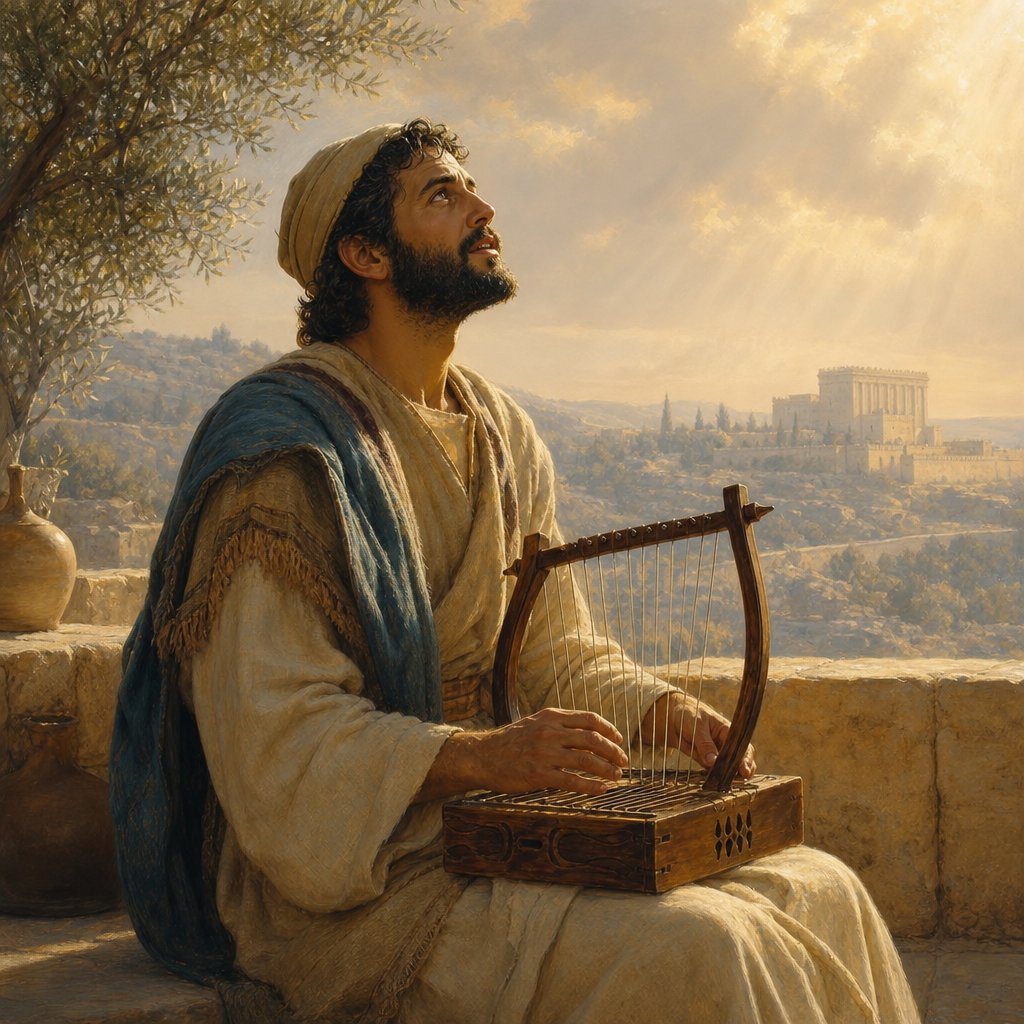
Psalm 71 is the prayer of someone who has known God for a long time and now, in later years and under pressure from enemies, is asking not only to be delivered but also to be upheld so that his life will continue to testify of God’s faithfulness. The speaker looks back over a lifetime in which the LORD has been a refuge “from my mother’s bowels” and looks forward to old age with the plea, “cast me not off in the time of old age.” That setting matters for Psalm 71:22 because the verse is not an isolated promise but the sound of a seasoned believer turning remembered mercies into public praise.
The verse reads, in the KJV: “I will also praise thee with the psaltery, even thy truth, O my God: unto thee will I sing with the harp, O thou Holy One of Israel.” It is a vow of worship that answers the preceding cries for help. The psalmist is not merely relieved that danger has passed; he is intent on responding to God in a fitting way. The language is personal and direct: “I will also praise thee,” “O my God,” “unto thee will I sing.” That repeated “thee” centers the whole action on the LORD, not on the psalmist’s survival. Deliverance becomes doxology.
Two themes stand out immediately: the truth of God and the holiness of God. When the psalmist says, “even thy truth, O my God,” he is treating God’s truth as something worthy of musical praise in itself. In the context of Psalm 71, “truth” is not an abstract idea but the LORD’s reliability—his steadfastness to what he has spoken and his consistency with his own character. The psalm has already been filled with appeals that rest on that reliability: “Deliver me in thy righteousness,” “Be thou my strong habitation,” “Thou, which hast shewed me great and sore troubles, shalt quicken me again.” When Psalm 71:22 vows praise “even thy truth,” it is as though the psalmist is saying that God’s rescue will not be interpreted as luck, strength, or timing, but as evidence that God is true, that he keeps faith with his servant, and that his promises are not empty when years have grown long and strength has grown small.
The second title, “O thou Holy One of Israel,” brings a different kind of weight to the praise. “Holy” points to God’s separateness and purity, his utter moral otherness and faithfulness to his own nature. “Of Israel” ties that holiness to God’s covenant identity, the God who has bound himself to a people and acted in history with power and judgment and mercy. In Psalm 71, the speaker’s hope is not floating in general spirituality; it is anchored in the covenant God who has acted for Israel and therefore can be trusted by this individual worshipper. Calling God “the Holy One of Israel” also adds a note of awe: praise is not casual gratitude but reverent worship offered to the One who is both near (“my God”) and exalted (“Holy One”).
The instruments themselves carry symbolic and contextual significance. “Psaltery” and “harp” are not random musical details; they evoke the formal worship language of Israel’s praise, the kind of music associated with the sanctuary, with ordered thanksgiving, and with publicly declaring God’s works. By promising to praise with instruments, the psalmist signals that his gratitude will not remain private. The psalm has already leaned toward public testimony—“My mouth shall shew forth thy righteousness and thy salvation all the day”—and now the vow of instrumental praise envisions worship that can be heard. This is not only emotional relief but a deliberate offering. The instruments symbolize the gathering up of one’s whole capacity—skill, breath, voice, time—into a response shaped for God.
There is also a movement in the verse from accompaniment to direct singing: “I will also praise thee with the psaltery… unto thee will I sing with the harp.” The shift underscores that the center is not the tool but the act of honoring God. Music becomes a vehicle for proclaiming “thy truth,” and the goal is communion directed “unto thee.” The psalmist is promising that the story of deliverance will be transfigured into worship, that the rescue will become song, and that the song will confess who God is.
In the broader flow of Psalm 71, Psalm 71:22 stands as part of a rising conclusion. The psalm moves through pleas for deliverance and protection into confidence, then into commitment: “But I will hope continually, and will yet praise thee more and more.” Verse 22 belongs to that “more and more,” showing what increased praise looks like—more deliberate, more expressive, more focused on God’s character. It prepares for the next verses’ emphasis on rejoicing and on telling of God’s righteousness “all the day long.” The enemies who “seek my soul” are not allowed to define the final sound of the psalm. The final sound is worship.
So the significance of Psalm 71:22 is that it presents praise as the proper end of God’s saving work and the proper posture of a believer who has walked with God through many years. It teaches that deliverance should lead to testimony, that God’s “truth” is not merely to be believed but to be celebrated, and that the One who helps in old age is the same “Holy One of Israel” who has always been faithful. The verse turns personal rescue into covenant worship and makes clear that the believer’s response to God’s faithfulness is not silence but song.
Get our apps


Artwork for Psalms 71:22
"I will also praise thee with the psaltery, even thy truth, O my God: unto thee will I sing with the harp, O thou Holy One of Israel." - Psalms 71:22

Psalms 71:22 - "I will also praise thee with the psaltery, even thy truth, O my God: unto thee will I sing with the harp, O thou Holy One of Israel."

"I will also praise thee with the psaltery, even thy truth, O my God: unto thee will I sing with the harp, O thou Holy One of Israel." - Psalms 71:22
"I will also praise thee with the psaltery, even thy truth, O my God: unto thee will I sing with the harp, O thou Holy One of Israel." - Psalms 71:22

Psalms 71:14 - "But I will hope continually, and will yet praise thee more and more."

Psalms 71:21 - "Thou shalt increase my greatness, and comfort me on every side."

Psalms 71:8 - "Let my mouth be filled with thy praise and with thy honour all the day."

Psalms 71:7 - "I am as a wonder unto many; but thou art my strong refuge."

Psalms 71:11 - "Saying, God hath forsaken him: persecute and take him; for there is none to deliver him."

Psalms 119:71 - "It is good for me that I have been afflicted; that I might learn thy statutes."

Psalms 71:9 - "Cast me not off in the time of old age; forsake me not when my strength faileth."

Psalms 71:12 - "O God, be not far from me: O my God, make haste for my help."

Psalms 71:10 - "For mine enemies speak against me; and they that lay wait for my soul take counsel together,"

Psalms 71:1 - "In thee, O LORD, do I put my trust: let me never be put to confusion."

"O God, be not far from me: O my God, make haste for my help." - Psalms 71:12

Psalms 71:16 - "I will go in the strength of the Lord GOD: I will make mention of thy righteousness, even of thine only."

Psalms 71:4 - "Deliver me, O my God, out of the hand of the wicked, out of the hand of the unrighteous and cruel man."

Psalms 71:5 - "For thou art my hope, O Lord GOD: thou art my trust from my youth."

Psalms 71:2 - "Deliver me in thy righteousness, and cause me to escape: incline thine ear unto me, and save me."

Psalms 71:13 - "Let them be confounded and consumed that are adversaries to my soul; let them be covered with reproach and dishonour that seek my hurt."

Psalms 78:71 - "From following the ewes great with young he brought him to feed Jacob his people, and Israel his inheritance."

"Deliver me, O my God, out of the hand of the wicked, out of the hand of the unrighteous and cruel man." - Psalms 71:4

Psalms 71:15 - "My mouth shall shew forth thy righteousness and thy salvation all the day; for I know not the numbers thereof."

Psalms 71:17 - "O God, thou hast taught me from my youth: and hitherto have I declared thy wondrous works."

Psalms 71:23 - "My lips shall greatly rejoice when I sing unto thee; and my soul, which thou hast redeemed."

Psalms 71:24 - "My tongue also shall talk of thy righteousness all the day long: for they are confounded, for they are brought unto shame, that seek my hurt."

"But I will hope continually, and will yet praise thee more and more." - Psalms 71:14

"Deliver me in thy righteousness, and cause me to escape: incline thine ear unto me, and save me." - Psalms 71:2

Psalms 71:19 - "Thy righteousness also, O God, is very high, who hast done great things: O God, who is like unto thee!"

"But I will hope continually, and will yet praise thee more and more." - Psalms 71:14