What does Psalms 89:1 mean?
"I will sing of the mercies of the LORD for ever: with my mouth will I make known thy faithfulness to all generations." - Psalms 89:1

“Psalms 89:1” in the King James Version reads, “I will sing of the mercies of the LORD for ever: with my mouth will I make known thy faithfulness to all generations.”
In its plain sense, the verse is a vow of worship expressed in two closely linked actions. First, the speaker resolves to “sing” of the LORD’s “mercies” without end. Second, he commits to “make known” God’s “faithfulness” broadly and publicly, so that what God is like will not be kept private or forgotten but will be carried forward “to all generations.” The verse is not simply describing a feeling; it is a deliberate decision to respond to God’s character with praise and testimony.
The themes embedded in the language are covenant themes. “Mercies” in the KJV often points to God’s steadfast lovingkindness—his gracious, undeserved favor shown to his people, especially in the way he keeps covenant promises. “Faithfulness” speaks to God’s reliability, that he does not change, fail, or prove false, even when circumstances are confusing or dark. Taken together, these two words express a foundational biblical confession: God is good toward his people, and God is true to his word. The verse therefore opens on the note of assurance, anchoring praise not in the speaker’s changing circumstances but in the LORD’s unchanging nature.
The context of Psalm 89 heightens the significance of that opening resolve. Psalm 89 is a psalm that celebrates God’s covenant with David and God’s promise concerning David’s throne, and it later wrestles honestly with distress that seems to contradict those promises. The psalm moves from exaltation of God’s character and his pledged word to lament and complaint over apparent rejection and ruin. Against that backdrop, verse 1 functions like a chosen starting point for the whole prayer: before the psalmist processes the painful tension between promise and present experience, he begins by fixing his gaze on who God has revealed himself to be. In that sense, the verse is a theological orientation. It teaches that biblical lament does not begin with despair, but with remembered mercy and affirmed faithfulness.
The symbolism of “singing” and “with my mouth” is important. Singing in Scripture is not merely artistic expression; it is a form of worship and a way of preserving truth in the community. To sing of the LORD’s mercies “for ever” suggests enduring praise that outlasts the moment. It can imply not only lifelong devotion but also the perpetuation of worship in the congregation, where songs are repeated and taught. “With my mouth will I make known” emphasizes spoken witness—truth declared aloud, not hidden in the heart alone. The mouth is the outward instrument of inward conviction; what God has done and who God is are to be confessed, taught, and remembered in public life. The psalmist is taking on a role like that of a herald, ensuring that God’s faithfulness is not lost to forgetfulness.
The phrase “to all generations” expands the horizon from the individual to the communal and from the present to the future. It assumes that faith is meant to be transmitted: parents to children, elders to youth, one era to the next. This is especially meaningful in a psalm concerned with God’s covenant dealings in history. God’s faithfulness is not merely a private comfort; it is a historical reality that the people of God are responsible to recount. In this way, Psalm 89:1 echoes a broader biblical pattern in which remembering and declaring God’s acts safeguards the community from spiritual amnesia and sustains hope when current events feel threatening.
The verse also sets up a contrast that runs through the psalm: human instability versus divine constancy. A singer’s voice can weaken, generations pass and die, kingdoms rise and fall; yet the psalmist speaks of mercies “for ever” and faithfulness that reaches every generation. The implicit message is that the ground for praise is not the permanence of human arrangements but the permanence of the LORD’s character. Even before the psalm confronts questions and sorrow later on, it establishes the interpretive key: whatever is happening, God’s mercy and faithfulness remain the truest facts.
In sum, Psalm 89:1 is a doorway into the psalm’s larger meditation on covenant, memory, and hope. It is the psalmist’s choice to respond to God’s revealed character with enduring worship and public testimony, and it calls the reader to see praise as both proclamation and inheritance—truth sung and spoken so that the knowledge of the LORD’s mercies and faithfulness will not end with one life, but will be carried “to all generations.”
Have questions about Psalms 89:1?
Dive deeper into this scripture with Bible Chat — an AI-powered tool for exploring God's Word through conversation. Ask questions, get context, and grow in your understanding of the Bible.
Get Our Apps


Psalms 89:1 Artwork
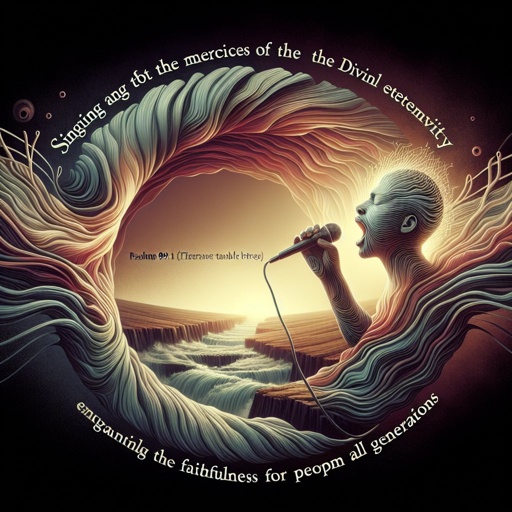
Psalms 89:1 - "I will sing of the mercies of the LORD for ever: with my mouth will I make known thy faithfulness to all generations."
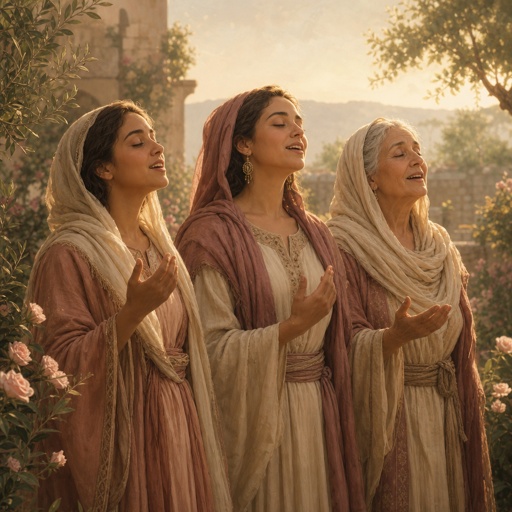
"I will sing of the mercies of the LORD for ever: with my mouth will I make known thy faithfulness to all generations." - Psalms 89:1

"I will sing of the mercies of the LORD for ever: with my mouth will I make known thy faithfulness to all generations." - Psalms 89:1

Psalms 89:41 - "All that pass by the way spoil him: he is a reproach to his neighbours."

"Blessed be the LORD for evermore. Amen, and Amen." - Psalms 89:52

Psalms 89:15 - "Blessed is the people that know the joyful sound: they shall walk, O LORD, in the light of thy countenance."

"For ever, O LORD, thy word is settled in heaven." - Psalms 119:89

Psalm 119:89-96

Psalm 119:89-96

Psalms 89:52 - "Blessed be the LORD for evermore. Amen, and Amen."

Psalms 89:31 - "If they break my statutes, and keep not my commandments;"

Psalms 89:32 - "Then will I visit their transgression with the rod, and their iniquity with stripes."

Psalms 119:89 - "For ever, O LORD, thy word is settled in heaven."

Psalms 89:18 - "For the LORD is our defence; and the Holy One of Israel is our king."

Psalms 89:30 - "If his children forsake my law, and walk not in my judgments;"

Psalms 89:37 - "It shall be established for ever as the moon, and as a faithful witness in heaven. Selah."

"Also I will make him my firstborn, higher than the kings of the earth." - Psalms 89:27

Psalms 89:27 - "Also I will make him my firstborn, higher than the kings of the earth."

Psalms 89:35 - "Once have I sworn by my holiness that I will not lie unto David."

Psalms 89:36 - "His seed shall endure for ever, and his throne as the sun before me."

Psalms 89:16 - "In thy name shall they rejoice all the day: and in thy righteousness shall they be exalted."

Psalms 89:25 - "I will set his hand also in the sea, and his right hand in the rivers."

Psalms 89:17 - "For thou art the glory of their strength: and in thy favour our horn shall be exalted."

Psalms 89:22 - "The enemy shall not exact upon him; nor the son of wickedness afflict him."

Psalms 89:34 - "My covenant will I not break, nor alter the thing that is gone out of my lips."

Psalms 89:21 - "With whom my hand shall be established: mine arm also shall strengthen him."

Psalms 89:29 - "His seed also will I make to endure for ever, and his throne as the days of heaven."

Psalms 89:13 - "Thou hast a mighty arm: strong is thy hand, and high is thy right hand."

Psalms 89:7 - "God is greatly to be feared in the assembly of the saints, and to be had in reverence of all them that are about him."

Psalms 89:9 - "Thou rulest the raging of the sea: when the waves thereof arise, thou stillest them."