What does Romans 12:13 mean?
“Distributing to the necessity of saints; given to hospitality.” — Romans 12:13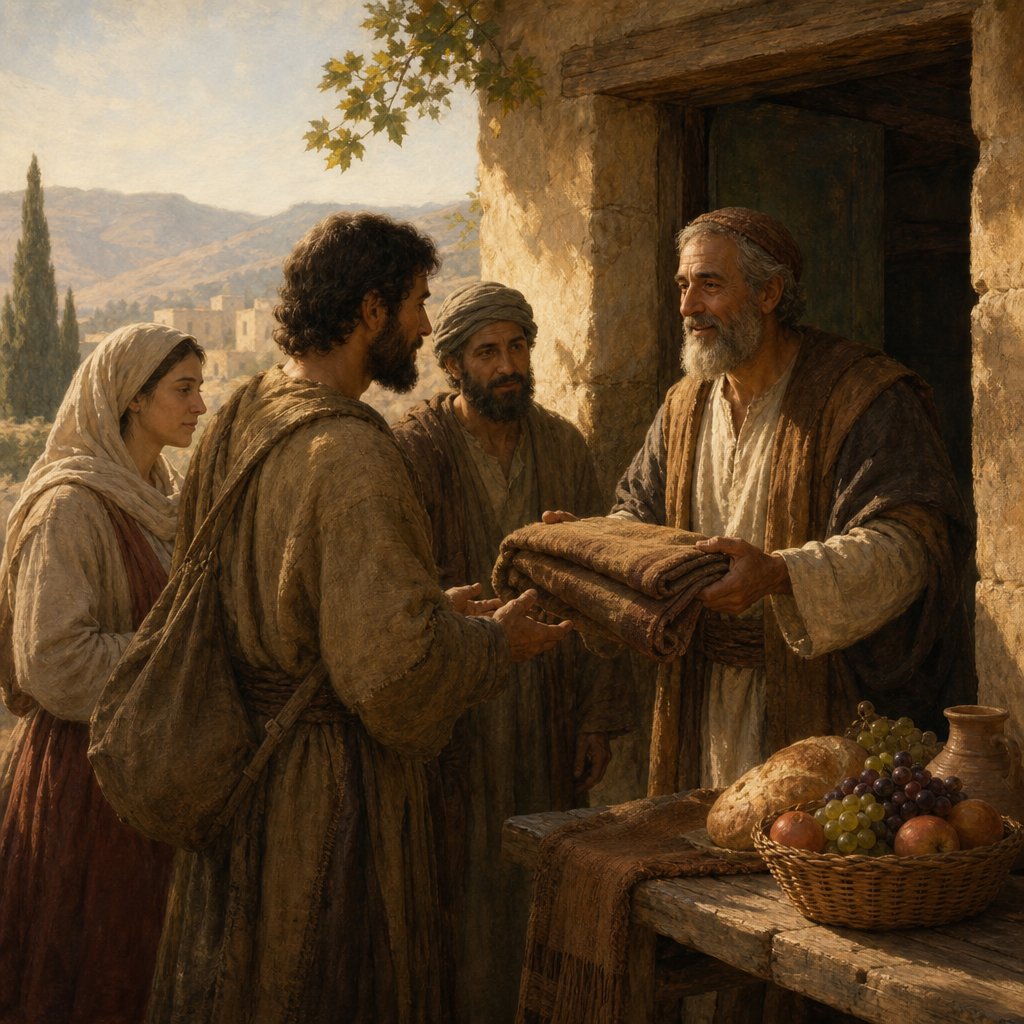
Romans 12:13 in the King James Version reads, “Distributing to the necessity of saints; given to hospitality.”
In its immediate context, this sentence belongs to a stretch of Romans where Paul turns from explaining the gospel’s doctrines to describing the gospel’s lived shape. After urging believers to present their bodies “a living sacrifice” and to be “not conformed to this world” but “transformed,” Paul begins to describe the renewed mind in motion: sincere love, humble service, patience in tribulation, perseverance in prayer, peaceable conduct, and practical mercy. Romans 12:13 is one of those compact, concrete commands that shows what spiritual renewal looks like when it touches money, homes, schedules, and attention. It is not a call to vague benevolence, but to embodied care.
“Distributing to the necessity of saints” joins two ideas that, taken together, define Christian giving as both purposeful and personal. “Distributing” implies more than feeling compassion; it implies sharing what one has so that another’s lack is relieved. The word choice carries the sense of a deliberate parting with goods, not simply offering advice or sympathy. The phrase “to the necessity” focuses the giving on real needs rather than on display or self-indulgence. Paul’s concern is not primarily the funding of religious projects, but the meeting of necessities—those pressures of life where lack becomes a burden: hunger, poverty, displacement, vulnerability, and the ordinary crises that afflict the faithful in a hostile world. “Of saints” identifies the immediate household of concern as God’s people, those set apart in Christ. In Romans, “saints” does not mean a special class of spiritual heroes; it is the ordinary identity of believers who belong to Christ. The command therefore assumes the church is a family with shared obligations, where the suffering or shortage of one member becomes a matter for the whole body. The significance here is communal: faith is not merely private assent but covenantal solidarity. When necessities arise among the saints, those with supply are to become channels through which God’s care reaches His people.
Yet the verse does not end at the boundary of the church’s internal needs; it moves outward in spirit and practice: “given to hospitality.” This phrase suggests an active pursuit rather than a passive openness. Hospitality is not merely entertaining friends; in biblical thought it is the welcoming of others—often strangers, travelers, the displaced, the vulnerable—into one’s space and protection. The home becomes a place of refuge, and the table becomes a place of fellowship. In a first-century setting, this carried heightened weight. Travel was common, inns were unreliable or immoral, persecution could scatter believers, and the early church met in homes. Hospitality, then, was not peripheral; it was part of the church’s infrastructure and a direct expression of love. To be “given” to it indicates a readiness of heart, a habit, even a kind of devoted energy toward receiving others. The command presses beyond financial sharing into relational sharing: not only giving resources, but giving presence, time, dignity, and belonging.
Taken together, the two clauses form a unified picture of Christian charity that is both material and relational, both practical and personal. “Distributing” addresses what you possess; “hospitality” addresses what you control—your space, your privacy, your routine. One meets need by transferring goods; the other meets need by extending welcome. One combats scarcity; the other combats isolation. In this way, Romans 12:13 portrays love as tangible and costly, not sentimental. It also quietly challenges the tendency to separate spirituality from everyday life. The verse assumes that a renewed mind produces a renewed household economy: generosity with possessions and generosity with access.
There is also symbolism in the movement from “necessity” to “hospitality.” Necessity represents the pressures of a fallen world—lack, suffering, instability. Hospitality represents the creation of a small foretaste of God’s kingdom within that world: a space where care displaces fear, where provision answers lack, where strangers become brethren. The open hand and the open door become living parables of grace. Just as God in Christ has received believers who were once estranged, so believers are to receive others. Just as God supplies what His people cannot supply for themselves, so they are to supply one another in times of need. The verse does not explicitly state that theological rationale, but it stands inside a chapter shaped by the mercies of God, implying that mercy received becomes mercy practiced.
The significance of Romans 12:13, then, is that it defines Christian maturity in ordinary acts that can be measured: sharing with saints when needs arise and actively practicing hospitality. It locates the holiness of the “saints” not only in worship and confession, but in kitchens, guest rooms, wallets, and schedules. It calls the church to be a community where no one’s necessity is ignored and no one is left outside the circle of welcome.
Get our apps


Artwork for Romans 12:13

Romans 12:13 - "Distributing to the necessity of saints; given to hospitality."

"Distributing to the necessity of saints; given to hospitality." - Romans 12:13
"Distributing to the necessity of saints; given to hospitality." - Romans 12:13

romans 12:1-2

Romans 12:1-2

"The night is far spent, the day is at hand: let us therefore cast off the works of darkness, and let us put on the armour of light." - Romans 13:12

Romans 13:12 - "The night is far spent, the day is at hand: let us therefore cast off the works of darkness, and let us put on the armour of light."

"The night is far spent, the day is at hand: let us therefore cast off the works of darkness, and let us put on the armour of light." - Romans 13:12

"The night is far spent, the day is at hand: let us therefore cast off the works of darkness, and let us put on the armour of light." - Romans 13:12

Romans 12:2

Romans 12:2

Romans 12:2

Romans 12:2

Romans 12:2

Romans 12:2

Romans 12:2

Romans 12:2

Romans 12:2

Romans 12:2

Romans 12:2

Romans 12:2

Romans 12:2

Romans 12:2

Romans 12:2

Romans 13:8

Romans 13:8

Romans 12:2

Romans 12:2

Romans 14:12

Romans 12:1