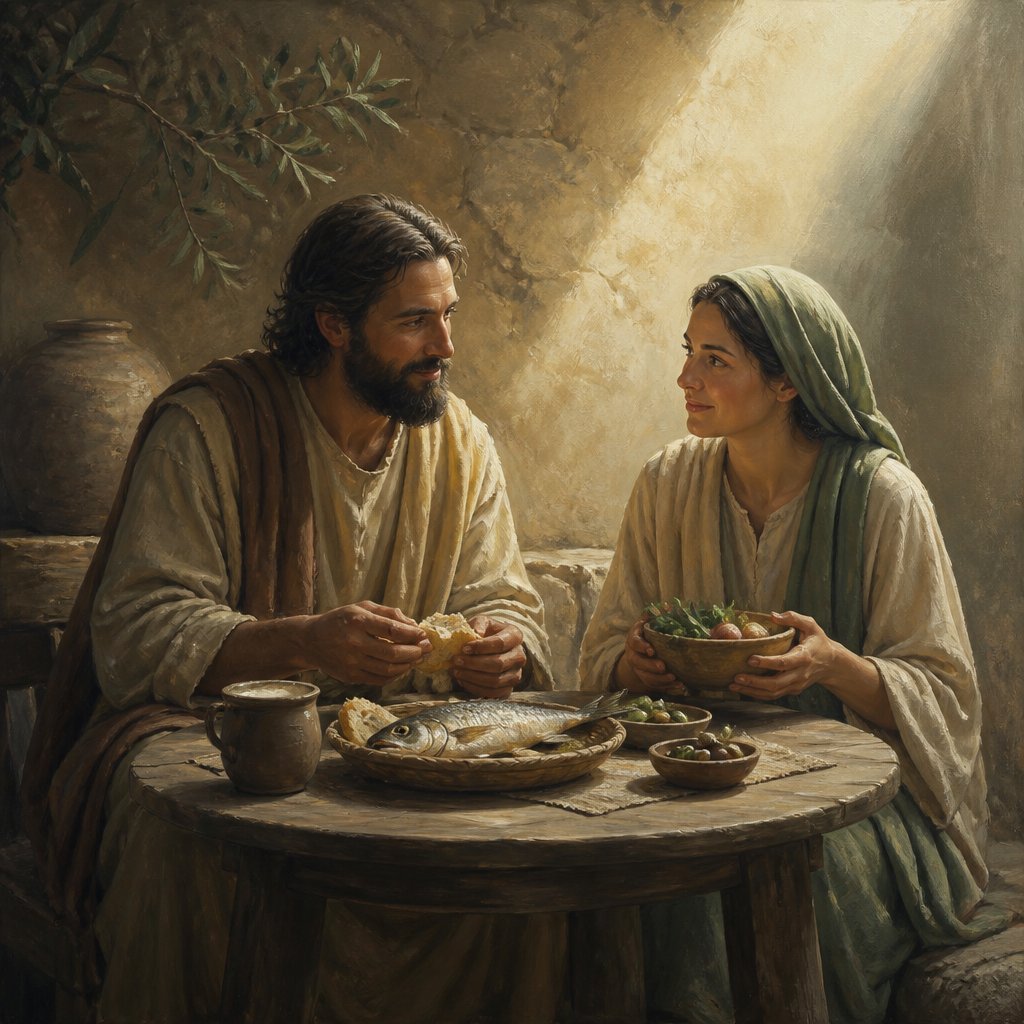
Romans 14:1-5 in the King James Version of the Bible reads, "Him that is weak in the faith receive ye, but not to doubtful disputations. For one believeth that he may eat all things: another, who is weak, eateth herbs. Let not him that eateth despise him that eateth not; and let not him which eateth not judge him that eateth: for God hath received him. Who art thou that judgest another man's servant? to his own master he standeth or falleth. Yea, he shall be holden up: for God is able to make him stand. One man esteemeth one day above another: another esteemeth every day alike. Let every man be fully persuaded in his own mind."
In these verses, the apostle Paul is addressing the Roman church, which was comprised of both Jewish and Gentile believers. He is addressing the issue of differing opinions and practices within the church, particularly in regards to food and observance of religious days. In this passage, Paul is promoting unity and tolerance within the body of believers, regardless of differing beliefs and practices.
The overarching theme of Romans 14:1-5 is the importance of unity and the acceptance of differing beliefs within the body of Christ. Paul urges believers to receive those who are "weak in the faith" without getting into debates or arguments over disputable matters. The "weak" believers in this context are likely those who were new to the faith or who were still struggling with legalistic tendencies inherited from their Jewish background. Paul is instructing the stronger believers not to look down on those who may have different convictions, but to receive them with love and grace.
The specific issue Paul addresses in these verses is the matter of eating certain foods. In the Jewish culture, there were dietary laws and restrictions that were considered important for maintaining purity and holiness. However, with the Gentile believers now joining the church, there were differing opinions on whether these dietary laws should still apply. Paul's message in this passage is to not be divisive over these matters, but to accept and love one another despite these differences.
The symbolism in these verses lies in the broader idea of what it means to live in Christian community. Paul is using the example of differing opinions on food and religious observance to address a much larger issue - the unity of believers in Christ. The imagery of "doubtful disputations" suggests unnecessary divisions and arguments that can arise over secondary issues within the church. Paul is calling believers to prioritize the fundamentals of the faith and to avoid getting bogged down in non-essential matters.
The context of these verses is important to understand the broader message of the book of Romans. Paul's letter to the Romans is a comprehensive explanation of the gospel and its implications for both Jews and Gentiles. He spends the first eleven chapters outlining the doctrines of salvation, grace, and God's covenant with Israel. In chapters 12-16, Paul shifts to practical instruction for Christian living and unity within the church. This context is crucial for understanding the weight of Paul's words in Romans 14:1-5.
Through this passage, believers are reminded of their need to set aside personal convictions and preferences for the sake of unity and love. The emphasis is placed on respecting and honoring one another, even in areas where there may be disagreement. Paul reminds the church that each person is accountable to God alone for their beliefs and actions, and that all members of the body should be fully persuaded in their own minds. This means that while individuals may hold to differing convictions, they should do so with a clear conscience, without judgment or condemnation towards others.
In summary, Romans 14:1-5 is a call to unity and humility within the body of believers. Paul urges the church to accept one another despite differing opinions and convictions. The message of this passage is timeless and relevant for the church today, as it challenges believers to prioritize love and unity over non-essential matters. The symbolism of these verses extends beyond the specific issue of food and religious observance, serving as a reminder of the importance of mutual acceptance and respect within the diverse body of Christ.
Get our apps


Artwork for Romans 14:1-5

Romans 14:1-5 - "Accept the one whose faith is weak, without quarreling over disputable matters. One person’s faith allows them to eat anything, but another, whose faith is weak, eats only vegetables. The one who eats everything must not treat with contempt the one who does not, and the one who does not eat everything must not judge the one who does, for God has accepted them. Who are you to judge someone else’s servant? To their own master, servants stand or fall. And they will stand, for the Lord is able to make them stand. One person considers one day more sacred than another; another considers every day alike. Each of them should be fully convinced in their own mind."
"Accept the one whose faith is weak, without quarreling over disputable matters. One person’s faith allows them to eat anything, but another, whose faith is weak, eats only vegetables. The one who eats everything must not treat with contempt the one who does not, and the one who does not eat everything must not judge the one who does, for God has accepted them. Who are you to judge someone else’s servant? To their own master, servants stand or fall. And they will stand, for the Lord is able to make them stand. One person considers one day more sacred than another; another considers every day alike. Each of them should be fully convinced in their own mind." - Romans 14:1-5

Loving Beyond Our Differences; Romans 14:1-12

Romans 5:1

Together in Christ: Loving Beyond Our Differences; Romans 14:1-12

Together in Christ: Loving Beyond Our Differences; Romans 14:1-12

Together in Christ: Loving Beyond Our Differences; Romans 14:1-12

Romans 14:1 - "Him that is weak in the faith receive ye, but not to doubtful disputations."

Romans 5: 1-11

Romans 5: 1-11

Romans 1:14 - "I am debtor both to the Greeks, and to the Barbarians; both to the wise, and to the unwise."

"Him that is weak in the faith receive ye, but not to doubtful disputations." - Romans 14:1

Romans 5:14 - "Nevertheless death reigned from Adam to Moses, even over them that had not sinned after the similitude of Adam's transgression, who is the figure of him that was to come."

Romans 14:5 - "One man esteemeth one day above another: another esteemeth every day alike. Let every man be fully persuaded in his own mind."

Romans 5:1 - "Therefore being justified by faith, we have peace with God through our Lord Jesus Christ:"

Romans 1:5 - "By whom we have received grace and apostleship, for obedience to the faith among all nations, for his name:"

Matthew 5:14

Matthew 5:14

Romans 14:12

Romans 8:14

Romans 10:14

1 Chronicles 14:5 - "And Ibhar, and Elishua, and Elpalet,"

Romans 5:19

Romans 5:8

Romans 5:8

Romans 5:8

Romans 5:19

"I am debtor both to the Greeks, and to the Barbarians; both to the wise, and to the unwise." - Romans 1:14

"Therefore being justified by faith, we have peace with God through our Lord Jesus Christ:" - Romans 5:1

Romans 3:14 - "Whose mouth is full of cursing and bitterness:"