What does Romans 14:19 mean?
“Let us therefore follow after the things which make for peace, and things wherewith one may edify another.” — Romans 14:19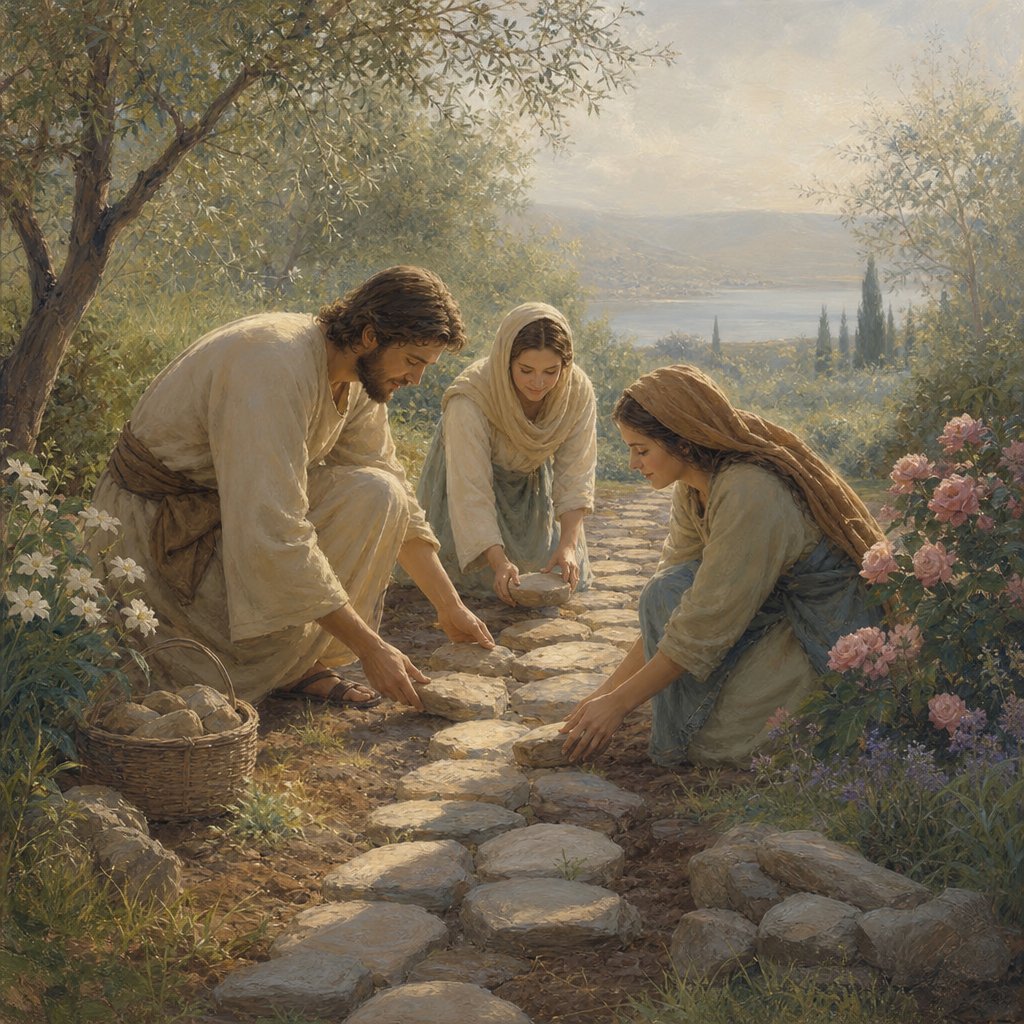
“Let us therefore follow after the things which make for peace, and things wherewith one may edify another.” (Romans 14:19, KJV)
In Romans 14:19 Paul gathers the whole argument of the chapter into a single, practical aim: in the fellowship of believers, the controlling pursuit is not the winning of disputes but the chasing down of peace and the deliberate building up of one another. The verse begins with “Let us therefore,” which points back to everything just said. In the immediate context Paul has been addressing tensions between brethren over “doubtful disputations” (Romans 14:1, KJV), matters like “meat” and “drink” and the esteem of certain “days” (Romans 14:2, 5, KJV). These were real points of conscience for different believers, yet Paul insists that such issues must not become occasions for despising, judging, or wounding a brother for whom Christ died (Romans 14:3–4, 10–15, KJV). Because all believers stand before God’s judgment seat and must give account of themselves to God (Romans 14:10–12, KJV), they are forbidden to take God’s seat by condemning one another over secondary matters. That is the “therefore” that drives Romans 14:19: since God alone is Judge, and since Christ has received His people, believers must choose a different aim than self-assertion—peace and edification.
The verb “follow after” is strong language. It does not mean a casual preference for harmony; it means to pursue, to chase, to make it an active goal. Paul is not describing peace as something that merely happens when everyone finally agrees; he presents it as something believers must seek even when they do not agree. The verse’s first theme is thus the intentional pursuit of “the things which make for peace.” In the chapter Paul has already defined what destroys peace: putting a “stumblingblock or an occasion to fall” in a brother’s way (Romans 14:13, KJV), grieving him with one’s liberty (Romans 14:15, KJV), allowing one’s “good” to be “evil spoken of” (Romans 14:16, KJV), and turning the kingdom of God into a battlefield over “meat and drink” (Romans 14:17, KJV). Peace, then, is not mere quietness or the absence of argument. It is the spiritual and relational condition in which brethren can walk together without being tripped, provoked, shamed, or pushed to violate conscience. It is peace that protects a brother’s walk and conscience, peace that makes room for difference without contempt, peace that values a person above a preference.
At the same time, Paul’s peace is not peace at any price, as though truth or holiness are negotiable. Just before verse 19 he locates the center of Christian life not in ceremonial or dietary freedoms but in what God’s reign produces: “For the kingdom of God is not meat and drink; but righteousness, and peace, and joy in the Holy Ghost.” (Romans 14:17, KJV). Peace belongs with righteousness and joy in the Holy Ghost; it is a fruit of living under God’s rule, not a compromise with sin. Paul is teaching that in the realm of “meat and drink” believers must refuse to make the lesser thing ultimate, because the kingdom reality is deeper than the controversies that often preoccupy the church.
The second theme is “edify another.” To “edify” is to build up, as a house is built. That image is not stated outright in the verse, but the word carries the sense of constructive strengthening rather than destructive tearing down. In the context, edification has a particular shape: it means acting in love so that a brother is not “destroyed” by another’s use of liberty (Romans 14:15, KJV), and it means conducting oneself so that one’s liberty does not become a stumblingblock. Where peace addresses the relational climate between brethren, edification addresses the spiritual outcome within them. Paul is not satisfied that believers merely avoid open conflict; he calls them to choose words, actions, and freedoms in ways that leave others stronger in faith, clearer in conscience, and more able to serve God without fear or confusion.
The symbolism and moral force of the verse come into sharper focus when placed beside Paul’s warnings in the same passage. He has said, “It is good neither to eat flesh, nor to drink wine, nor any thing whereby thy brother stumbleth, or is offended, or is made weak.” (Romans 14:21, KJV). That is the kind of “thing” that makes for peace and edification: sometimes it is the restraint of a right for the sake of love. Paul is not abolishing liberty; he is ordering it. In Romans 14, liberty is real—“I know, and am persuaded by the Lord Jesus, that there is nothing unclean of itself” (Romans 14:14, KJV)—but love governs liberty, because the church is not a collection of isolated individuals but a body in which the strong can harm the weak, and in which the weak can be pressured into acting “not of faith” (Romans 14:23, KJV). Edification, therefore, includes protecting another person from being pulled into sin against conscience, for “whatsoever is not of faith is sin” (Romans 14:23, KJV). The pursuit of peace and edification is, in that sense, a pursuit of spiritual safety for one another.
Romans 14:19 also carries the theme of humility under God. Earlier Paul says, “Who art thou that judgest another man’s servant? to his own master he standeth or falleth.” (Romans 14:4, KJV). The push toward peace and edification is rooted in recognizing that each believer belongs to the Lord. Because each one “liveth to the Lord” and “dieth to the Lord” (Romans 14:8, KJV), and because Christ is Lord “both of the dead and living” (Romans 14:9, KJV), believers must treat one another as the Lord’s possession, not as opponents to be conquered. Peace is the social expression of that humility; edification is the active expression of that care.
The significance of Romans 14:19, then, is that it gives the church a clear test for conduct in disputable matters. The question is not merely, Is it permitted? or, Can I defend my position? but, Does this “make for peace”? Does this “edify another”? Paul’s “therefore” turns doctrine into a path: because God judges, because Christ died and rose, because the kingdom is righteousness and peace and joy in the Holy Ghost, believers are to chase what heals rather than what harms, and to build rather than to break. The verse stands as a call to a community shaped by love, where consciences are treated with tenderness, where freedom is practiced with wisdom, and where the goal is not triumph in argument but the strengthening of the people of God.
Get our apps


Artwork for Romans 14:19

Romans 14:19 - "Let us therefore follow after the things which make for peace, and things wherewith one may edify another."
"Let us therefore follow after the things which make for peace, and things wherewith one may edify another." - Romans 14:19

Romans 7:19

Romans 5:19

Romans 8:19

Romans 8:19

Romans 5:19

Romans 14:12

Romans 8:14

Romans 10:14

Romans 14:16 - "Let not then your good be evil spoken of:"

Romans 3:14 - "Whose mouth is full of cursing and bitterness:"

Romans 8:19 - "For the earnest expectation of the creature waiteth for the manifestation of the sons of God."

Romans 8:14 - "For as many as are led by the Spirit of God, they are the sons of God."

Romans 14:7 - "For none of us liveth to himself, and no man dieth to himself."

depict the theme of Romans 13:8-14

Romans 14:1 - "Him that is weak in the faith receive ye, but not to doubtful disputations."

Romans 12:14 - "Bless them which persecute you: bless, and curse not."

Romans 11:19 - "Thou wilt say then, The branches were broken off, that I might be graffed in."

Romans 9:14 - "What shall we say then? Is there unrighteousness with God? God forbid."

Romans 14:18 - "For he that in these things serveth Christ is acceptable to God, and approved of men."

Romans 14:14 - "I know, and am persuaded by the Lord Jesus, that there is nothing unclean of itself: but to him that esteemeth any thing to be unclean, to him it is unclean."

Romans 2:19 - "And art confident that thou thyself art a guide of the blind, a light of them which are in darkness,"

Romans 7:19 - "For the good that I would I do not: but the evil which I would not, that I do."

Romans 14:12 - "So then every one of us shall give account of himself to God."

Romans 1:14 - "I am debtor both to the Greeks, and to the Barbarians; both to the wise, and to the unwise."

Romans 16:14 - "Salute Asyncritus, Phlegon, Hermas, Patrobas, Hermes, and the brethren which are with them."

Romans 14:17 - "For the kingdom of God is not meat and drink; but righteousness, and peace, and joy in the Holy Ghost."

Romans 1:19 - "Because that which may be known of God is manifest in them; for God hath shewed it unto them."

Romans 7:14 - "For we know that the law is spiritual: but I am carnal, sold under sin."