What does Romans 2:21 mean?
"Thou therefore which teachest another, teachest thou not thyself? thou that preachest a man should not steal, dost thou steal?" - Romans 2:21

Romans 2:21 in the King James Version of the Bible reads: "Thou therefore which teachest another, teachest thou not thyself? thou that preachest a man should not steal, dost thou steal?"
This verse is part of an extended passage in the book of Romans where the apostle Paul addresses the issue of hypocrisy. In this particular verse, Paul is pointing out the hypocrisy of those who claim to be teachers and preachers of the law, yet fail to live up to the standards they espouse.
The preceding verses in this chapter reveal that Paul is speaking to the Jews in Rome, who prided themselves on having the law of God and considered themselves as guides to the blind, instructors of the foolish, and teachers of babes (Romans 2:17-20). However, Paul challenges this superiority complex by pointing out that they do not practice what they preach.
This verse speaks to a universal truth that is as relevant today as it was in Paul's time. It reminds us that actions speak louder than words and that living a life of integrity is essential in teaching and preaching the principles of God. It is a call to self-examination and to live consistently with the beliefs we hold and the truths we teach.
The theme of hypocrisy is central to this verse. Hypocrisy is the practice of claiming to have moral standards or beliefs to which one's own behavior does not conform. In this case, the Jews were quick to point out the faults and transgressions of others, but failed to acknowledge their own shortcomings. This passage challenges all believers to examine their own lives and ensure that they practice what they preach.
The context of this verse is also significant. The Jews in Rome prided themselves on being the chosen people of God and custodians of the law. However, Paul's message to them is one of humility and self-examination. It serves as a reminder to all believers that we are all accountable to God, regardless of our heritage or religious upbringing. We must all strive to live in accordance with the principles of God, not just speak about them.
The symbolism in this verse lies in the contrast between teaching and practicing. The image of a teacher instructing others while neglecting to teach themselves is a powerful one. It highlights the discrepancy between outward appearance and inner reality. It serves as a cautionary tale for all believers, reminding them that it is not enough to simply know and talk about the truth; it must be internalized and reflected in our daily lives.
In summary, Romans 2:21 in the King James Version of the Bible addresses the issue of hypocrisy and challenges believers to live in accordance with the principles they proclaim. It serves as a reminder that integrity and self-examination are essential in teaching and preaching the truths of God. The verse is relevant in any context and serves as a timeless call to live with authenticity and integrity.
Have questions about Romans 2:21?
Dive deeper into this scripture with Bible Chat — an AI-powered tool for exploring God's Word through conversation. Ask questions, get context, and grow in your understanding of the Bible.
Get Our Apps


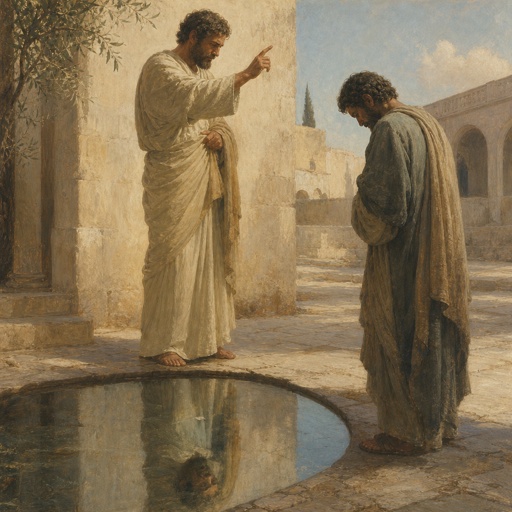
Romans 2:21 Artwork

Romans 2:21 - "Thou therefore which teachest another, teachest thou not thyself? thou that preachest a man should not steal, dost thou steal?"

"Thou therefore which teachest another, teachest thou not thyself? thou that preachest a man should not steal, dost thou steal?" - Romans 2:21

Romans 2:1 - "Therefore thou art inexcusable, O man, whosoever thou art that judgest: for wherein thou judgest another, thou condemnest thyself; for thou that judgest doest the same things."

Romans 12:21 - "Be not overcome of evil, but overcome evil with good."

Romans 16:21 - "Timotheus my workfellow, and Lucius, and Jason, and Sosipater, my kinsmen, salute you."

Romans 3:21 - "But now the righteousness of God without the law is manifested, being witnessed by the law and the prophets;"

Romans 15:21 - "But as it is written, To whom he was not spoken of, they shall see: and they that have not heard shall understand."

Acts 16:21 - "And teach customs, which are not lawful for us to receive, neither to observe, being Romans."

Romans 4:21 - "And being fully persuaded that, what he had promised, he was able also to perform."

Romans 11:21 - "For if God spared not the natural branches, take heed lest he also spare not thee."

Romans 7:21 - "I find then a law, that, when I would do good, evil is present with me."

"Be not overcome of evil, but overcome evil with good." - Romans 12:21

"Be not overcome of evil, but overcome evil with good." - Romans 12:21

Romans 12:2

Romans 12:2

Romans 12:2

Romans 12:2

Romans 12:2

Romans 12:2

Romans 12:2

Romans 12:2

Romans 12:2

Romans 12:2

Romans 12:2

Romans 12:2

Romans 12:2

Romans 12:2

Romans 12:2

Romans 8:21 - "Because the creature itself also shall be delivered from the bondage of corruption into the glorious liberty of the children of God."
"Therefore thou art inexcusable, O man, whosoever thou art that judgest: for wherein thou judgest another, thou condemnest thyself; for thou that judgest doest the same things." - Romans 2:1