What does Romans 8:1-2 mean?
“There is therefore now no condemnation to them which are in Christ Jesus, who walk not after the flesh, but after the Spirit. For the law of the Spirit of life in Christ Jesus hath made me free from the law of sin and death.” — Romans 8:1-2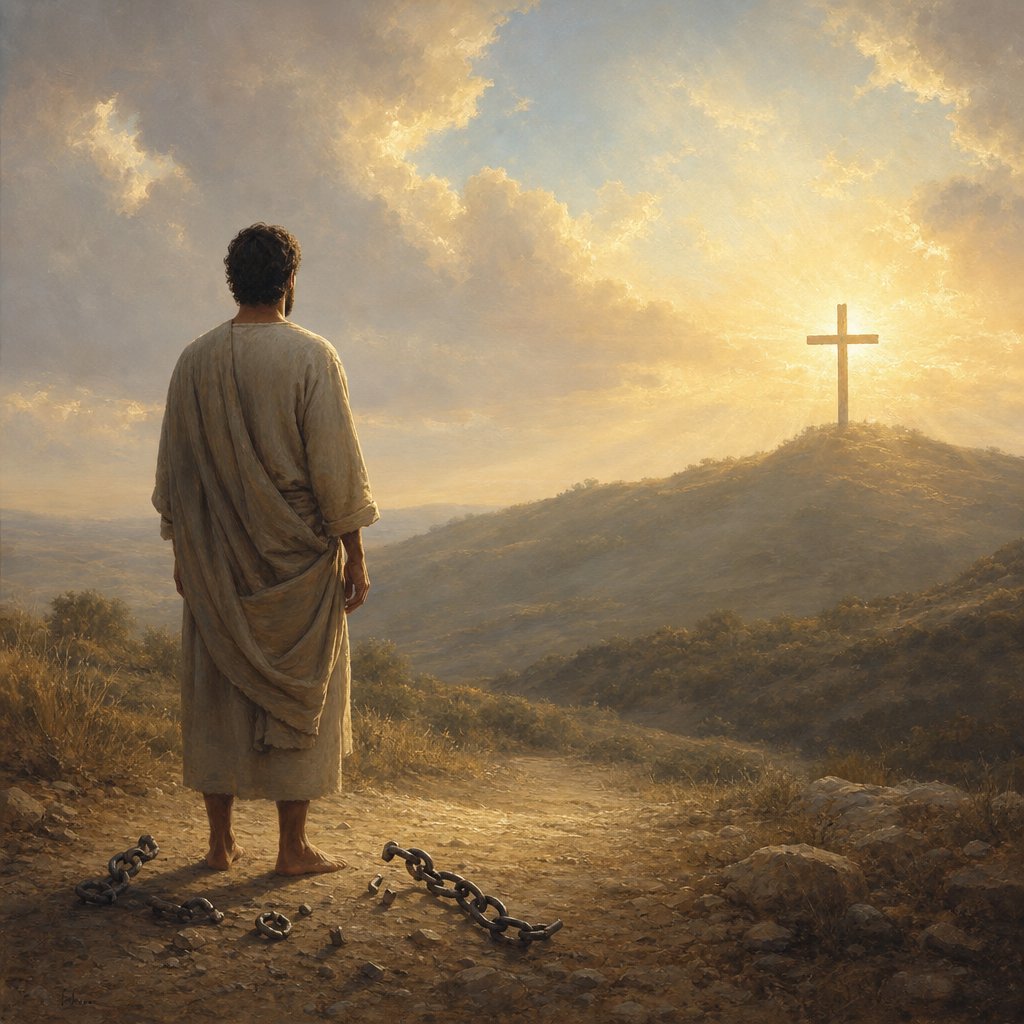
“ There is therefore now no condemnation to them which are in Christ Jesus, who walk not after the flesh, but after the Spirit. For the law of the Spirit of life in Christ Jesus hath made me free from the law of sin and death.” (Romans 8:1–2, KJV)
These words stand like a threshold in Paul’s epistle, opening from the struggle he has just described into the liberty he is about to proclaim. The “therefore” is not a decorative transition; it gathers up what has been argued and experienced beforehand. In Romans, Paul has laid out the universal problem of sin, the inability of the law to justify the guilty, the gift of righteousness by faith, and the new standing of the believer through union with Christ. Immediately before this passage he has spoken of the inward conflict in which a man discovers that, though he may consent to what is good, sin working within brings him into captivity, ending with the cry, “O wretched man that I am! who shall deliver me from the body of this death?” and then the answer that deliverance comes “through Jesus Christ our Lord.” Romans 8:1–2 is the dawn after that night: not a denial that sin is real or that conflict is felt, but a declaration that the decisive verdict over the believer has changed and that a new power has entered the field.
When Paul says, “There is therefore now no condemnation,” he is speaking courtroom language. Condemnation is not merely the feeling of shame, nor only the consequence of poor choices; it is the judicial sentence that falls on the guilty. The gospel, as Paul has been unfolding it, does not simply offer advice or improvement; it announces an acquittal and more than an acquittal, because the believer’s standing is not described as merely “not condemned,” but as a person placed “in Christ Jesus.” The phrase “in Christ Jesus” is the heart of the matter. It is union language, the way Paul expresses the believer’s new location, as though a man has been taken out of one realm and set into another. To be “in” Adam is to share the ruin of Adam; to be “in” Christ Jesus is to share the saving work, the righteousness, and the life of Christ. The “now” underscores a present reality. Paul is not postponing this to a distant judgment only; he is saying that, in the present, for those who are in Christ Jesus, the sentence of condemnation has been removed.
The clause, “who walk not after the flesh, but after the Spirit,” is not inserted to make the promise fragile, as though condemnation is removed only so long as one performs well enough. Rather, it describes the characteristic path of those who truly are in Christ Jesus. In Romans, “flesh” is more than the physical body; it signifies human nature as it stands in its weakness and sinfulness, the self acting independently of God, the life driven by desires and powers that belong to the old order. To “walk after the flesh” is to have one’s course, direction, and governing principle shaped by that old order. “Walk” is a common biblical image for one’s manner of life—steady, continual movement, not merely isolated acts. By contrast, to “walk after the Spirit” is to have the Spirit as the animating and directing power of life. Paul is beginning to unfold the ministry of the Spirit in this chapter: the Spirit is not an accessory to faith but the defining presence of the new covenant life. Thus this clause functions as a mark of identity and evidence of a new realm: those who belong to Christ are not left under the dominion of the flesh, but are led into another walk.
Verse 2 explains the ground of verse 1: “For the law of the Spirit of life in Christ Jesus hath made me free from the law of sin and death.” Paul uses “law” here not only in the sense of the Mosaic law as a written code, but in the sense of an operative principle, a ruling power, a consistent dominion. The “law of sin and death” is the principle by which sin exerts its mastery and death follows as its wage and consequence. It is like a downward gravity in fallen humanity: sin rules, and death inevitably results. Against this, Paul sets “the law of the Spirit of life in Christ Jesus.” This is the new, effective power that comes through the Spirit, who brings life because He applies and communicates what is in Christ Jesus. Life here is not only continued existence; it is the God-given life that answers death, the life that belongs to the risen Christ and is shared with His people. The Spirit’s “law” is not a mere command; it is an inward, liberating power. The Spirit does not only tell a man to live; He brings the life by which a man can live.
The symbolism of freedom is crucial. “Hath made me free” speaks like emancipation from slavery. Paul has already described sin as a master and men as servants; he has also described the law’s inability to deliver because, though the law is holy, man is “carnal, sold under sin.” In Romans 8:2 the bondage is not treated as a minor habit but as a dominating regime, and the deliverance is not portrayed as self-reform but as a freeing act accomplished “in Christ Jesus.” The believer is not freed by discovering hidden strength within the flesh, but by being transferred into the realm where the Spirit of life operates. The Spirit’s liberating “law” breaks the older “law” of sin and death the way a stronger power overcomes a weaker one, not by negotiation but by conquest.
This is why “no condemnation” is so significant. It is not merely that past sins are overlooked; it is that the entire relationship to guilt and penalty has been altered through Christ. Condemnation belongs to those under sin’s rule; freedom belongs to those under the Spirit’s life. The two verses together hold both the legal and the living dimensions of salvation. Verse 1 speaks to the verdict: no condemnation. Verse 2 speaks to the power: made free. Paul will go on to show that the same Spirit who frees also indwells, leads, bears witness, helps, and ultimately will quicken mortal bodies. But already in Romans 8:1–2 the pattern is clear: the gospel does not leave a man pardoned yet unchanged; it places him in Christ and grants him the Spirit who brings life.
In their immediate context, these verses answer the despair of Romans 7 without pretending the struggle never existed. They announce that the believer’s deepest problem is not simply that he feels divided, but that he stood under condemnation and under a law of sin and death; and they declare that, in Christ Jesus, a new state has arrived “now.” The significance is that assurance is rooted not in the believer’s fluctuating performance, but in the believer’s union with Christ and the effective, life-giving work of the Spirit. Those who are in Christ Jesus are described by a new walk, not as a price paid to remove condemnation, but as the fruit of the freedom that the Spirit of life has already wrought.
Get our apps


Artwork for Romans 8:1-2

Romans 8:1-2 - "Therefore, there is now no condemnation for those who are in Christ Jesus, because through Christ Jesus the law of the Spirit who gives life has set you free from the law of sin and death."

"Therefore, there is now no condemnation for those who are in Christ Jesus, because through Christ Jesus the law of the Spirit who gives life has set you free from the law of sin and death." - Romans 8:1-2

Romans 8:1

Romans 8:19

Romans 13:8

Romans 8:28

Romans 13:8

Romans 8:28

Romans 8:19

Romans 8:11

Romans 2:4

Romans 2:8 - "But unto them that are contentious, and do not obey the truth, but obey unrighteousness, indignation and wrath,"

Romans 8:1 - "There is therefore now no condemnation to them which are in Christ Jesus, who walk not after the flesh, but after the Spirit."

romans 12:1-2

Romans 12:1-2

Romans 8:2 - "For the law of the Spirit of life in Christ Jesus hath made me free from the law of sin and death."

Romans 8

romans 8

Romans 1:8 - "First, I thank my God through Jesus Christ for you all, that your faith is spoken of throughout the whole world."

Romans 8:8 - "So then they that are in the flesh cannot please God."

Romans 1:2 - "(Which he had promised afore by his prophets in the holy scriptures,)"

Romans 8:18

Romans 8:28

Romans 8:31

Romans chapter 8

Romans 8:14

Romans 5:8

romans 8:38

Romans 8:35

Romans 5:8