What does Ruth 3:6 mean?
“And she went down unto the floor, and did according to all that her mother in law bade her.” — Ruth 3:6
In order to provide a detailed and in-depth analysis of Ruth 3:6 from the King James Version of the Bible, it is important to consider the historical and cultural context in which this verse takes place, as well as the themes and symbolism present in the passage.
Ruth 3:6 (KJV) reads, "And she went down unto the floor, and did according to all that her mother in law bade her."
The book of Ruth is set during the time of the judges in Israel, a period of instability and unrest. The story of Ruth revolves around the titular character, a Moabite woman, who chooses to remain loyal to her Israelite mother-in-law, Naomi, after the death of her husband. The two women return to Naomi's homeland of Bethlehem, where Ruth's loyalty and faithfulness are tested as she seeks to provide for herself and Naomi.
In this particular verse, we find Ruth obeying the instructions of her mother-in-law, Naomi. The significance of Ruth's obedience is not simply in her willingness to follow instructions, but rather in her recognition of Naomi's authority and wisdom. In the context of the story, Ruth's actions demonstrate her commitment to Naomi and her willingness to humble herself and submit to her mother-in-law's guidance. This act of obedience reflects Ruth's character and her dedication to serving and caring for Naomi despite the challenges they face.
One of the central themes in this verse is the importance of obedience and humility. Ruth's willingness to follow Naomi's instructions reflects her humility and respect for her mother-in-law's wisdom and experience. Obedience is a recurring theme in the Bible, and in this instance, it serves as a model for how believers should submit to God's will and authority. By obeying Naomi, Ruth exemplifies the principles of faith and trust in a higher authority, which are essential components of a meaningful relationship with God.
Furthermore, the act of going down to the threshing floor carries symbolic significance. The threshing floor was a place of hard work and preparation, where grains were separated from chaff through a process of beating and winnowing. Ruth's journey to the threshing floor symbolizes her willingness to labor and provide for herself and Naomi. It also signifies her determination to take proactive steps towards securing their future, rather than passively waiting for their circumstances to improve. This action demonstrates Ruth's resilience, resourcefulness, and initiative in the face of adversity.
The verse also highlights the relationship between Ruth and Naomi, and the bond of trust and love that exists between them. Naomi's instructions to Ruth are given out of her desire to see Ruth provided for and cared for. Likewise, Ruth's obedience to Naomi's commands reflects her love and loyalty to her mother-in-law. Their relationship serves as a powerful example of mutual respect, support, and selflessness, demonstrating the importance of love and companionship in times of hardship.
In conclusion, Ruth 3:6 (KJV) carries profound meaning within the broader context of the book of Ruth. It serves as a testament to Ruth's humility, obedience, and determination, and to the enduring bond of love and loyalty between her and Naomi. The verse also conveys important spiritual and moral principles concerning obedience, humility, and the value of selfless love and service. Through its themes and symbolism, this passage offers valuable insights into the nature of faith, relationship, and duty, and provides a compelling example for believers to follow in their own lives.
Get our apps


Artwork for Ruth 3:6

Ruth 3:6 - "¶ And she went down unto the floor, and did according to all that her mother in law bade her."

"¶ And she went down unto the floor, and did according to all that her mother in law bade her." - Ruth 3:6

Ruth 3:9 - "And he said, Who art thou? And she answered, I am Ruth thine handmaid: spread therefore thy skirt over thine handmaid; for thou art a near kinsman."

Ruth 2:3 – "So she went out, entered a field and began to glean behind the harvesters."

Ruth 1:3 - "And Elimelech Naomi's husband died; and she was left, and her two sons."

Ruth 3:1 - "Then Naomi her mother in law said unto her, My daughter, shall I not seek rest for thee, that it may be well with thee?"

Ruth 3:5 - "And she said unto her, All that thou sayest unto me I will do."

Ruth 3:8 - "¶ And it came to pass at midnight, that the man was afraid, and turned himself: and, behold, a woman lay at his feet."

Ruth 3:12 - "And now it is true that I am thy near kinsman: howbeit there is a kinsman nearer than I."

Ruth 2:6 - "And the servant that was set over the reapers answered and said, It is the Moabitish damsel that came back with Naomi out of the country of Moab:"

Ruth 3:2 - "And now is not Boaz of our kindred, with whose maidens thou wast? Behold, he winnoweth barley to night in the threshingfloor."

Ruth 3:17 - "And she said, These six measures of barley gave he me; for he said to me, Go not empty unto thy mother in law."

Ruth 4:3 - "And he said unto the kinsman, Naomi, that is come again out of the country of Moab, selleth a parcel of land, which was our brother Elimelech's:"

Ruth 3:3 - "Wash thyself therefore, and anoint thee, and put thy raiment upon thee, and get thee down to the floor: but make not thyself known unto the man, until he shall have done eating and drinking."

Ruth 2:3 - "And she went, and came, and gleaned in the field after the reapers: and her hap was to light on a part of the field belonging unto Boaz, who was of the kindred of Elimelech."

"And now it is true that I am thy near kinsman: howbeit there is a kinsman nearer than I." - Ruth 3:12

Ruth 4:6 - "¶ And the kinsman said, I cannot redeem it for myself, lest I mar mine own inheritance: redeem thou my right to thyself; for I cannot redeem it."

"Then said she, Sit still, my daughter, until thou know how the matter will fall: for the man will not be in rest, until he have finished the thing this day." - Ruth 3:18

"And when she came to her mother in law, she said, Who art thou, my daughter? And she told her all that the man had done to her." - Ruth 3:16

Ruth 3:11 - "And now, my daughter, fear not; I will do to thee all that thou requirest: for all the city of my people doth know that thou art a virtuous woman."
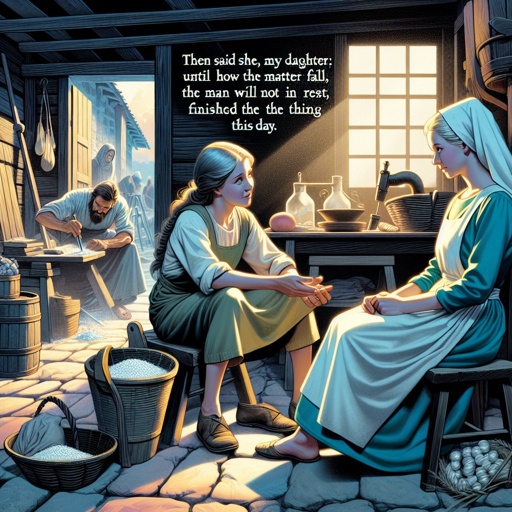
Ruth 3:18 - "Then said she, Sit still, my daughter, until thou know how the matter will fall: for the man will not be in rest, until he have finished the thing this day."

"And Elimelech Naomi's husband died; and she was left, and her two sons." - Ruth 1:3

Ruth 3:14 - "¶ And she lay at his feet until the morning: and she rose up before one could know another. And he said, Let it not be known that a woman came into the floor."

Ruth 3:16 - "And when she came to her mother in law, she said, Who art thou, my daughter? And she told her all that the man had done to her."

Ruth 3:15 - "Also he said, Bring the vail that thou hast upon thee, and hold it. And when she held it, he measured six measures of barley, and laid it on her: and she went into the city."

"¶ And it came to pass at midnight, that the man was afraid, and turned himself: and, behold, a woman lay at his feet." - Ruth 3:8

"And he said, Who art thou? And she answered, I am Ruth thine handmaid: spread therefore thy skirt over thine handmaid; for thou art a near kinsman." - Ruth 3:9

Ruth 1:6 - "¶ Then she arose with her daughters in law, that she might return from the country of Moab: for she had heard in the country of Moab how that the LORD had visited his people in giving them bread."

Ruth 3:10 - "And he said, Blessed be thou of the LORD, my daughter: for thou hast shewed more kindness in the latter end than at the beginning, inasmuch as thou followedst not young men, whether poor or rich."

Ruth 3:7 - "And when Boaz had eaten and drunk, and his heart was merry, he went to lie down at the end of the heap of corn: and she came softly, and uncovered his feet, and laid her down."