The Weight of Loyalty and the Depth of Despair
“And when his armourbearer saw that Saul was dead, he fell likewise on the sword, and died.” — 1 Chronicles 10:5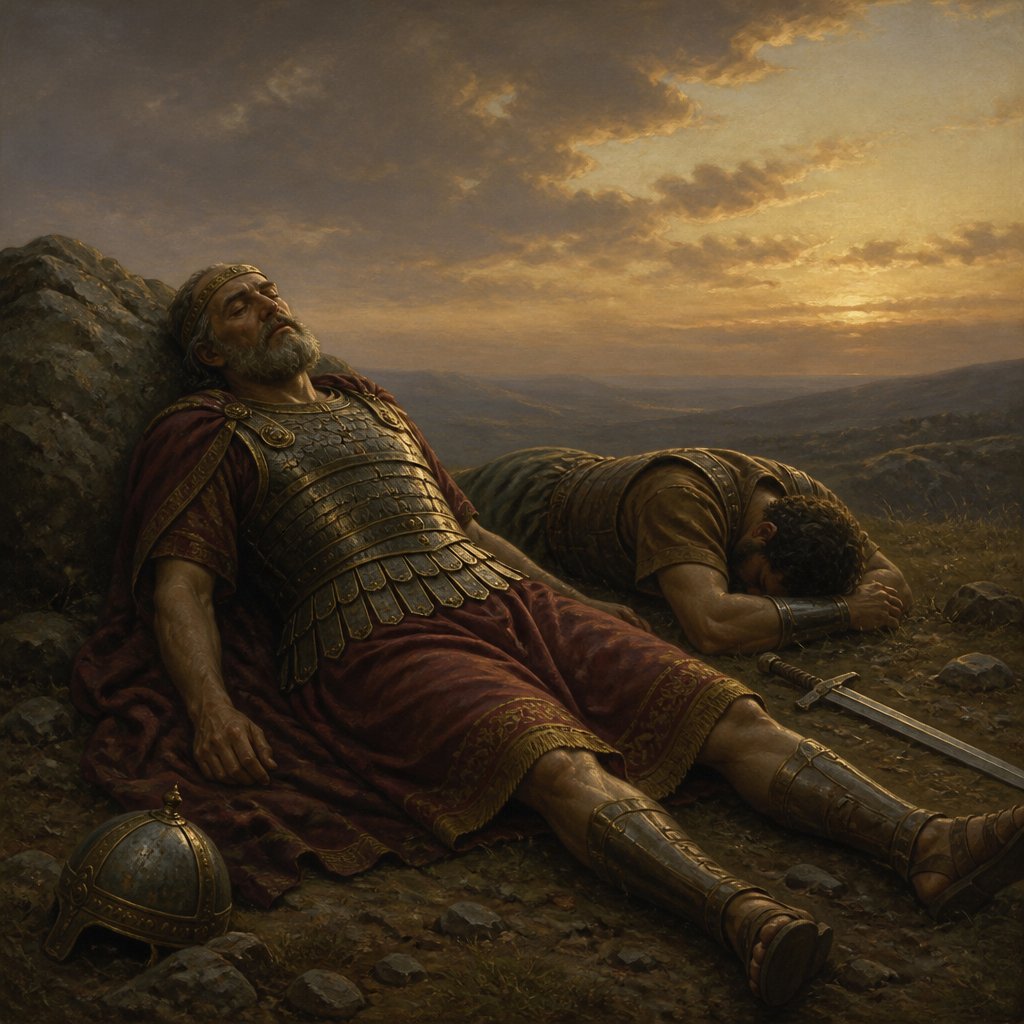
In 1 Chronicles 10:5, we read: "And when his armourbearer saw that Saul was dead, he fell likewise on the sword, and died." This poignant moment encapsulates the tragic demise of King Saul and the profound loyalty of his armor-bearer, reflecting the depths of despair that can accompany loyalty.
As we reflect on this scripture, it’s imperative to understand the position and significance of the armor-bearer in the ancient context. The armor-bearer was not merely a servant; he was a trusted companion, often sharing in both the glory of victory and the agony of defeat alongside his master. The bond between Saul and his armor-bearer was deep, forged in the fires of battle and loyalty. The armor-bearer’s immediate reaction to Saul’s death highlights a sorrow that transcends mere duty; it reveals a fierce allegiance that, in the face of overwhelming despair, drove him to a point of no return.
Saul’s reign ended catastrophically. He had lost God’s favor and faced defeat at the hands of the Philistines, culminating in his tragic decision to take his own life rather than fall into enemy hands. This moment not only signifies the end of Saul’s leadership but also opens the door to new beginnings for Israel under David. However, for the armor-bearer, Saul's death marks the end of everything he had known. His world crumbled when the life of his leader was extinguished. This begs the question: what do we do when faced with the death of what we hold dear?
The path that the armor-bearer chose can be seen as both noble and tragic. His death signifies the devastating impact of emotional turmoil and the weight of loyalty — a reminder of how intertwined our identities can become with those we serve and follow. In a world where we often idolize leaders and heroes, we must recognize the potential for personal despair and disillusionment that can arise following their failures.
Moreover, the armor-bearer's act serves as a sober reflection on our choices in times of suffering and loss. In our own lives, we may encounter moments where we feel burdened by the weight of loyalty to a leader, mentor, or even an ideal that we believed in wholeheartedly. When these figures fall — whether through moral failure, personal tragedy, or spiritual disillusionment — we are presented with a decision. Like the armor-bearer, we might feel the temptation to descend into despair, choosing to forsake hope in the wake of grief.
However, Ephesians 6:13 (KJV) reminds us, "Wherefore take unto you the whole armour of God, that ye may be able to withstand in the evil day, and having done all, to stand." Instead of succumbing to the same fate as the armor-bearer, we are called to stand firm in our faith, even when faced with loss and sorrow. Joseph’s life is a testament to this principle; despite being betrayed by his brothers, sold into slavery, and unjustly imprisoned, he chose to trust God’s plan and ultimately rose to become a savior for his people.
Let us take this opportunity to ask ourselves: Who or what am I loyal to? Is my loyalty prompting me to constructive actions — to stand firm in my faith and seek God’s path even when leaders falter? Or am I allowing my love and loyalty to lead me into despair? The call is clear — we must anchor ourselves in the Lord, who remains faithful through all circumstances.
As we meditate on the armor-bearer’s response to Saul’s death, let us strive for a deeper loyalty — one that points us towards hope rather than despair. May our allegiance ever be to Christ, who is the ultimate guide, sanctuary, and source of strength in both our triumphs and our tragedies.
Get our apps


Artwork for 1 Chronicles 10:5

1 Chronicles 10:5 - "And when his armourbearer saw that Saul was dead, he fell likewise on the sword, and died."
"And when his armourbearer saw that Saul was dead, he fell likewise on the sword, and died." - 1 Chronicles 10:5

2 Chronicles 10:5 - "And he said unto them, Come again unto me after three days. And the people departed."

1 Chronicles 5:10 - "And in the days of Saul they made war with the Hagarites, who fell by their hand: and they dwelt in their tents throughout all the east land of Gilead."
"And he said unto them, Come again unto me after three days. And the people departed." - 2 Chronicles 10:5

1 Chronicles 4 : 10

1 Chronicles 5:5 - "Micah his son, Reaia his son, Baal his son,"

1 Chronicles 10:10 - "And they put his armour in the house of their gods, and fastened his head in the temple of Dagon."

1 Chronicles 8:5 - "And Gera, and Shephuphan, and Huram."

1 Chronicles 14:5 - "And Ibhar, and Elishua, and Elpalet,"

1 Chronicles 9:10 - "¶ And of the priests; Jedaiah, and Jehoiarib, and Jachin,"

1 Chronicles 1:10 - "And Cush begat Nimrod: he began to be mighty upon the earth."

1 Chronicles 12:10 - "Mishmannah the fourth, Jeremiah the fifth,"

1 Chronicles 24:10 - "The seventh to Hakkoz, the eighth to Abijah,"

1 Chronicles 2:5 - "The sons of Pharez; Hezron, and Hamul."

1 Chronicles 10:6 - "So Saul died, and his three sons, and all his house died together."

1 Chronicles 1:5 - "¶ The sons of Japheth; Gomer, and Magog, and Madai, and Javan, and Tubal, and Meshech, and Tiras."

1 Chronicles 9:5 - "And of the Shilonites; Asaiah the firstborn, and his sons."

1 Chronicles 10:11 - "¶ And when all Jabesh-gilead heard all that the Philistines had done to Saul,"

1 Chronicles 12:5 - "Eluzai, and Jerimoth, and Bealiah, and Shemariah, and Shephatiah the Haruphite,"

1 Chronicles 5:19 - "And they made war with the Hagarites, with Jetur, and Nephish, and Nodab."

1 Chronicles 6:5 - "And Abishua begat Bukki, and Bukki begat Uzzi,"

Revelation 5:1-10

1 Chronicles 5:12 - "Joel the chief, and Shapham the next, and Jaanai, and Shaphat in Bashan."

1 Chronicles 15:10 - "Of the sons of Uzziel; Amminadab the chief, and his brethren an hundred and twelve."

1 Chronicles 8:10 - "And Jeuz, and Shachia, and Mirma. These were his sons, heads of the fathers."
"And in the days of Saul they made war with the Hagarites, who fell by their hand: and they dwelt in their tents throughout all the east land of Gilead." - 1 Chronicles 5:10

1 Chronicles 5:15 - "Ahi the son of Abdiel, the son of Guni, chief of the house of their fathers."

1 Chronicles 15:5 - "Of the sons of Kohath; Uriel the chief, and his brethren an hundred and twenty:"

1 Chronicles 4:5 - "¶ And Ashur the father of Tekoa had two wives, Helah and Naarah."