What does 1 Chronicles 10:5 mean?
“And when his armourbearer saw that Saul was dead, he fell likewise on the sword, and died.” — 1 Chronicles 10:5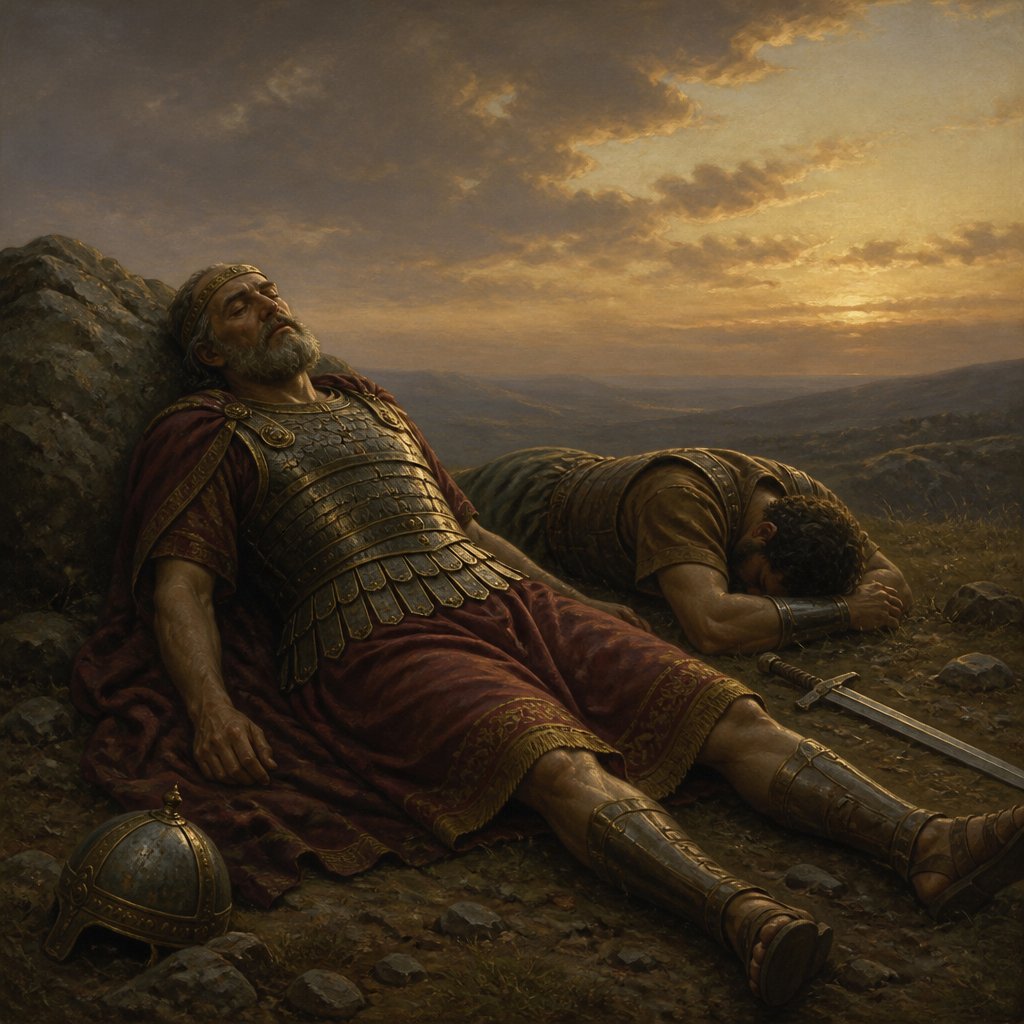
1 Chronicles 10:5 (KJV) states, "And when his armorbearer saw that Saul was dead, he fell likewise on the sword, and died." This verse comes from the Old Testament of the Bible and is part of the account of the death of King Saul, the first king of Israel. This event is a significant and tragic moment in the history of Israel, and it carries several important themes, contextual elements, and symbolism that provide deeper insight into the biblical narrative and the human condition.
To fully grasp the meaning and significance of 1 Chronicles 10:5, it is important to understand the historical and literary context in which this verse is situated. The book of 1 Chronicles is primarily concerned with tracing the genealogy of the Israelites and chronicling the history of the nation of Israel, particularly focusing on the reign of King David and the establishment of the Davidic dynasty. In the specific passage of 1 Chronicles 10, the focus is on the death of Saul and his sons in battle against the Philistines, which ultimately leads to the ascension of David to the throne.
The verse itself describes the moment when Saul's armorbearer, who was responsible for carrying the king's armor and weapons, witnessed Saul's death and chose to take his own life as well. This act of self-inflicted death is a tragic and poignant portrayal of the devastating outcome of a battle lost and the resulting despair and hopelessness that can lead individuals to such extreme actions.
One of the key themes present in this verse is that of tragedy and the consequences of disobedience and pride. Throughout the biblical narrative, Saul is depicted as a king who started with great promise but ultimately fell from grace due to his disobedience to God and his own pride. His death, along with that of his sons and his armorbearer, serves as a sobering reminder of the devastating effects of sin and the dire consequences that can result from turning away from God. It also highlights the fragility of human life and the futility of relying solely on one's own strength and wisdom.
Furthermore, the verse also carries a profound message about the nature of loyalty and the bond between a leader and his follower. The armorbearer's decision to follow his king in death, even though it was not required of him, speaks to the deep sense of loyalty and devotion that characterized their relationship. This act embodies the idea of sacrifice and commitment, even in the face of overwhelming defeat and despair.
Symbolically, the act of falling on the sword can be interpreted as a form of atonement or a way of taking responsibility for one's own actions. In this context, it can be seen as a poignant representation of the consequences of Saul's own failings as a leader, as well as the ultimate toll it takes on those around him. Additionally, the armorbearer's choice to also end his life can be seen as a demonstration of the loyalty and solidarity that existed between him and his king, even in death.
In conclusion, 1 Chronicles 10:5 offers a rich and multi-layered exploration of themes such as tragedy, the consequences of disobedience, the nature of loyalty, and the fragility of human life. It serves as a poignant reminder of the profound impact of our actions and the importance of remaining faithful to God even in the midst of adversity. The verse also highlights the complexity and depth of the human experience, offering valuable insights into the nature of leadership, sacrifice, and the enduring power of faith and loyalty.
Get our apps


Artwork for 1 Chronicles 10:5

1 Chronicles 10:5 - "And when his armourbearer saw that Saul was dead, he fell likewise on the sword, and died."
"And when his armourbearer saw that Saul was dead, he fell likewise on the sword, and died." - 1 Chronicles 10:5

2 Chronicles 10:5 - "And he said unto them, Come again unto me after three days. And the people departed."

1 Chronicles 5:10 - "And in the days of Saul they made war with the Hagarites, who fell by their hand: and they dwelt in their tents throughout all the east land of Gilead."
"And he said unto them, Come again unto me after three days. And the people departed." - 2 Chronicles 10:5

1 Chronicles 4 : 10

1 Chronicles 5:5 - "Micah his son, Reaia his son, Baal his son,"

1 Chronicles 10:10 - "And they put his armour in the house of their gods, and fastened his head in the temple of Dagon."

1 Chronicles 8:5 - "And Gera, and Shephuphan, and Huram."

1 Chronicles 14:5 - "And Ibhar, and Elishua, and Elpalet,"

1 Chronicles 9:10 - "¶ And of the priests; Jedaiah, and Jehoiarib, and Jachin,"

1 Chronicles 1:10 - "And Cush begat Nimrod: he began to be mighty upon the earth."

1 Chronicles 12:10 - "Mishmannah the fourth, Jeremiah the fifth,"

1 Chronicles 24:10 - "The seventh to Hakkoz, the eighth to Abijah,"

1 Chronicles 2:5 - "The sons of Pharez; Hezron, and Hamul."

1 Chronicles 10:6 - "So Saul died, and his three sons, and all his house died together."

1 Chronicles 1:5 - "¶ The sons of Japheth; Gomer, and Magog, and Madai, and Javan, and Tubal, and Meshech, and Tiras."

1 Chronicles 9:5 - "And of the Shilonites; Asaiah the firstborn, and his sons."

1 Chronicles 10:11 - "¶ And when all Jabesh-gilead heard all that the Philistines had done to Saul,"

1 Chronicles 12:5 - "Eluzai, and Jerimoth, and Bealiah, and Shemariah, and Shephatiah the Haruphite,"

1 Chronicles 5:19 - "And they made war with the Hagarites, with Jetur, and Nephish, and Nodab."

1 Chronicles 6:5 - "And Abishua begat Bukki, and Bukki begat Uzzi,"

Revelation 5:1-10

1 Chronicles 5:12 - "Joel the chief, and Shapham the next, and Jaanai, and Shaphat in Bashan."

1 Chronicles 15:10 - "Of the sons of Uzziel; Amminadab the chief, and his brethren an hundred and twelve."

1 Chronicles 8:10 - "And Jeuz, and Shachia, and Mirma. These were his sons, heads of the fathers."
"And in the days of Saul they made war with the Hagarites, who fell by their hand: and they dwelt in their tents throughout all the east land of Gilead." - 1 Chronicles 5:10

1 Chronicles 5:15 - "Ahi the son of Abdiel, the son of Guni, chief of the house of their fathers."

1 Chronicles 15:5 - "Of the sons of Kohath; Uriel the chief, and his brethren an hundred and twenty:"

1 Chronicles 4:5 - "¶ And Ashur the father of Tekoa had two wives, Helah and Naarah."