When Heaven’s Sword Hangs Over Our City: Learning to Bow Like David
“And David lifted up his eyes, and saw the angel of the LORD stand between the earth and the heaven, having a drawn sword in his hand stretched out over Jerusalem. Then David and the elders of Israel, who were clothed in sackcloth, fell upon their faces.” — 1 Chronicles 21:16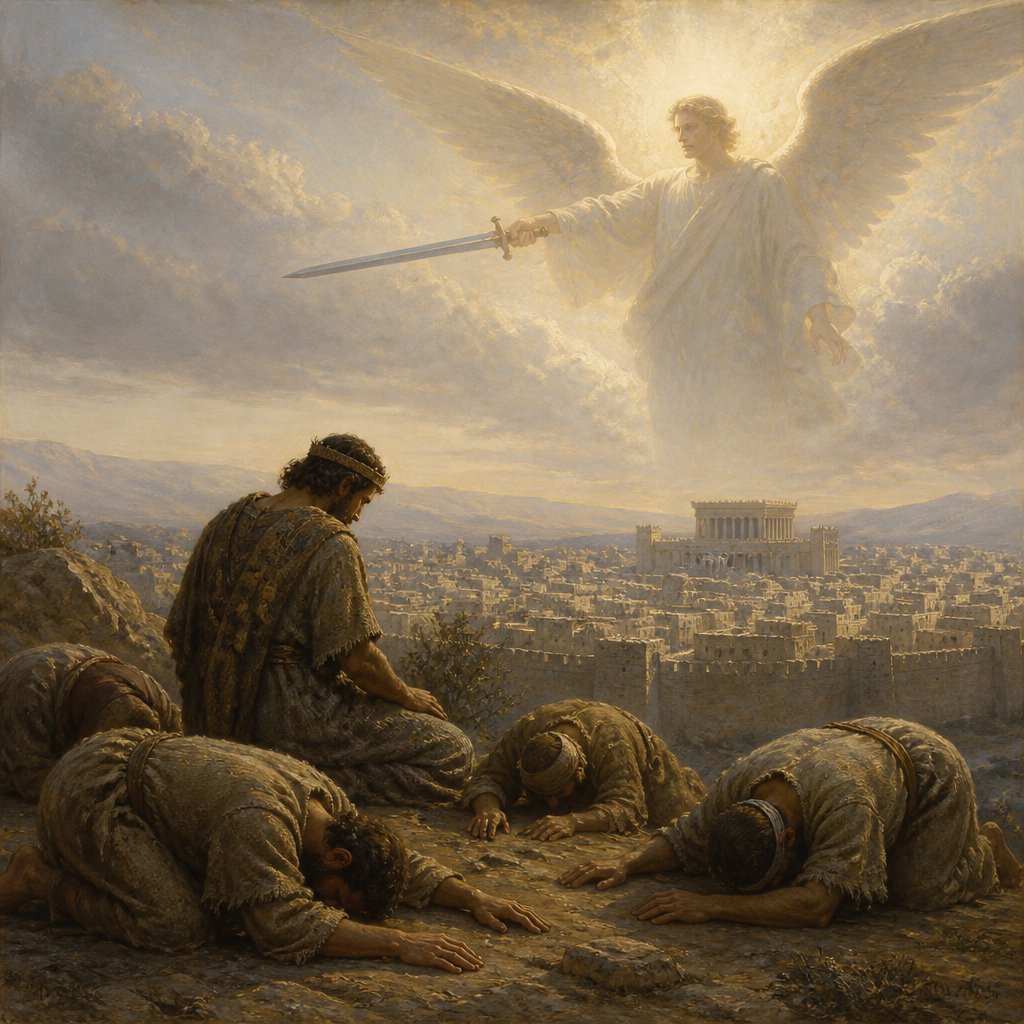
“And David lifted up his eyes, and saw the angel of the LORD stand between the earth and the heaven, having a drawn sword in his hand stretched out over Jerusalem. Then David and the elders of Israel, who were clothed in sackcloth, fell upon their faces.” (1 Chronicles 21:16, KJV)
This single verse places us in a moment of terrifying clarity. David “lifted up his eyes,” and what he saw was not a gentle symbol or a private impression, but an angel with “a drawn sword… stretched out over Jerusalem.” The scene hangs between worlds—“between the earth and the heaven”—as if to show that what is happening in Jerusalem cannot be explained merely by politics, disease, or circumstance. The judgment is not random. It is not impersonal. It is moral and spiritual, anchored in the reality of the LORD who rules above every throne.
There are seasons when God allows us to “lift up” our eyes and perceive what we have tried to ignore. David had numbered Israel, and though the broader chapter tells the story, this verse captures the result: sin ripens into consequence, and consequence reveals how small human control really is. David is a king, an experienced warrior, a man who has led nations—and yet one sight reduces him, and the elders with him, to the ground. When the drawn sword is over Jerusalem, rank and reputation do not matter. All are simply creatures before the Creator.
Notice first the posture: “Then David and the elders of Israel… fell upon their faces.” In a world that trains us to defend ourselves, explain ourselves, and manage our image, repentance looks like surrender. Falling on the face is not theater; it is honesty. It admits that the danger is real, that the LORD is righteous, and that we do not negotiate from a place of equality. The heart that truly repents does not bargain; it bows.
Second, notice the shared humility: “David and the elders of Israel.” This is not only personal remorse; it is leadership taking responsibility. The elders do not distance themselves from the crisis; they join the king in sackcloth. Their unity does not minimize David’s sin, but it models a critical truth: when God deals with a people, He often calls leaders to be the first to humble themselves. A community cannot be led into repentance by leaders who refuse to kneel.
Third, notice the clothing: “clothed in sackcloth.” Sackcloth in Scripture is the fabric of grief and confession. It is an outward sign of an inward collapse of pride. Sackcloth says, “We are not okay. We are not excused. We need mercy.” It rejects the illusion that we can dress up our condition before God. When judgment is near, God is not impressed by our ornaments; He responds to our contrition.
And what of the angel “between the earth and the heaven”? That image presses a question into our lives: do we recognize that our daily reality is lived under heaven? We often speak as if our choices are sealed inside the boundaries of earth—private, contained, manageable. But David sees a messenger of God poised in the space that links heaven’s authority and earth’s experience. Sin is never merely horizontal; it is always ultimately vertical. It is against the LORD. And mercy, too, is never merely psychological relief; it is heaven acting toward earth with compassion.
This verse also teaches that true spiritual sight leads to humility, not arrogance. David “lifted up his eyes,” and the immediate fruit was not confidence but reverence. Many want spiritual experiences that make them feel powerful. Yet the clearest encounters with God’s holiness often make a person small—small enough to be truthful, small enough to repent, small enough to pray.
If there is a “sword… stretched out” over any part of our lives—over our homes, our habits, our hidden compromises, our coldness toward God—the right response is not denial but surrender. Fall on your face in prayer. Put on the sackcloth of honesty. Agree with God rather than argue with Him. Confess where you have trusted numbers, strength, control, or approval more than the LORD.
The same God who allows David to see the drawn sword also allows David to bow. That is mercy already at work. Conviction is not God’s cruelty; it is often His rescue. When the LORD lets you see reality, He is inviting you to repentance before consequences go further.
Prayer: Lord, give me eyes to see truly and a heart willing to fall upon its face. Strip me of pride. Teach me the humility of sackcloth—a repentant spirit that does not justify sin but seeks mercy. Let my home and my life be under Thy rule, and turn my fear into reverent obedience. Amen.
Get our apps


Artwork for 1 Chronicles 21:16

1 Chronicles 21:16 - "And David lifted up his eyes, and saw the angel of the LORD stand between the earth and the heaven, having a drawn sword in his hand stretched out over Jerusalem. Then David and the elders of Israel, who were clothed in sackcloth, fell upon their faces."
!["And David lifted up his eyes, and saw the angel of the LORD stand between the earth and the heaven, having a drawn sword in his hand stretched out over Jerusalem. Then David and the elders [of Israel, who were] clothed in sackcloth, fell upon their faces." - 1 Chronicles 21:16](https://media.bible.art/19dd3e30-472d-4952-97fd-8dab1856a4f1-thumbnail.jpg)
"And David lifted up his eyes, and saw the angel of the LORD stand between the earth and the heaven, having a drawn sword in his hand stretched out over Jerusalem. Then David and the elders [of Israel, who were] clothed in sackcloth, fell upon their faces." - 1 Chronicles 21:16
"And David lifted up his eyes, and saw the angel of the LORD stand between the earth and the heaven, having a drawn sword in his hand stretched out over Jerusalem. Then David and the elders of Israel, who were clothed in sackcloth, fell upon their faces." - 1 Chronicles 21:16

1 Chronicles 16:21 - "He suffered no man to do them wrong: yea, he reproved kings for their sakes,"

1 Chronicles 1:21 - "Hadoram also, and Uzal, and Diklah,"

2 Chronicles 21:16 - "¶ Moreover the LORD stirred up against Jehoram the spirit of the Philistines, and of the Arabians, that were near the Ethiopians:"
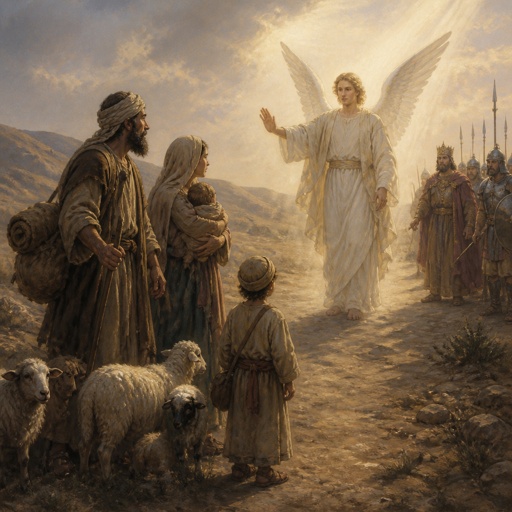
"He suffered no man to do them wrong: yea, he reproved kings for their sakes," - 1 Chronicles 16:21

1 Chronicles 1:16 - "And the Arvadite, and the Zemarite, and the Hamathite."

1 Chronicles 16:16 - "Even of the covenant which he made with Abraham, and of his oath unto Isaac;"

1 Chronicles 8:21 - "And Adaiah, and Beraiah, and Shimrath, the sons of Shimhi;"

1 Chronicles 21:1 - "And Satan stood up against Israel, and provoked David to number Israel."

1 Chronicles 24:16 - "The nineteenth to Pethahiah, the twentieth to Jehezekel,"

1 Chronicles 23:16 - "Of the sons of Gershom, Shebuel was the chief."

1 Chronicles 24:21 - "Concerning Rehabiah: of the sons of Rehabiah, the first was Isshiah."

1 Chronicles 9:21 - "And Zechariah the son of Meshelemiah was porter of the door of the tabernacle of the congregation."

1 Chronicles 6:16 - "¶ The sons of Levi; Gershom, Kohath, and Merari."

1 Chronicles 8:16 - "And Michael, and Ispah, and Joha, the sons of Beriah;"

1 Chronicles 21:7 - "And God was displeased with this thing; therefore he smote Israel."

1 Chronicles 21:9 - "¶ And the LORD spake unto Gad, David's seer, saying,"

1 Corinthians 16:21 - "The salutation of me Paul with mine own hand."

"Hadoram also, and Uzal, and Diklah," - 1 Chronicles 1:21

"And the Arvadite, and the Zemarite, and the Hamathite." - 1 Chronicles 1:16

1 Chronicles 21:21 - "And as David came to Ornan, Ornan looked and saw David, and went out of the threshingfloor, and bowed himself to David with his face to the ground."

1 Chronicles 11:16 - "And David was then in the hold, and the Philistines' garrison was then at Beth-lehem."

1 Chronicles 4:16 - "And the sons of Jehaleleel; Ziph, and Ziphah, Tiria, and Asareel."

1 Chronicles 23:21 - "¶ The sons of Merari; Mahli, and Mushi. The sons of Mahli; Eleazar, and Kish."

1 Chronicles 16:19 - "When ye were but few, even a few, and strangers in it."

1 Chronicles 12:16 - "And there came of the children of Benjamin and Judah to the hold unto David."

1 Chronicles 16:26 - "For all the gods of the people are idols: but the LORD made the heavens."

1 Chronicles 25:21 - "The fourteenth to Mattithiah, he, his sons, and his brethren, were twelve:"