Building God's House: A Legacy of Faith and Action
“Now, my son, the LORD be with thee; and prosper thou, and build the house of the LORD thy God, as he hath said of thee.” — 1 Chronicles 22:11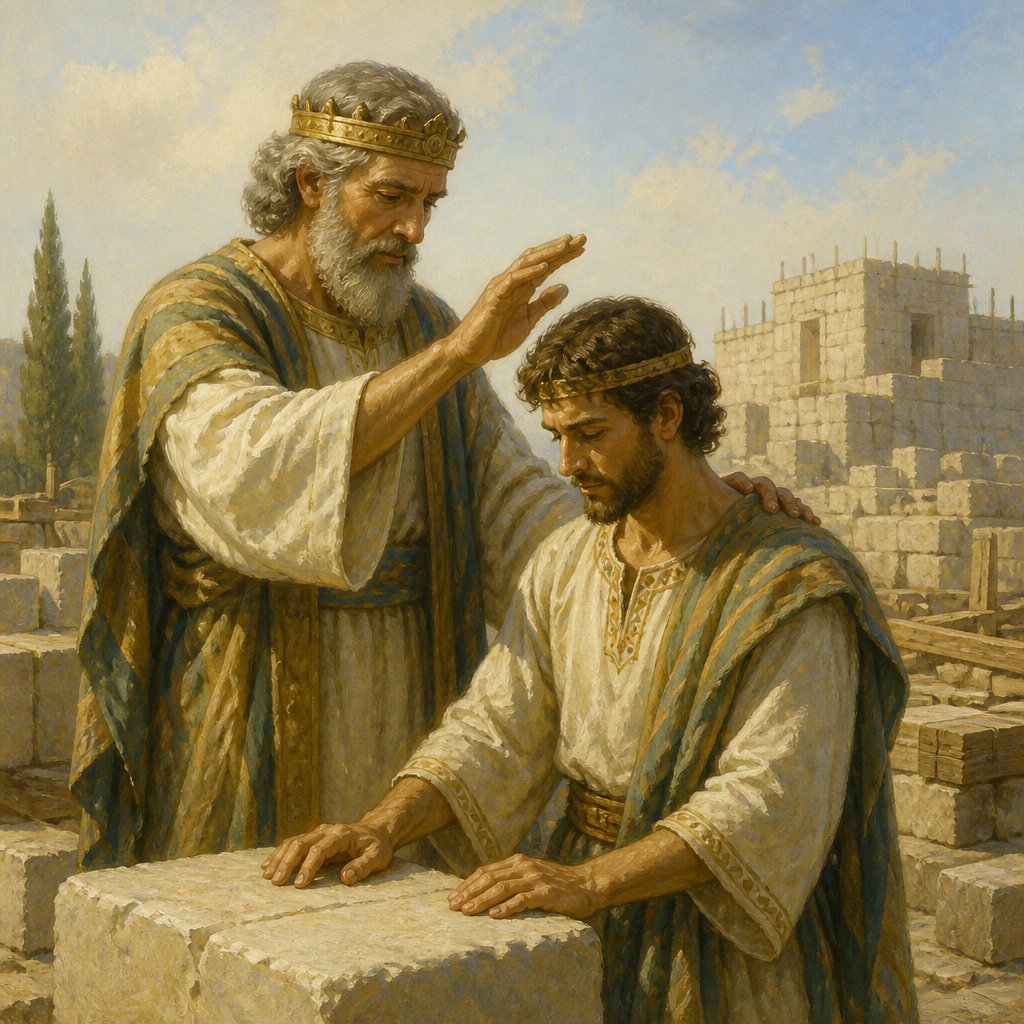
As we delve into the profound implications of 1 Chronicles 22:11, let us take a moment to set the scene. King David, a man after God’s own heart, had received a divine command to prepare for the building of the temple, a house dedicated to the worship of the Lord. In this verse, we witness a poignant moment between David and his son Solomon, who was destined to follow in his father's footsteps.
"Now, my son," David begins, emphasizing a personal connection that resonates deeply. He isn’t merely commanding; he is imparting wisdom and blessing upon Solomon. The phrase "the LORD be with thee" reveals the essence of David's hope for Solomon: that he would encounter God’s presence as he embarks on this monumental task. This is not just a wish for success; it is a heartfelt prayer for divine guidance and companionship. In our own lives, how often do we pause and invoke the presence of the Lord in our daily endeavors? The assurance that the Lord is with us transforms our approach to challenges and responsibilities.
Next, David pronounces, "and prosper thou, and build the house of the LORD thy God, as he hath said of thee." Here, we see an affirmation of Solomon's purpose. To prosper in building God’s house means to succeed in fulfilling God's promise and plan. It implies that Solomon’s work would not only be about bricks and mortar but about establishing a place for God's Spirit to dwell among His people. David’s blessing is also a reminder that prosperity comes from aligning our efforts with God’s will. As followers of Christ, we are called to build the kingdom of God in various ways—through acts of service, kindness, and love. Our call may not be to construct a physical temple, but rather to cultivate spaces in our lives and communities where God is glorified and worshipped.
The phrase "as he hath said of thee" serves as a reminder of promises made. Solomon’s destiny was foretold, and he had an inheritance not just of material wealth, but of spiritual legacy. This teaches us that our lives are part of a greater narrative. Each of us has been placed within God’s story with distinct roles and responsibilities. Are we aware of our own calling? Do we invest our time and resources in building a personal relationship with God akin to Solomon’s? The foundation of our spiritual home must be built on the solid rock of faith and active obedience.
David's instruction emphasizes the importance of preparation. He had gathered materials, resources, and had laid a plan for the temple before passing the baton to Solomon. This diligence demonstrates that while reliance upon God is paramount, human effort must also be integrated. In our spiritual journeys, we can’t merely sit back and wait for God to act; we must be proactive in our faith, studying His Word and engaging in prayer, allowing us to discern His direction and purpose.
As we reflect upon this passage, let’s consider the legacy we are building. David's desire for Solomon to be filled with God's presence and to carry out His plans encourages us to reflect on our own aspirations. Are we raising those around us—be it children, friends, or community members—encouraging them to seek God and understand the significance of their own roles in God's kingdom? How can we, like David, prepare the way for future generations to thrive in their relationship with God?
In conclusion, 1 Chronicles 22:11 is not just a historical account; it is a beautiful invitation to participate in God's grand narrative. May we embrace the call to build, to prosper, and to align our lives with God's purpose. Let us pray for the Lord to be with us, guiding our every effort as we endeavor to construct not just our lives, but an enduring legacy for the glory of God.
Get our apps


Artwork for 1 Chronicles 22:11

1 Chronicles 22:11 - "Now, my son, the LORD be with thee; and prosper thou, and build the house of the LORD thy God, as he hath said of thee."
"Now, my son, the LORD be with thee; and prosper thou, and build the house of the LORD thy God, as he hath said of thee." - 1 Chronicles 22:11

1 Chronicles 1:22 - "And Ebal, and Abimael, and Sheba,"

2 Chronicles 4:22

1 Chronicles 11:22 - "Benaiah the son of Jehoiada, the son of a valiant man of Kabzeel, who had done many acts; he slew two lionlike men of Moab: also he went down and slew a lion in a pit in a snowy day."

1 Chronicles 8:22 - "And Ishpan, and Heber, and Eliel,"

1 Chronicles 24:22 - "Of the Izharites; Shelomoth: of the sons of Shelomoth; Jahath."

1 Chronicles 22:1 - "Then David said, This is the house of the LORD God, and this is the altar of the burnt offering for Israel."

"And Ebal, and Abimael, and Sheba," - 1 Chronicles 1:22

2 Chronicles 11:22 - "And Rehoboam made Abijah the son of Maachah the chief, to be ruler among his brethren: for he thought to make him king."

1 Chronicles 1:11 - "And Mizraim begat Ludim, and Anamim, and Lehabim, and Naphtuhim,"

1 Chronicles 11:29 - "Sibbecai the Hushathite, Ilai the Ahohite,"

1 Chronicles 12:11 - "Attai the sixth, Eliel the seventh,"

1 Chronicles 24:11 - "The ninth to Jeshua, the tenth to Shecaniah,"

1 Chronicles 11:40 - "Ira the Ithrite, Gareb the Ithrite,"

1 Chronicles 11:27 - "Shammoth the Harorite, Helez the Pelonite,"

1 Chronicles 11:36 - "Hepher the Mecherathite, Ahijah the Pelonite,"

1 Chronicles 11:47 - "Eliel, and Obed, and Jasiel the Mesobaite."

1 Chronicles 11:33 - "Azmaveth the Baharumite, Eliahba the Shaalbonite,"

1 Samuel 22:11-13

1 Chronicles 16:22 - "Saying, Touch not mine anointed, and do my prophets no harm."

1 Chronicles 27:22 - "Of Dan, Azareel the son of Jeroham. These were the princes of the tribes of Israel."

1 Chronicles 8:11 - "And of Hushim he begat Abitub, and Elpaal."

1 Chronicles 11:43 - "Hanan the son of Maachah, and Joshaphat the Mithnite,"

1 Chronicles 11:32 - "Hurai of the brooks of Gaash, Abiel the Arbathite,"

1 Chronicles 11:41 - "Uriah the Hittite, Zabad the son of Ahlai,"

1 Chronicles 11:37 - "Hezro the Carmelite, Naarai the son of Ezbai,"

1 Chronicles 22:17 - "¶ David also commanded all the princes of Israel to help Solomon his son, saying,"

1 Chronicles 25:22 - "The fifteenth to Jeremoth, he, his sons, and his brethren, were twelve:"

"And Ishpan, and Heber, and Eliel," - 1 Chronicles 8:22