Divine Order in Worship: Lessons from 1 Chronicles 24:18
“The three and twentieth to Delaiah, the four and twentieth to Maaziah.” — 1 Chronicles 24:18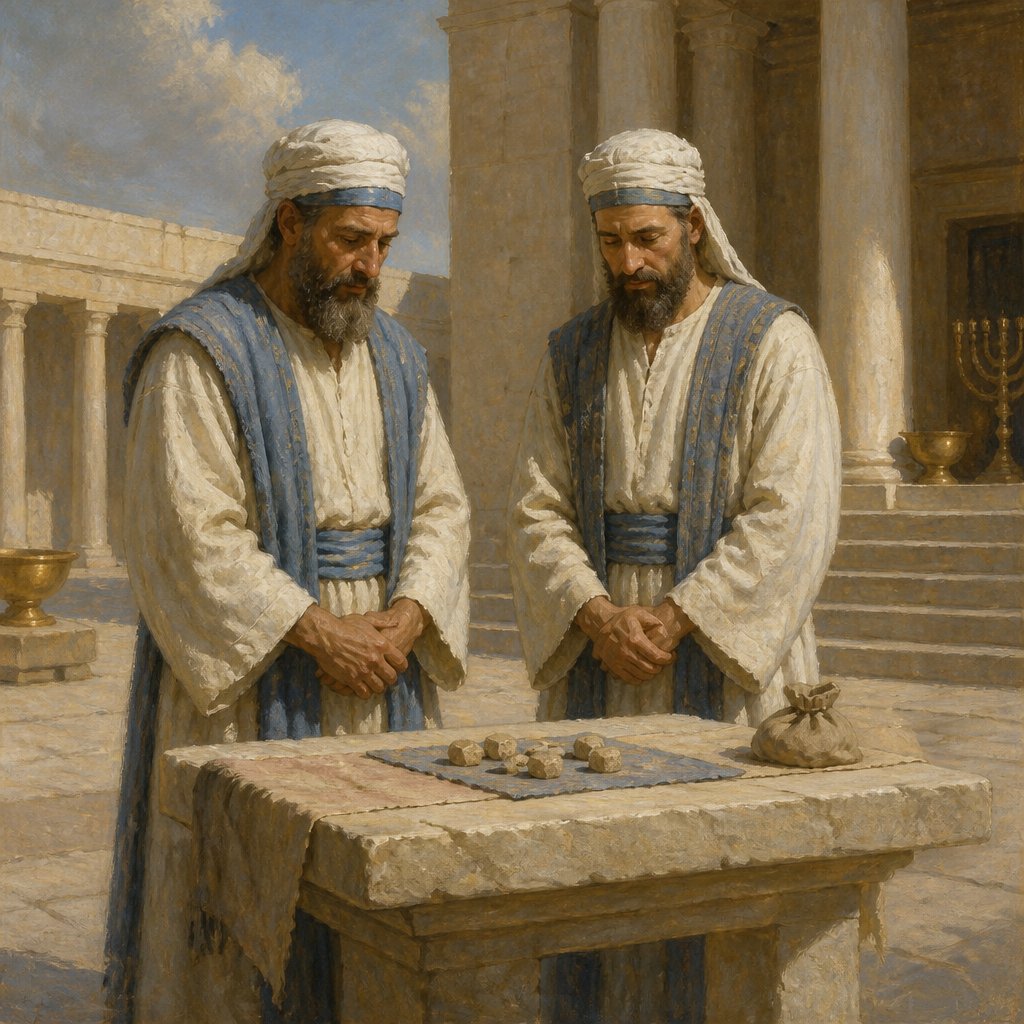
In the heart of the Old Testament, we encounter an often-overlooked passage from 1 Chronicles 24:18: "The three and twentieth to Delaiah, the four and twentieth to Maaziah." At first glance, this verse may seem to signify merely a statistic in a long record of positions for the priests, yet in its simplicity lies profound truths about the nature of divine order, worship, and community service.
The Chronicles, primarily authored by Ezra, aim to remind the post-exilic community of Israel of their identity and the importance of proper worship. This chapter succinctly outlines the divisions of the priests, highlighting the ordered structure God established for His people. Understanding these intricacies offers us vital insights about our lives today.
Firstly, we learn that God values order. Throughout Scripture, we see an inherent divine structure in creation: God spoke, and the universe came into being in an organized fashion. The same can be seen in the arrangement of the Tabernacle, the appointment of priests, and the governance of Israel. Order in worship does not stifle creativity or joy; rather, it enhances the experience of communal and individual worship. God desires not chaos but a community aligned with His purpose and plan.
In the context of 1 Chronicles 24, we must pause and reflect on the assignment of priests to their specific duties and times of service. Each priest’s role was critical to the proper functioning of the worship system established under the Law. Delaiah and Maaziah were not just names on a list; they represented individuals who had a calling and responsibility in God's holy temple. They understood that their service, no matter how seemingly minor, was integral to the whole.
This principle applies to our lives today. Each member of the body of Christ has unique gifts and assignments, which, when performed in faithfulness, contribute to the greater work of the Kingdom. Paul reflects this in 1 Corinthians 12:12-14, where he illustrates that the body of Christ is one but has many members, each with different roles. No position is insignificant. Perhaps you’re a listener, a prayer warrior, a teacher, or even a behind-the-scenes supporter. Each role is vital to the mission of spreading the love of Christ.
Secondly, this passage emphasizes the importance of accountability and commitment. The priests knew their assignments and the significance of showing up. They did not work according to their own schedule but were required to serve in accordance with a predetermined order that ensured the continuity of worship practices. Their commitment to fulfilling their roles is a powerful reminder for us in our spiritual journeys. How often do we neglect our commitments to our local churches or Christian service? Are we showing up fully in our responsibilities, or are we complacently drifting along?
Moreover, the specificity of their duties demonstrates God's intention for worship to be community-oriented. Worship is not meant to be a solo endeavor but rather an act intertwined with the lives of others. Delaiah and Maaziah remind us that our worship is enhanced in the collective. As we gather with one another in communities of believers, we lift our voices in unity and express collective praise, making our worship more profound and impactful.
Lastly, let us consider the historical context in which these priests served. In a time when Israel faced challenges and uncertainty after exile, the structured worship served as a beacon of hope and restoration. It reaffirmed their identity, reminding them that they were the chosen people of God, entrusted with His presence through the temple service. As we engage in our own acts of worship and service, whether through music, prayer, or acts of kindness, we are participating in a divine lineage that connects us with our forebearers who sought after the heart of God.
In conclusion, when we examine 1 Chronicles 24:18, we are invited to see the larger picture of how God orders our worship, calls each of us to service, encourages accountability, and forms us into a community of believers. May we take inspiration from Delaiah and Maaziah to serve faithfully in our respective roles, contributing to the harmonious function of the body of Christ, and glorifying God through our orderly acts of worship.
Get our apps


Artwork for 1 Chronicles 24:18

1 Chronicles 24:18 - "The three and twentieth to Delaiah, the four and twentieth to Maaziah."
"The three and twentieth to Delaiah, the four and twentieth to Maaziah." - 1 Chronicles 24:18

1 Chronicles 24:24 - "Of the sons of Uzziel; Michah: of the sons of Michah; Shamir."

1 Chronicles 1:24 - "¶ Shem, Arphaxad, Shelah,"

2 Chronicles 24:18 - "And they left the house of the LORD God of their fathers, and served groves and idols: and wrath came upon Judah and Jerusalem for this their trespass."

1 Chronicles 8:24 - "And Hananiah, and Elam, and Antothijah,"

2 Chronicles 18:24 - "And Micaiah said, Behold, thou shalt see on that day when thou shalt go into an inner chamber to hide thyself."

1 Chronicles 24:15 - "The seventeenth to Hezir, the eighteenth to Aphses,"

1 Chronicles 24:16 - "The nineteenth to Pethahiah, the twentieth to Jehezekel,"

1 Chronicles 24:11 - "The ninth to Jeshua, the tenth to Shecaniah,"

1 Chronicles 24:14 - "The fifteenth to Bilgah, the sixteenth to Immer,"

1 Chronicles 24:9 - "The fifth to Malchijah, the sixth to Mijamin,"

1 Chronicles 24:13 - "The thirteenth to Huppah, the fourteenth to Jeshebeab,"

1 Chronicles 24:10 - "The seventh to Hakkoz, the eighth to Abijah,"

1 Chronicles 24:8 - "The third to Harim, the fourth to Seorim,"

1 Chronicles 24:12 - "The eleventh to Eliashib, the twelfth to Jakim,"

1 Chronicles 1:18 - "And Arphaxad begat Shelah, and Shelah begat Eber."

1 Chronicles 24:22 - "Of the Izharites; Shelomoth: of the sons of Shelomoth; Jahath."

1 Chronicles 24:29 - "Concerning Kish: the son of Kish was Jerahmeel."

"¶ Shem, Arphaxad, Shelah," - 1 Chronicles 1:24

1 Chronicles 24:25 - "The brother of Michah was Isshiah: of the sons of Isshiah; Zechariah."

1 Chronicles 24:21 - "Concerning Rehabiah: of the sons of Rehabiah, the first was Isshiah."

1 Chronicles 24:28 - "Of Mahli came Eleazar, who had no sons."

1 Chronicles 24:17 - "The one and twentieth to Jachin, the two and twentieth to Gamul,"

1 Chronicles 24:1 - "Now these are the divisions of the sons of Aaron. The sons of Aaron; Nadab, and Abihu, Eleazar, and Ithamar."

1 Chronicles 23:18 - "Of the sons of Izhar; Shelomith the chief."

1 Chronicles 26:24 - "And Shebuel the son of Gershom, the son of Moses, was ruler of the treasures."

1 Chronicles 24:27 - "¶ The sons of Merari by Jaaziah; Beno, and Shoham, and Zaccur, and Ibri."

"Of the sons of Uzziel; Michah: of the sons of Michah; Shamir." - 1 Chronicles 24:24

1 Chronicles 24:7 - "Now the first lot came forth to Jehoiarib, the second to Jedaiah,"