The Legacy of Faith: Lessons from Kish and Jerahmeel
“Concerning Kish: the son of Kish was Jerahmeel.” — 1 Chronicles 24:29
When we delve into the genealogical verses of the Bible, such as 1 Chronicles 24:29, "Concerning Kish: the son of Kish was Jerahmeel," we find more than just names; we uncover profound truths about legacy, lineage, and the divine plan interwoven in our daily lives. In our culture, where names often carry little more than a familial connection or a cultural significance, the Bible presents names as carriers of weighty spiritual truths and historical significance.
To understand the richness of this verse, we need to look carefully at the figures mentioned. Kish appears in the genealogy of the Levites, a tribe set apart for service in God’s temple. By noting that Jerahmeel is the son of Kish, we begin to see the importance of family within God’s covenant. While some genealogies might seem tedious at first glance, they reveal God’s faithfulness through generations. Kish and Jerahmeel remind us that our place in God’s plan often involves those who came before us and those who come after.
Kish was a significant figure in Israel's history, though many may remember him primarily as the father of King Saul, the first king of Israel. His legacy is not solely tied to royalty but rather a reminder of the blend of human frailty and divine purpose. Kish's son Jerahmeel, in this context, brings to light the idea that every individual, whether they hold power or not, plays an integral part in the unfolding story of God's people.
This verse invites us to consider the importance of our own families and genealogies in the context of faith. What legacy are we leaving for future generations? Just as Kish had a son who would be remembered, we too must ponder the spiritual inheritance we pass on. Are we nurturing a faith that persists beyond our years?
In studying the function of the Levites, we see each man's role was significant in Israel’s worship and community life. God appointed them for specific duties that allowed the people to express their faith and seek His presence. Jerahmeel, although not as prominent as Saul, still emerges with a purpose within the Levitical service. This suggests that even those who may walk in the shadows of giants have a vital role that upholds the structure of God’s work among His people. We must recognize that every believer contributes to the Kingdom, whether through leadership, service or quiet faithfulness.
There’s another layer to this scripture that can be easy to overlook: the harmony in God’s design. While Kish denotes a historical lineage, Jerahmeel, as a servant in the temple, signifies a covenantal faithfulness within the community of Israel. This relationship reminds us that God desires unity amongst His people, not competition or envy. Just like each part of the body serves its function, so do families and individuals fulfill their God-given roles. We can reflect on our roles within our families, churches, and communities. Are we operating in unity, encouraging one another to fulfill the calling God has placed on each of our lives?
Moreover, the simplicity yet profundity of this verse should inspire us. We often find ourselves reflecting on our own family dynamics, be it challenging or harmonious. While lineage plays a role in shaping our identity, it is our relationship with God that truly defines who we are and directs our paths. God can take any line of descent, whether noble, humble, broken, or perfect, and use it for His glory. This is a comfort to those who come from less than ideal backgrounds, reminding them that they too can be vessels of honor.
As we contemplate 1 Chronicles 24:29, let us celebrate our heritage and recognize our unique place within the lineage of faith. May we honor our ancestors by living out the faith they have instilled in us. And as we strive to write our own legacies, may we do so with the understanding that our actions today resonate with eternity, impacting not just ourselves, but generations to come.
Get our apps


Artwork for 1 Chronicles 24:29

1 Chronicles 24:29 - "Concerning Kish: the son of Kish was Jerahmeel."

"Concerning Kish: the son of Kish was Jerahmeel." - 1 Chronicles 24:29

1 Chronicles 29:24 - "And all the princes, and the mighty men, and all the sons likewise of king David, submitted themselves unto Solomon the king."

1 Chronicles 4:29 - "And at Bilhah, and at Ezem, and at Tolad,"

1 Chronicles 24:24 - "Of the sons of Uzziel; Michah: of the sons of Michah; Shamir."

1 Chronicles 1:24 - "¶ Shem, Arphaxad, Shelah,"

1 Chronicles 1:29 - "¶ These are their generations: The firstborn of Ishmael, Nebaioth; then Kedar, and Adbeel, and Mibsam,"

1 Chronicles 11:29 - "Sibbecai the Hushathite, Ilai the Ahohite,"
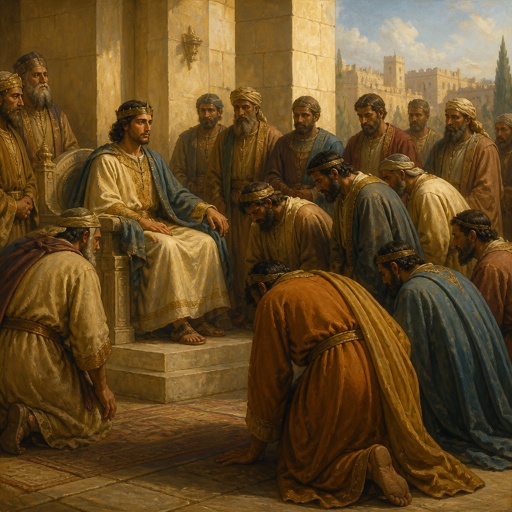
"And all the princes, and the mighty men, and all the sons likewise of king David, submitted themselves unto Solomon the king." - 1 Chronicles 29:24

1 Chronicles 8:24 - "And Hananiah, and Elam, and Antothijah,"

1 Chronicles 24:15 - "The seventeenth to Hezir, the eighteenth to Aphses,"

1 Chronicles 24:16 - "The nineteenth to Pethahiah, the twentieth to Jehezekel,"

1 Chronicles 24:11 - "The ninth to Jeshua, the tenth to Shecaniah,"

1 Chronicles 29:29 - "Now the acts of David the king, first and last, behold, they are written in the book of Samuel the seer, and in the book of Nathan the prophet, and in the book of Gad the seer,"

1 Chronicles 24:14 - "The fifteenth to Bilgah, the sixteenth to Immer,"

1 Chronicles 24:9 - "The fifth to Malchijah, the sixth to Mijamin,"

1 Chronicles 24:13 - "The thirteenth to Huppah, the fourteenth to Jeshebeab,"

1 Chronicles 24:10 - "The seventh to Hakkoz, the eighth to Abijah,"

1 Chronicles 24:8 - "The third to Harim, the fourth to Seorim,"

1 Chronicles 24:12 - "The eleventh to Eliashib, the twelfth to Jakim,"

1 Chronicles 29:26 - "¶ Thus David the son of Jesse reigned over all Israel."

1 Chronicles 8:29 - "And at Gibeon dwelt the father of Gibeon; whose wife's name was Maachah:"

2 Chronicles 29:24 - "And the priests killed them, and they made reconciliation with their blood upon the altar, to make an atonement for all Israel: for the king commanded that the burnt offering and the sin offering should be made for all Israel."

1 Chronicles 24:22 - "Of the Izharites; Shelomoth: of the sons of Shelomoth; Jahath."

1 Chronicles 2:29 - "And the name of the wife of Abishur was Abihail, and she bare him Ahban, and Molid."

"And at Bilhah, and at Ezem, and at Tolad," - 1 Chronicles 4:29

"¶ Shem, Arphaxad, Shelah," - 1 Chronicles 1:24

1 Chronicles 24:25 - "The brother of Michah was Isshiah: of the sons of Isshiah; Zechariah."

1 Chronicles 24:18 - "The three and twentieth to Delaiah, the four and twentieth to Maaziah."

1 Chronicles 24:21 - "Concerning Rehabiah: of the sons of Rehabiah, the first was Isshiah."