The Weight of Divine Calling: Embracing God’s Purpose for Our Lives
“Furthermore David the king said unto all the congregation, Solomon my son, whom alone God hath chosen, is yet young and tender, and the work is great: for the palace is not for man, but for the LORD God.” — 1 Chronicles 29:1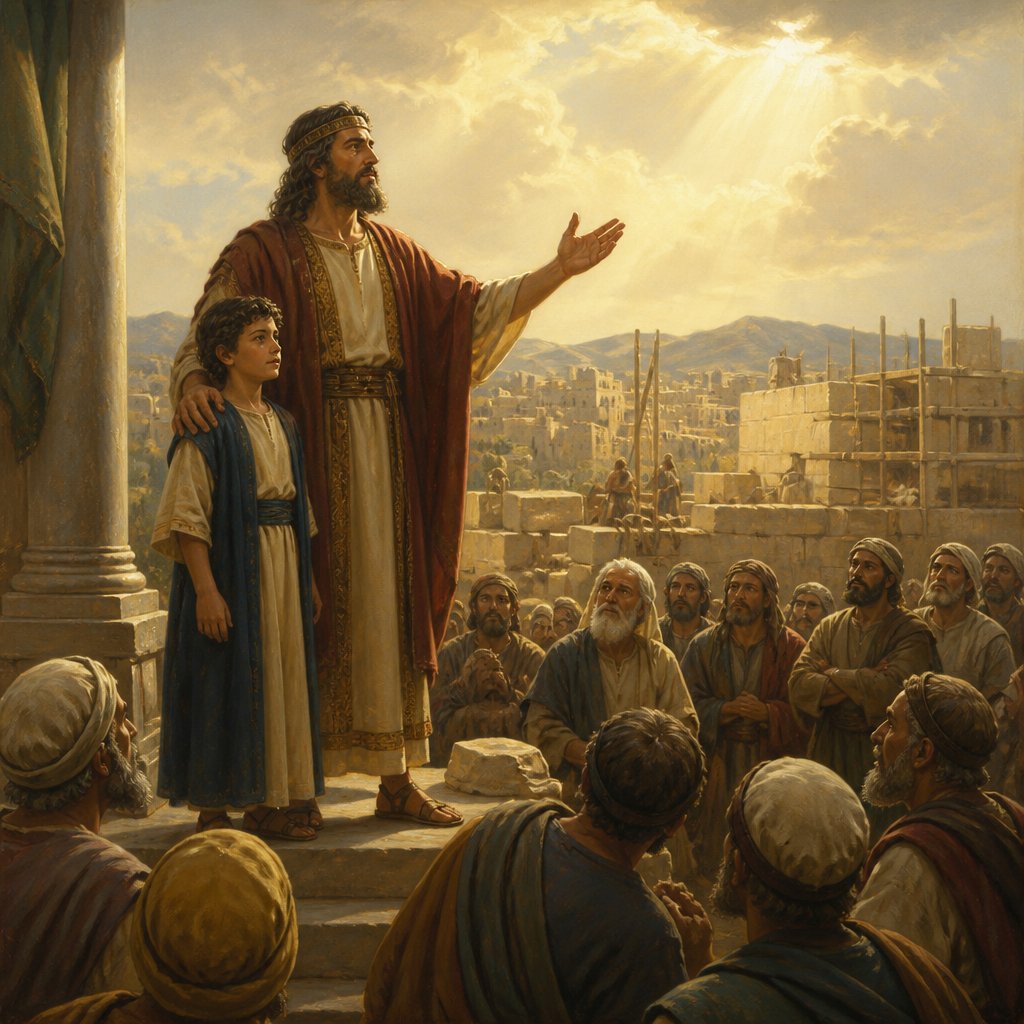
In 1 Chronicles 29:1, we read: "Furthermore David the king said unto all the congregation, Solomon my son, whom alone God hath chosen, is yet young and tender, and the work is great: for the palace is not for man, but for the LORD God." This verse captures a pivotal moment in the life of Israel, as King David addresses the congregation regarding the succession of leadership and the monumental task ahead of Solomon—building the temple of the Lord.
As we reflect on this passage, we can draw several key insights into the nature of divine calling and the responsibilities that come with it. David acknowledges Solomon’s youth and inexperience, recognizing that even though he has been chosen by God, he still has much to learn and grow. This brings to light the truth that God often calls the young and inexperienced to do His work, not because He overlooks their immaturity, but because He sees their potential and desires to mold them into vessels for His glory.
Solomon’s calling was not just a personal challenge; it was a national calling. David’s declaration to the congregation serves as a reminder that our individual purposes often intersect with God’s larger plan for His people. Solomon was to lead a significant endeavor—not merely for his own gain or recognition but to build a place of worship dedicated to the Lord. As we navigate our paths, we must remember that our efforts must point back to God’s glory. Who are we serving in our pursuits?
Moreover, David emphasizes that the work ahead is great and involves building a palace not for man, but for the Lord God. This delineation is crucial for understanding our own callings. We are not to seek personal glory or accolades in our work; instead, our focus should be on serving the Lord in all capacities. Everything we do—whether it be in the workplace, at home, in our communities, or in our relationships—must be approached with the intention of honoring God.
David also provides a beautiful framework for understanding the transition of leadership. He recognizes that leadership is not merely a rank or title, but a responsibility to serve others with humility and dedication. By openly declaring Solomon’s divine appointment, David models the importance of supporting those in leadership roles, fostering a community of encouragement rather than envy.
This verse prompts us to consider our own roles in the community of faith. Are we supportive of others in their God-given callings? As Christians, we are part of the body of Christ, each with unique gifts and responsibilities. Encouraging and uplifting one another, especially the younger or less experienced members of our congregations, reflects the heart of David’s message. It calls us to cultivate a spirit of mentorship and discipleship.
Lastly, we need to recognize the significance of individual preparation in the face of collective expectation. Solomon was young and 'tender,' suggesting that part of fulfilling his calling would require him to grow and mature in wisdom and understanding. As we aspire towards our God-given tasks, we, too, must commit ourselves to preparation—praying for wisdom, seeking knowledge through Scripture, and learning from those who have gone before us.
In conclusion, 1 Chronicles 29:1 challenges us to reflect on our own lives and the great work we are called to, not for ourselves but for the Lord God. Let us remind ourselves that while the work may be great and daunting, it is God who equips and empowers us for the task ahead. As we engage in God’s work, may we do so with a humble heart, focused on His glory, supporting one another in our respective journeys, and recognizing that every step we take is in service to the most high—a palace not for man, but for the Lord.
Get our apps


Artwork for 1 Chronicles 29:1

1 Chronicles 29:1 - "Furthermore David the king said unto all the congregation, Solomon my son, whom alone God hath chosen, is yet young and tender, and the work is great: for the palace is not for man, but for the LORD God."
"Furthermore David the king said unto all the congregation, Solomon my son, whom alone God hath chosen, is yet young and tender, and the work is great: for the palace is not for man, but for the LORD God." - 1 Chronicles 29:1

1 Chronicles 1:29 - "¶ These are their generations: The firstborn of Ishmael, Nebaioth; then Kedar, and Adbeel, and Mibsam,"

1 Chronicles 4:29 - "And at Bilhah, and at Ezem, and at Tolad,"

1 Chronicles 11:29 - "Sibbecai the Hushathite, Ilai the Ahohite,"

1 Chronicles 24:29 - "Concerning Kish: the son of Kish was Jerahmeel."

1 Chronicles 29:26 - "¶ Thus David the son of Jesse reigned over all Israel."

1 Chronicles 8:29 - "And at Gibeon dwelt the father of Gibeon; whose wife's name was Maachah:"

1 Chronicles 29:29 - "Now the acts of David the king, first and last, behold, they are written in the book of Samuel the seer, and in the book of Nathan the prophet, and in the book of Gad the seer,"

1 Chronicles 2:29 - "And the name of the wife of Abishur was Abihail, and she bare him Ahban, and Molid."

"And at Bilhah, and at Ezem, and at Tolad," - 1 Chronicles 4:29

1 Chronicles 25:29 - "The two and twentieth to Giddalti, he, his sons, and his brethren, were twelve:"

"¶ These are their generations: The firstborn of Ishmael, Nebaioth; then Kedar, and Adbeel, and Mibsam," - 1 Chronicles 1:29

1 Chronicles 16:29 – "Ascribe to the Lord the glory due his name; bring an offering and come before him."

1 Chronicles 29:13 - "Now therefore, our God, we thank thee, and praise thy glorious name."

1 Chronicles 26:29 - "¶ Of the Izharites, Chenaniah and his sons were for the outward business over Israel, for officers and judges."

"Sibbecai the Hushathite, Ilai the Ahohite," - 1 Chronicles 11:29

1 Chronicles 6:29 - "The sons of Merari; Mahli, Libni his son, Shimei his son, Uzza his son,"

1 Kings 14:29 - "¶ Now the rest of the acts of Rehoboam, and all that he did, are they not written in the book of the chronicles of the kings of Judah?"

1 Chronicles 29:6 - "¶ Then the chief of the fathers and princes of the tribes of Israel, and the captains of thousands and of hundreds, with the rulers of the king's work, offered willingly,"

1 Chronicles 29:8 - "And they with whom precious stones were found gave them to the treasure of the house of the LORD, by the hand of Jehiel the Gershonite."

1 Chronicles 27:29 - "And over the herds that fed in Sharon was Shitrai the Sharonite: and over the herds that were in the valleys was Shaphat the son of Adlai:"

"Concerning Kish: the son of Kish was Jerahmeel." - 1 Chronicles 24:29

1 Chronicles 21:29 - "For the tabernacle of the LORD, which Moses made in the wilderness, and the altar of the burnt offering, were at that season in the high place at Gibeon."

1 Chronicles 29:24 - "And all the princes, and the mighty men, and all the sons likewise of king David, submitted themselves unto Solomon the king."

1 Chronicles 29:23 - "Then Solomon sat on the throne of the LORD as king instead of David his father, and prospered; and all Israel obeyed him."

1 Chronicles 29:15 - "For we are strangers before thee, and sojourners, as were all our fathers: our days on the earth are as a shadow, and there is none abiding."

1 Chronicles 29:28 - "And he died in a good old age, full of days, riches, and honour: and Solomon his son reigned in his stead."

1 Chronicles 29:30 - "With all his reign and his might, and the times that went over him, and over Israel, and over all the kingdoms of the countries."

1 Chronicles 12:29 - "And of the children of Benjamin, the kindred of Saul, three thousand: for hitherto the greatest part of them had kept the ward of the house of Saul."