Blessed Beyond Measure: A Heart of Gratitude in Worship
“Wherefore David blessed the LORD before all the congregation: and David said, Blessed be thou, LORD God of Israel our father, for ever and ever.” — 1 Chronicles 29:10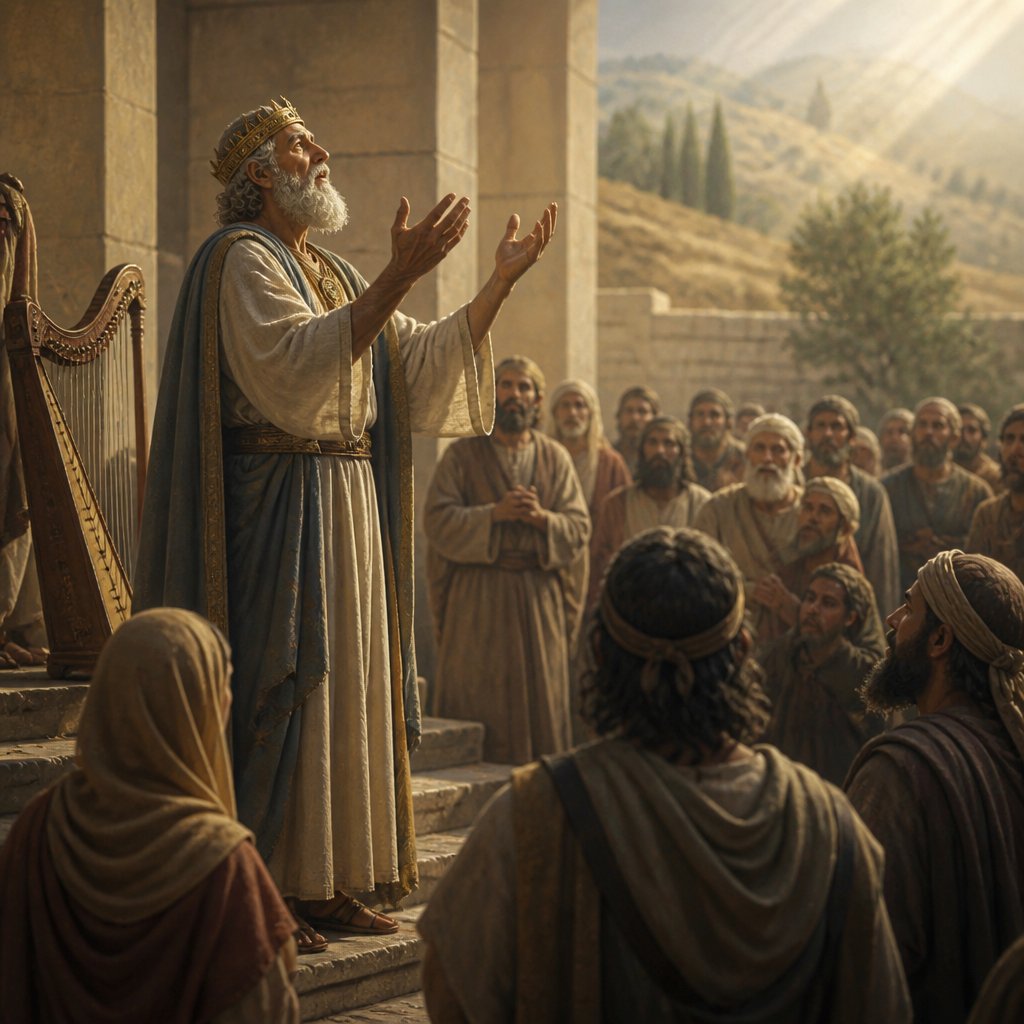
In 1 Chronicles 29:10, King David exemplifies a profound expression of worship as he declares, "Wherefore David blessed the LORD before all the congregation: and David said, Blessed be thou, LORD God of Israel our father, for ever and ever." This moment is charged with significance, not merely as a ritualistic act of blessing but as a heartfelt acknowledgment of God’s sovereignty, faithfulness, and everlasting nature. In exploring this verse, we are invited to reflect upon our own posture in worship and gratitude towards God.
David’s blessing of the Lord before the entire congregation serves a dual purpose: it affirms God’s eternal greatness and inspires communal worship among the people of Israel. Throughout his life, David encountered numerous challenges—from the rejection of Saul to his personal failings—but in every circumstance, he maintained a posture of gratitude. His heartfelt expression can serve as a model for us, offering today’s believers insight into both personal devotion and communal worship.
### The Heart Posture of Blessing
To ‘bless’ the Lord is to acknowledge His attributes, His greatness, and His role in our lives both individually and collectively. David’s declaration recognizes God not only as the Creator but also as the Lord of Israel, establishing a relationship that is founded on love, loyalty, and reverence. His words, "Blessed be thou," are not mere formalities; they resonate with the authenticity of a king who understood the weight of his position and the depth of his dependence on God.
When we read this verse, it invites us to consider how we position our hearts toward the Lord. Do we come before God with gratitude, acknowledging His hand in our lives? Do we verbally bless His name, as David did, or do we allow the busyness of life to stifle our praise? A heart that recognizes God’s sovereignty and goodness will naturally overflow with worship. We must be intentional in our prayer and praise, taking cues from David about expressing our gratitude not as a duty but as a sincere response to God's greatness.
### Acknowledging God as Our Father
David affirms the eternal relationship with God as "our father." This acknowledgment brings warmth and intimacy into our understanding of God. The term ‘father’ conveys a deep sense of familial love, care, and responsibility. In a time when leadership was often associated with tyranny or fear, David’s acknowledgment of God as a compassionate father highlights a revolution in understanding divine authority.
As children of God, we are invited into this same relationship; through Christ, we can call God ‘Father’ (Romans 8:15). This is a profound truth that should shape both our personal prayers and public worship. When we gather as congregations, how often do we reflect this familial connection in our praise? It is a reminder that worship is not just an act we perform; it is an intimate exchange with our loving Father.
### Everlasting Praise
Finally, David’s exclamation "for ever and ever" encapsulates the eternal nature of God. He is beyond time, unchanging, and constantly good. Every blessing we receive and every gift we experience comes from a source that is both faithful and eternal. This knowledge invites us to cultivate a lifestyle marked by gratitude and thanksgiving.
In the trials of our daily lives, it can be easy to forget the eternal nature of our God. Yet, when we bless God for what He has done, is doing, and will do, we align ourselves with the reality of His everlasting kingdom. Our circumstances may change, but our God remains constant. Therefore, in our worship, we must echo David’s words, acknowledging His grandeur, His fatherly love, and His eternal reign.
### Conclusion
As we close our reflection on 1 Chronicles 29:10, may our hearts be ignited with a renewed passion to bless the Lord, both privately and publicly. Let us take inspiration from David, embracing a life rich in thankfulness, aware of God's unchanging character as our Father. Let this recognition fuel our worship, fostering an environment where we, like David, bless the Lord for ever and ever.
Get our apps


Artwork for 1 Chronicles 29:10

1 Chronicles 29:10 - "¶ Wherefore David blessed the LORD before all the congregation: and David said, Blessed be thou, LORD God of Israel our father, for ever and ever."
"¶ Wherefore David blessed the LORD before all the congregation: and David said, Blessed be thou, LORD God of Israel our father, for ever and ever." - 1 Chronicles 29:10

1 Chronicles 4:29 - "And at Bilhah, and at Ezem, and at Tolad,"

1 Chronicles 1:29 - "¶ These are their generations: The firstborn of Ishmael, Nebaioth; then Kedar, and Adbeel, and Mibsam,"

1 Chronicles 11:29 - "Sibbecai the Hushathite, Ilai the Ahohite,"

1 Chronicles 24:29 - "Concerning Kish: the son of Kish was Jerahmeel."

2 Chronicles 29:10 - "Now it is in mine heart to make a covenant with the LORD God of Israel, that his fierce wrath may turn away from us."

1 Chronicles 29:29 - "Now the acts of David the king, first and last, behold, they are written in the book of Samuel the seer, and in the book of Nathan the prophet, and in the book of Gad the seer,"

1 Chronicles 29:26 - "¶ Thus David the son of Jesse reigned over all Israel."

1 Chronicles 8:29 - "And at Gibeon dwelt the father of Gibeon; whose wife's name was Maachah:"

"And at Bilhah, and at Ezem, and at Tolad," - 1 Chronicles 4:29

1 Chronicles 2:29 - "And the name of the wife of Abishur was Abihail, and she bare him Ahban, and Molid."

2 Chronicles 29:10 (KJVA) 10 Now it is in mine heart to make a covenant with the LORD God of Israel, that his fierce wrath may turn away from us.

2 Chronicles 29:10 (KJVA) 10 Now it is in mine heart to make a covenant with the LORD God of Israel, that his fierce wrath may turn away from us.

2 Chronicles 29:10 (KJVA) 10 Now it is in mine heart to make a covenant with the LORD God of Israel, that his fierce wrath may turn away from us.

1 Chronicles 25:29 - "The two and twentieth to Giddalti, he, his sons, and his brethren, were twelve:"

2 Chronicles 29:10 (KJVA) 10 Now it is in mine heart to make a covenant with the LORD God of Israel, that his fierce wrath may turn away from us.

1 Chronicles 16:29 – "Ascribe to the Lord the glory due his name; bring an offering and come before him."

1 Chronicles 29:13 - "Now therefore, our God, we thank thee, and praise thy glorious name."

1 Chronicles 26:29 - "¶ Of the Izharites, Chenaniah and his sons were for the outward business over Israel, for officers and judges."

"Sibbecai the Hushathite, Ilai the Ahohite," - 1 Chronicles 11:29

1 Chronicles 4 : 10

1 Chronicles 6:29 - "The sons of Merari; Mahli, Libni his son, Shimei his son, Uzza his son,"

1 Kings 14:29 - "¶ Now the rest of the acts of Rehoboam, and all that he did, are they not written in the book of the chronicles of the kings of Judah?"

1 Chronicles 10:10 - "And they put his armour in the house of their gods, and fastened his head in the temple of Dagon."

1 Chronicles 29:6 - "¶ Then the chief of the fathers and princes of the tribes of Israel, and the captains of thousands and of hundreds, with the rulers of the king's work, offered willingly,"

"¶ These are their generations: The firstborn of Ishmael, Nebaioth; then Kedar, and Adbeel, and Mibsam," - 1 Chronicles 1:29

1 Chronicles 29:8 - "And they with whom precious stones were found gave them to the treasure of the house of the LORD, by the hand of Jehiel the Gershonite."

1 Chronicles 27:29 - "And over the herds that fed in Sharon was Shitrai the Sharonite: and over the herds that were in the valleys was Shaphat the son of Adlai:"

1 Chronicles 9:10 - "¶ And of the priests; Jedaiah, and Jehoiarib, and Jachin,"