Willing Hearts: A Study of Generosity in Service
“Then the chief of the fathers and princes of the tribes of Israel, and the captains of thousands and of hundreds, with the rulers of the king’s work, offered willingly,” — 1 Chronicles 29:6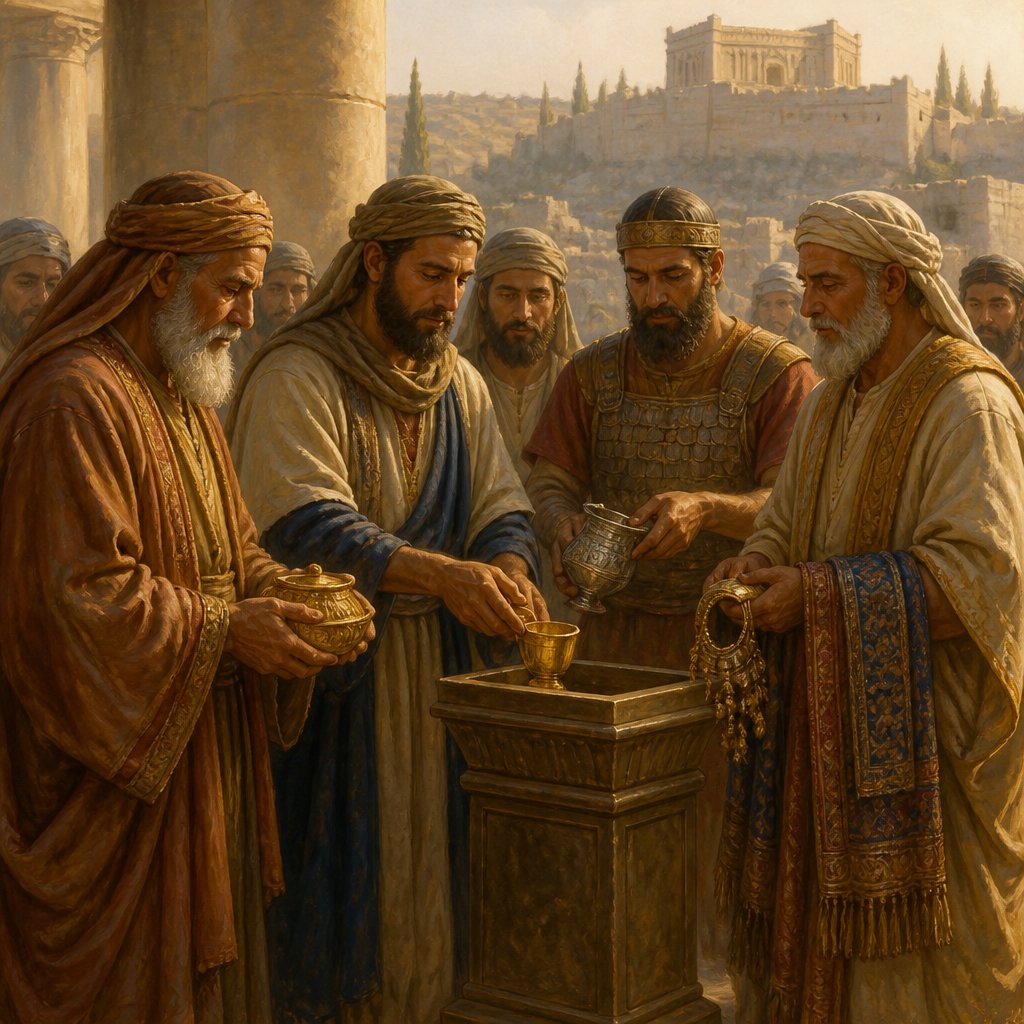
The verse 1 Chronicles 29:6 in the King James Version tells us, "Then the chief of the fathers and princes of the tribes of Israel, and the captains of thousands and of hundreds, with the rulers of the king's work, offered willingly." This scripture serves as a profound testament to the spirit of giving and the importance of a willing heart in service to God and His work.
As we consider the contextual backdrop of this verse, it is pivotal to recognize that this moment occurs towards the end of King David’s reign. David had a grand vision to construct a temple for the Lord—a place that would house the Ark of the Covenant and serve as a center of worship for the Israelite people. This was not merely an architectural endeavor; it was a spiritual undertaking, meant to express the collective love, reverence, and commitment of a nation towards their God.
The catalysts for the offerings mentioned in this passage are significant. Here we see the heads of families, tribal leaders, military captains, and rulers rallying together. Their unity is emblematic of a nation coming together for a common cause, reflecting a shared understanding of their mission: to dedicate resources that would facilitate the worship of God. There is both leadership and participation, suggesting that spiritual ownership does not lie with just a few, but radiates throughout the entire community.
The word “willingly” in this passage resonates deeply. It suggests a sense of autonomy and joy in giving rather than obligation or compulsion. It prompts us to reflect on our own motivations for serving God and contributing to His work. How often do we give out of obligation—out of duty—rather than from a genuinely willing heart? This question stirs the soul to aspire to the kind of devotion that moves beyond mere action to the spirit of the offering.
In examining how we can embody the willing spirit seen in this verse, we must consider several key aspects:
1. **Understanding Our Role as Contributors**: Every believer has a part to play in the work of God’s kingdom. Just as the chiefs and captains in Israel rallied together, we too are called to contribute—be it through our time, talents, resources, or prayers. Recognizing this can transform our perspective, moving us from seeing giving as a chore to embracing it as a privilege and an opportunity to serve the Lord.
2. **Responding to God’s Prompting**: The leaders gave willingly, and it is crucial to understand that willingness is often birthed from a response to God. In prayer and meditation, seek the Lord's guidance in what He desires for you to give. It could be in service, generosity, or even dedication to a cause. This discerning process resembles cultivating a relationship with God, where we learn to hear His voice and respond with open hearts.
3. **Embracing Sacrificial Giving**: The leaders’ offerings were not without personal sacrifice. In our Christian journey, sacrifice may take multiple forms. It could mean relinquishing personal comforts or taking time out of a busy schedule to serve others. It is important to note that a true offering is often accompanied by the willingness to go beyond our comfort zones.
4. **Celebrating Collective Generosity**: Just as the leaders came together in a unified effort, celebrating and encouraging collective generosity in our communities is vital. When we witness shared sacrificial giving, it inspires others to reflect on their own willingness to contribute, fostering a community of abundance and support.
Ultimately, 1 Chronicles 29:6 challenges us to introspect on our own contributions to God’s work. Are we giving willingly? Are our acts of service rooted in a heart that delights in glorifying God? As we seek to be willing in our offerings, may we remember that it is not merely the act that matters, but the heart behind it. Let us strive to emulate the chief leaders of Israel, who understood that the success of a grand vision lay in their shared commitment, joyful sacrifice, and unwavering faith in God.
Get our apps


Artwork for 1 Chronicles 29:6

1 Chronicles 29:6 - "¶ Then the chief of the fathers and princes of the tribes of Israel, and the captains of thousands and of hundreds, with the rulers of the king's work, offered willingly,"
"¶ Then the chief of the fathers and princes of the tribes of Israel, and the captains of thousands and of hundreds, with the rulers of the king's work, offered willingly," - 1 Chronicles 29:6

1 Chronicles 6:29 - "The sons of Merari; Mahli, Libni his son, Shimei his son, Uzza his son,"

1 Chronicles 4:29 - "And at Bilhah, and at Ezem, and at Tolad,"

1 Chronicles 1:29 - "¶ These are their generations: The firstborn of Ishmael, Nebaioth; then Kedar, and Adbeel, and Mibsam,"

1 Chronicles 11:29 - "Sibbecai the Hushathite, Ilai the Ahohite,"

1 Chronicles 24:29 - "Concerning Kish: the son of Kish was Jerahmeel."
"The sons of Merari; Mahli, Libni his son, Shimei his son, Uzza his son," - 1 Chronicles 6:29

1 Chronicles 29:29 - "Now the acts of David the king, first and last, behold, they are written in the book of Samuel the seer, and in the book of Nathan the prophet, and in the book of Gad the seer,"

1 Chronicles 29:26 - "¶ Thus David the son of Jesse reigned over all Israel."

1 Chronicles 8:29 - "And at Gibeon dwelt the father of Gibeon; whose wife's name was Maachah:"

"And at Bilhah, and at Ezem, and at Tolad," - 1 Chronicles 4:29

1 Chronicles 2:29 - "And the name of the wife of Abishur was Abihail, and she bare him Ahban, and Molid."

1 Chronicles 25:29 - "The two and twentieth to Giddalti, he, his sons, and his brethren, were twelve:"

1 Chronicles 6:6 - "And Uzzi begat Zerahiah, and Zerahiah begat Meraioth,"

Matthew 6:29 expressed as a rose garden

1 Chronicles 16:29 – "Ascribe to the Lord the glory due his name; bring an offering and come before him."

1 Chronicles 29:13 - "Now therefore, our God, we thank thee, and praise thy glorious name."

1 Chronicles 26:29 - "¶ Of the Izharites, Chenaniah and his sons were for the outward business over Israel, for officers and judges."

1 Chronicles 1:6 - "And the sons of Gomer; Ashchenaz, and Riphath, and Togarmah."

"Sibbecai the Hushathite, Ilai the Ahohite," - 1 Chronicles 11:29

1 Chronicles 6:1 - "The sons of Levi; Gershon, Kohath, and Merari."

1 Kings 14:29 - "¶ Now the rest of the acts of Rehoboam, and all that he did, are they not written in the book of the chronicles of the kings of Judah?"

1 Chronicles 14:6 - "And Nogah, and Nepheg, and Japhia,"

"¶ These are their generations: The firstborn of Ishmael, Nebaioth; then Kedar, and Adbeel, and Mibsam," - 1 Chronicles 1:29

1 Chronicles 29:8 - "And they with whom precious stones were found gave them to the treasure of the house of the LORD, by the hand of Jehiel the Gershonite."

1 Chronicles 27:29 - "And over the herds that fed in Sharon was Shitrai the Sharonite: and over the herds that were in the valleys was Shaphat the son of Adlai:"

"Concerning Kish: the son of Kish was Jerahmeel." - 1 Chronicles 24:29

1 Chronicles 21:29 - "For the tabernacle of the LORD, which Moses made in the wilderness, and the altar of the burnt offering, were at that season in the high place at Gibeon."

1 Chronicles 29:24 - "And all the princes, and the mighty men, and all the sons likewise of king David, submitted themselves unto Solomon the king."