Weaving the Threads of Legacy
“The sons of Shelah the son of Judah were, Er the father of Lecah, and Laadah the father of Mareshah, and the families of the house of them that wrought fine linen, of the house of Ashbea,” — 1 Chronicles 4:21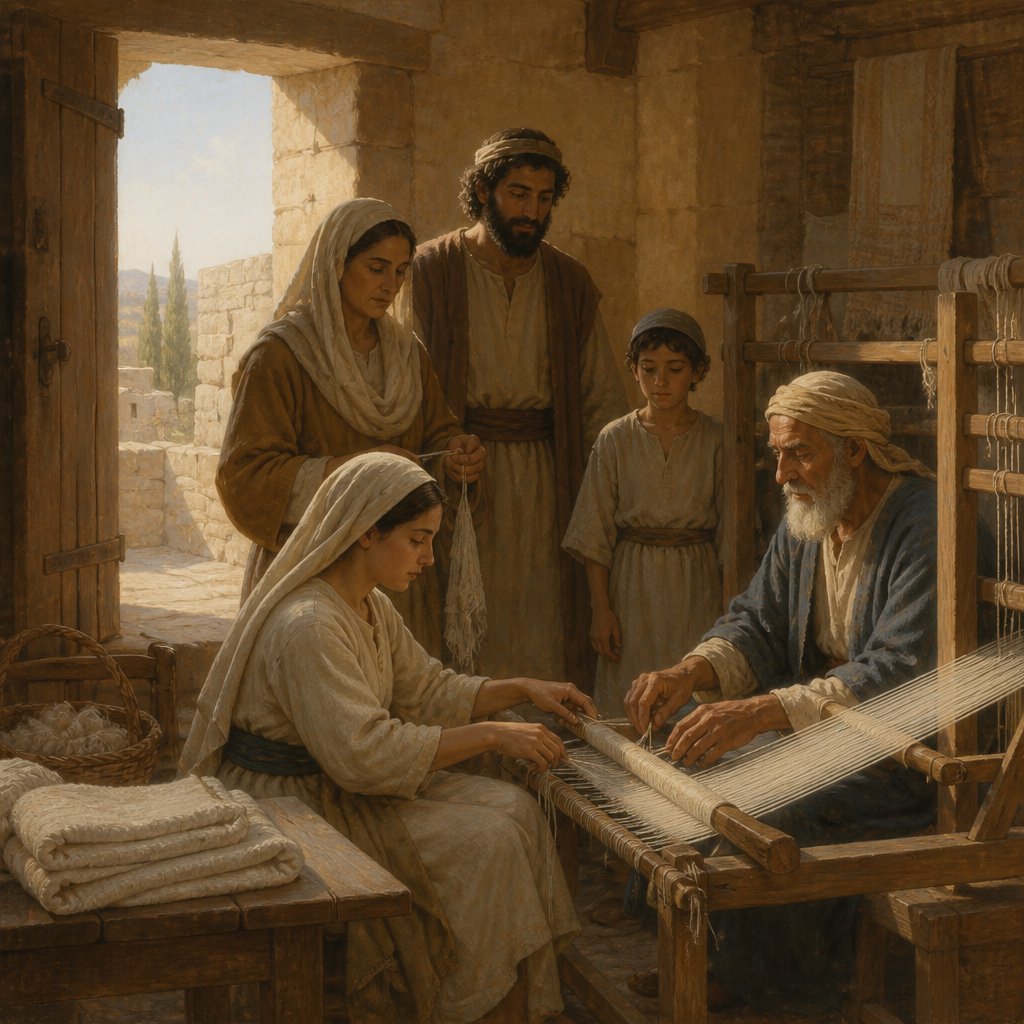
In 1 Chronicles 4:21, we read, "The sons of Shelah the son of Judah were, Er the father of Lecah, and Laadah the father of Mareshah, and the families of the house of them that wrought fine linen, of the house of Ashbea." At first glance, this verse may seem mundane, a mere catalogue of names and familial ties. Yet, upon deeper reflection, it unveils profound truths about legacy, craftsmanship, and the unnoticed contributions of individuals throughout biblical history.
The genealogies in the Bible often serve a dual purpose: they mark the lineage of prominent figures and illustrate the often-overlooked individuals who played significant roles in God’s unfolding story. Shelah, the son of Judah, is a vital link in the genealogical chain that leads to the lineage of Christ. Yet, his descendants are not the central focus of grandiose titles or heroic deeds. Instead, we find them described simply as families of artisans—those who created beautiful textiles, or fine linen. This observation brings us to an essential truth: God values diligence and skill in the ordinary tasks of life just as much as in the extraordinary acts of leadership and power.
In the ancient Near East, the production of fine linen was not just a craft; it was a trade that spoke of luxury and quality. Those who wove fine linen played a crucial role in society, as their products were highly sought after for clothing, ceremonial garb, and even the temple's furnishings. The mention of the families of Shelah working in this profession illustrates that every skill, no matter how humble it may appear, has value in the kingdom of God. It reminds us that God calls individuals not only to the spotlight jobs but also to the backstage roles where they can serve creatively and faithfully, contributing to the beauty of the community.
Moreover, the act of weaving itself becomes a metaphor for the way God intricately works in our lives. Just as the families of Shelah used their skills to produce fine linen, God weaves together the threads of our experiences—joys and sorrows, triumphs and trials—into a beautiful tapestry that reflects His glory. In moments when life feels chaotic or challenging, we can trust that He is at work, weaving our stories together for a greater purpose. Romans 8:28 reminds us, "And we know that all things work together for good to them that love God, to them who are the called according to his purpose." Every thread of our existence is held in the Master's hands, who knows exactly how to craft each one into something beautiful and meaningful.
This passage encourages us to assess our own legacies. What are we weaving with our lives? Are we using our God-given skills and passions to contribute positively to the world around us? Each act of service, no matter how small, adds to the greater narrative of God’s love in action. Like the artisans of the Shelah lineage, we too can become weave-makers in our families, workplaces, and communities, bringing forth vibrant colors of compassion, understanding, and creativity.
Furthermore, in our modern world that often idolizes visibility and recognition, this scripture beckons us to celebrate the unseen laborers—the caregivers, the workers, the everyday heroes. God honors the faithfulness behind closed doors, in quiet places where most aspire not to be. Jesus himself declared in Matthew 6:6, "But thou, when thou prayest, enter into thy closet, and when thou hast shut thy door, pray to thy Father which is in secret; and thy Father which seeth in secret shall reward thee openly."
In conclusion, as we reflect on 1 Chronicles 4:21, may we be inspired to embrace our crafts, however small, and recognize the significance of the everyday roles we play. Let us weave our lives with righteousness and purpose, contributing to God’s legacy in our world. Weaving together the threads of service and love, may we glorify Him in all that we do, and leave behind a legacy of faith that honors those who come after us.
Get our apps


Artwork for 1 Chronicles 4:21

1 Chronicles 4:21 - "¶ The sons of Shelah the son of Judah were, Er the father of Lecah, and Laadah the father of Mareshah, and the families of the house of them that wrought fine linen, of the house of Ashbea,"
"¶ The sons of Shelah the son of Judah were, Er the father of Lecah, and Laadah the father of Mareshah, and the families of the house of them that wrought fine linen, of the house of Ashbea," - 1 Chronicles 4:21

1 Chronicles 21:4 - "Nevertheless the king's word prevailed against Joab. Wherefore Joab departed, and went throughout all Israel, and came to Jerusalem."

2 Chronicles 4:21 - "And the flowers, and the lamps, and the tongs, made he of gold, and that perfect gold;"

1 Chronicles 1:21 - "Hadoram also, and Uzal, and Diklah,"

1 Chronicles 4 : 10

1 Chronicles 8:21 - "And Adaiah, and Beraiah, and Shimrath, the sons of Shimhi;"

1 Chronicles 21:1 - "And Satan stood up against Israel, and provoked David to number Israel."

1 Chronicles 24:21 - "Concerning Rehabiah: of the sons of Rehabiah, the first was Isshiah."

Revelations 21:4

1 Chronicles 1:4 - "Noah, Shem, Ham, and Japheth."

Revelations 21:4

Revelation 21:4

1 Chronicles 9:21 - "And Zechariah the son of Meshelemiah was porter of the door of the tabernacle of the congregation."

1 Chronicles 21:7 - "And God was displeased with this thing; therefore he smote Israel."

1 Chronicles 21:9 - "¶ And the LORD spake unto Gad, David's seer, saying,"

"Hadoram also, and Uzal, and Diklah," - 1 Chronicles 1:21

1 Chronicles 21:21 - "And as David came to Ornan, Ornan looked and saw David, and went out of the threshingfloor, and bowed himself to David with his face to the ground."

2 Chronicles 4:22

"And the flowers, and the lamps, and the tongs, made he of gold, and that perfect gold;" - 2 Chronicles 4:21

1 Chronicles 23:21 - "¶ The sons of Merari; Mahli, and Mushi. The sons of Mahli; Eleazar, and Kish."

1 Chronicles 25:21 - "The fourteenth to Mattithiah, he, his sons, and his brethren, were twelve:"

1 Chronicles 4:29 - "And at Bilhah, and at Ezem, and at Tolad,"

1 Chronicles 4:30 - "And at Bethuel, and at Hormah, and at Ziklag,"

1 Chronicles 8:4 - "And Abishua, and Naaman, and Ahoah,"

1 Chronicles 4:1 - "The sons of Judah; Pharez, Hezron, and Carmi, and Hur, and Shobal."

1 Chronicles 21:19 - "And David went up at the saying of Gad, which he spake in the name of the LORD."

1 Chronicles 21:6 - "But Levi and Benjamin counted he not among them: for the king's word was abominable to Joab."

1 Chronicles 15:21 - "And Mattithiah, and Elipheleh, and Mikneiah, and Obed-edom, and Jeiel, and Azaziah, with harps on the Sheminith to excel."

1 Chronicles 21:25 - "So David gave to Ornan for the place six hundred shekels of gold by weight."