Freedom and Responsibility: Understanding 1 Corinthians 6:12
“All things are lawful unto me, but all things are not expedient: all things are lawful for me, but I will not be brought under the power of any.” — 1 Corinthians 6:12
In 1 Corinthians 6:12, the Apostle Paul presents a profound truth that resonates deeply with the human experience:
"All things are lawful unto me, but all things are not expedient: all things are lawful for me, but I will not be brought under the power of any." (KJV)
At first glance, Paul seems to be discussing the concept of Christian liberty, proclaiming that as believers, we are freed from the stringent laws of the old covenant. In Christ, we have been liberated from the burden of sin and the weight of the law, but this freedom is accompanied by a call to discernment and responsibility. This verse invites us to dive deeper into the nature of our freedoms and the exercise thereof.
In the context of Corinth, a city steeped in immorality and excess, Paul was addressing the church's struggle with living out its faith amid a culture that celebrated indulgence. The Corinthians had distorted grace to justify their actions, believing that because they were free in Christ, they could do anything they wanted. Paul counters this thought by highlighting that not everything that is legal is beneficial.
To be lawful means to possess the right or permission to do something, yet being expedient—or beneficial—means evaluating whether an action aligns with God's purpose for us. Herein lies the crux of the matter: Just because we can engage in certain activities does not mean we should. Imagine a man who can eat all the food he desires; however, indulging in all his cravings may lead to detrimental health consequences. Similarly, our spiritual and moral well-being demands that we assess the value of our choices in light of our commitment to Christ.
Paul's statement also implies a profound truth about the nature of freedom itself. While we are free in Christ, we must be cautious not to allow ourselves to become enslaved by our choices. He asserts, "but I will not be brought under the power of any." This is a declaration of sovereignty over one's life and decisions. Paul warns that permissible actions might lead to an unforeseen bondage that counters the freedom we find in Christ. The seductive power of sin can creep in subtly, leading us away from our true source of joy and fulfillment.
As modern believers, we can apply Paul’s wisdom to our lives today. Consider the overwhelming access we have to various forms of entertainment, social media, and the rampant self-indulgence that defines our culture. We are inundated with choices that we are technically free to partake in, yet we must ask ourselves: Do these pursuits draw us closer to God, or do they ensnare us in distractions that dull our spiritual senses?
The challenge is to cultivate a mindset that evaluates our actions against God's will rather than mere personal gratification. Paul advises the church to not just follow after what is legal or permissible but instead to embrace living wisely. We should not only seek to know what is lawful but also what is right, what brings glory to God, and what builds us up in faith.
This is a call to achieve balance in our freedom. Let us not forget that true freedom in Christ does not equate with a lack of boundaries; rather, it requires creating healthy limits within which we thrive spiritually. We are called to be stewards of our lives, understanding that every action has consequences. Therefore, let us actively choose what enhances our walk with Christ, choosing activities and relationships that foster growth and lead us toward holiness.
In conclusion, let us treasure our freedom in Christ while committing ourselves to live a life that is governed by discernment and faithfulness. May our liberties become avenues through which we honor God, showcase His love, and grow in righteousness. Let us be ever mindful that while we are lawful, it is our responsibility to discern what is truly expedient for our lives as we aim to emulate Christ’s character in all we do.
Get our apps


Artwork for 1 Corinthians 6:12
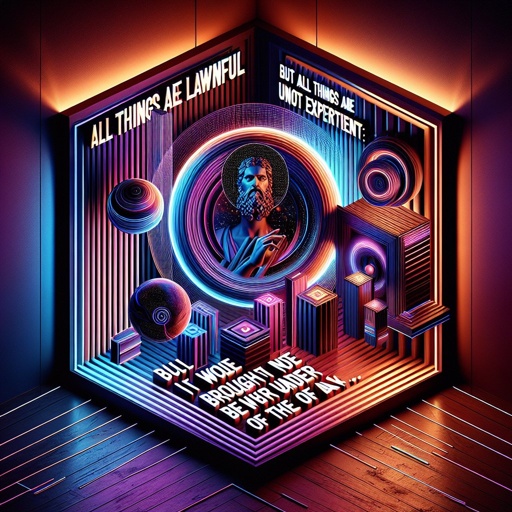
1 Corinthians 6:12 - "All things are lawful unto me, but all things are not expedient: all things are lawful for me, but I will not be brought under the power of any."

"All things are lawful unto me, but all things are not expedient: all things are lawful for me, but I will not be brought under the power of any." - 1 Corinthians 6:12

1 Corinthians 12:6 - "And there are diversities of operations, but it is the same God which worketh all in all."

1 Corinthians 12:12

1 Corinthians 12:4-6 - "Now there are varieties of gifts, but the same Spirit; and there are varieties of service, but the same Lord; and there are varieties of activities, but it is the same God who empowers them all in everyone."

2 Corinthians 6:12 - "Ye are not straitened in us, but ye are straitened in your own bowels."

"And there are diversities of operations, but it is the same God which worketh all in all." - 1 Corinthians 12:6

1 corinthians 2:12

1 corinthians 2:12

1 corinthians 2:12

1 corinthians 2:12

1 Corinthians 6:19

1 Corinthians 6:19

1 Corinthians 6:19

1 Corinthians 12:12-13

1 Corinthians 12:12-22

1 Corinthians 6:19

1 Corinthians 6:19

1 Corinthians 6:19

1 Corinthians 13:4-6

1 Corinthians 13:4-6

1 Corinthians 13:4-6

1 Corinthians 13:4-6

1 Corinthians 13:4-6

1 Corinthians 6:19-20

1 Corinthians 6:19-20
1 Corinthians 6:19-20

1 Corinthians 13:4-6

1 Corinthians 13:4-6

1 Corinthians 13:4-6