The Weight of Leadership: Lessons from Rehoboam's Decision
“So Jeroboam and all the people came to Rehoboam the third day, as the king had appointed, saying, Come to me again the third day.” — 1 Kings 12:12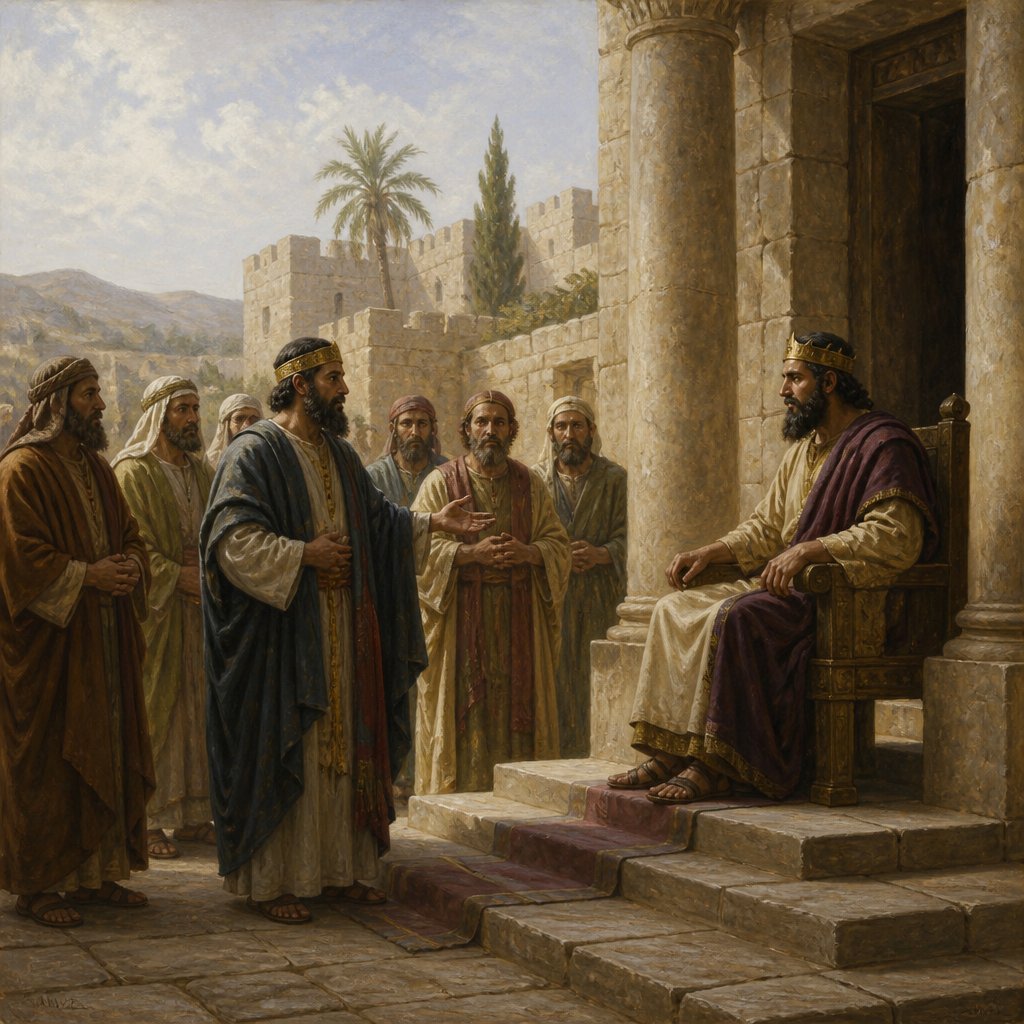
In the realm of leadership, decisions echo far beyond their immediate consequences, reverberating through the lives of others and the fabric of society. This is profoundly illustrated in 1 Kings 12:12: "So Jeroboam and all the people came to Rehoboam the third day, as the king had appointed, saying, Come to me again the third day." This verse serves as a critical juncture in the history of Israel, marking a moment of potential and peril.
Rehoboam, the son of Solomon, had just ascended to the throne of Israel, inheriting a kingdom known for its wealth and wisdom. Yet, he confronted a pivotal choice that could either solidify his reign or fracture the nation. The request of Jeroboam and the people for relief from the burdensome yoke that his father Solomon had placed upon them was not merely a demand for lighter taxes; it was a plea for a leadership that understood the heart of the people.
Rehoboam’s promise to respond after three days was a traditional way of demonstrating thoughtful leadership. However, the third day became a critical moment of reckoning, where Rehoboam had the opportunity to embrace wisdom or turn towards folly. His journey in this passage poses significant lessons for us about the nature of leadership, the importance of counsel, and the potential consequences of our choices.
First, we see the importance of seeking wise counsel. In the following verses, Rehoboam would seek advice first from the seasoned elders who had advised his father, and then from the younger advisors who were more concerned with asserting authority than with serving the needs of the people. The elder advisors counseled him to ease the burdens of the people, while the younger advisors urged him to assert his authority more heavily than his father. Rehoboam’s choice to follow the less wise counsel resulted in a split in the kingdom and the eventual fracturing of Israel into two separate nations—Israel in the north and Judah in the south. The consequences of this decision not only affected Rehoboam’s reign but also the spiritual and political landscape of the nation for generations to come.
In our own lives, how often do we seek counsel before making significant decisions? Like Rehoboam, we may face pressures that tempt us to favor our own desires or the opinions of those who only wish to see us assert power rather than serve wisely. In Proverbs 15:22, we are reminded, "Without counsel purposes are disappointed: but in the multitude of counselors they are established." This principle holds true in our professional and personal lives. Choosing to surround ourselves with wise, experienced individuals who encourage us to be servant leaders will yield far better outcomes than seeking affirmation from those who merely want us to exercise authority.
Furthermore, Rehoboam’s situation exemplifies the broader theme of accountability. Leadership is not about the individual wielding power, but about fulfilling the expectations of those who have entrusted us with their care. Leaders are accountable to their followers, and the decisions we make in our roles have lasting impacts on those around us. This calls for humility, the willingness to listen, and a heart that prioritizes the needs of others over personal ambition.
Lastly, we must consider the spiritual implications of Rehoboam’s decisions. The choice to reject wise counsel in favor of pride led to a division that would symbolize the ongoing struggle of God’s people throughout history. It serves as a profound reminder of the necessity for godly wisdom in our decisions. James 1:5 encourages us: "If any of you lack wisdom, let him ask of God, that giveth to all men liberally, and upbraideth not; and it shall be given him." In our own moments of decision, particularly when faced with pressure, we must remember to seek God's guidance and to be willing to submit our ambitions to His will.
In conclusion, Rehoboam’s choice at this crossroad serves as a powerful lesson in leadership and accountability. We must delve into our own hearts: Are we listening to wise counsel? Are we prioritizing the well-being of those we lead? And ultimately, are we seeking God’s wisdom in the choices we make? As we meditate on these lessons, may we strive to be leaders who carry the burden of our responsibilities with a heart attuned to the will of God and the needs of others.
Get our apps


Artwork for 1 Kings 12:12

1 Kings 12:12 - "¶ So Jeroboam and all the people came to Rehoboam the third day, as the king had appointed, saying, Come to me again the third day."
"¶ So Jeroboam and all the people came to Rehoboam the third day, as the king had appointed, saying, Come to me again the third day." - 1 Kings 12:12

1 Kings 12:11

1 Kings 12:11

1 Kings 12:10

1 Kings 12:10

1 kings 3:12

1 Kings 12:10

1 Kings 12:11

1 Kings 12:10
1 Kings 12:11

1 Kings 12:14

1 Kings 12:14

1 Kings 12:11

1 Kings 12:1 - "And Rehoboam went to Shechem: for all Israel were come to Shechem to make him king."

1 Kings 21:12 - "They proclaimed a fast, and set Naboth on high among the people."

1 Kings 12:19 - "So Israel rebelled against the house of David unto this day."

1 Kings 12:22 - "But the word of God came unto Shemaiah the man of God, saying,"

1 Kings 12:13 - "And the king answered the people roughly, and forsook the old men's counsel that they gave him;"

1 Kings 12:29 - "And he set the one in Beth-el, and the other put he in Dan."

1 Kings 8:12 - "¶ Then spake Solomon, The LORD said that he would dwell in the thick darkness."

1 Kings 19:12 - "And after the earthquake a fire; but the LORD was not in the fire: and after the fire a still small voice."

1 Kings 12:17 - "But as for the children of Israel which dwelt in the cities of Judah, Rehoboam reigned over them."

1 Kings 12:26 - "And Jeroboam said in his heart, Now shall the kingdom return to the house of David:"

1 Kings 2:12 - "¶ Then sat Solomon upon the throne of David his father; and his kingdom was established greatly."

1 Kings 12:30 - "And this thing became a sin: for the people went to worship before the one, even unto Dan."

1 Kings 12:3 - "That they sent and called him. And Jeroboam and all the congregation of Israel came, and spake unto Rehoboam, saying,"

1 Kings 15:12 - "And he took away the sodomites out of the land, and removed all the idols that his fathers had made."

1 Kings 12:31 - "And he made an house of high places, and made priests of the lowest of the people, which were not of the sons of Levi."

1 Kings 12:25 - "¶ Then Jeroboam built Shechem in mount Ephraim, and dwelt therein; and went out from thence, and built Penuel."