The Weight of Leadership: Lessons from Solomon's Oath
“Then king Solomon sware by the LORD, saying, God do so to me, and more also, if Adonijah have not spoken this word against his own life.” — 1 Kings 2:23
In 1 Kings 2:23, we find a powerful moment of accountability and integrity that plays a pivotal role in the transition of kingship from David to Solomon. The scripture states, "Then king Solomon sware by the LORD, saying, God do so to me, and more also, if Adonijah have not spoken this word against his own life." This verse captures the essence of Solomon’s response to Adonijah’s attempt to seize the throne, revealing profound lessons for us about leadership, justice, and the gravity of our commitments.
As we delve deeper into this verse, we witness King Solomon taking a solemn oath before God that holds grave implications. Adonijah, previously a rival for the throne who had sought to usurp Solomon’s rightful claim to leadership, approaches Solomon following his own defeat. With a request for mercy—specifically, for a woman to serve him as a wife—Adonijah reveals not just desperation but a lack of understanding of the kingdom’s integrity and the seriousness of his actions.
We note that Solomon’s reaction is one rooted in wisdom and discernment. His oath effectively recognizes the severity of Adonijah's actions while also setting a standard for his reign. Solomon could have chosen to ignore the significance of Adonijah's former ambitions, but instead, he calls for justice, making it clear that attempts to undermine the rightful authority would not be tolerated. In swearing an oath—an act both binding and sacred—he places himself against the backdrop of a divine witness. In doing so, Solomon emphasizes that his reign will be governed by principles of righteousness and accountability.
This moment serves as a reflection for our own lives, particularly in our roles and responsibilities. Each of us holds different forms of leadership—be it within our families, workplaces, or communities. The weight of our decisions is significant, as we navigate through choices that can either lead to unity or division. Solomon’s commitment to confront Adonijah’s request illustrates the necessity of standing firm in our convictions, even when it is challenging to do so. It reminds us that we are called to act with justice, and that taking an oath or making a promise carries the responsibility of upholding truth and integrity.
Moreover, Solomon’s oath brings forth the notion of accountability not only before the people but also before God. This is fundamental to a leader's character. When we commit our words and actions into the hands of God, we invite His guidance and wisdom into our decisions. The prayerful reliance on God is a source of strength that empowers us to make tough calls that might not always be popular.
But it also speaks directly to how we should approach our own relationships within the context of leadership. Adonijah’s actions were motivated by personal ambition that disregarded the covenantal promise made to David and the rightful succession to Solomon. It’s a critical reminder for us to evaluate our motives against God’s truth and to take ownership of our actions. Each word uttered, each decision made could potentially impact the lives of others, and as such, we ought to strive to lead with an awareness of this great responsibility.
In today's world, rivalries and ambitions abound, often overshadowing our collective purpose. Solomon’s oath calls us to rise above these challenges, to pursue a leadership style that mirrors divine principles rather than human selfishness. Let us be emboldened to make oaths in alignment with God’s will and retain the courage to execute justice when necessary.
As we reflect on this passage, let us absorb the weight of our commitments. Like Solomon, may we swear by the Lord to uphold truth, to stand against injustice, and to lead with humility and integrity. In doing so, we can create a lasting impact that radiates beyond our immediate circles, ultimately shaping a community that honors God.
Get our apps


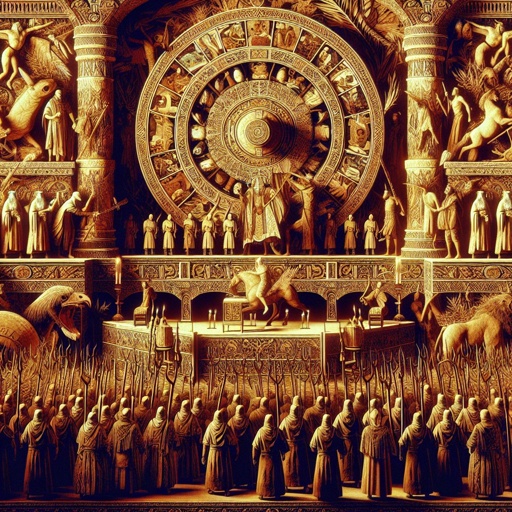
Artwork for 1 Kings 2:23

1 Kings 2:23 - "Then king Solomon sware by the LORD, saying, God do so to me, and more also, if Adonijah have not spoken this word against his own life."

"Then king Solomon sware by the LORD, saying, God do so to me, and more also, if Adonijah have not spoken this word against his own life." - 1 Kings 2:23

2 Kings 23:1 - "And the king sent, and they gathered unto him all the elders of Judah and of Jerusalem."

2 Kings 23:23 - "But in the eighteenth year of king Josiah, wherein this passover was holden to the LORD in Jerusalem."

1 Kings 10:23 - "So king Solomon exceeded all the kings of the earth for riches and for wisdom."

2 Kings 8:23 - "And the rest of the acts of Joram, and all that he did, are they not written in the book of the chronicles of the kings of Judah?"
2 Kings 23:22 - "Surely there was not holden such a passover from the days of the judges that judged Israel, nor in all the days of the kings of Israel, nor of the kings of Judah;"

"And the king sent, and they gathered unto him all the elders of Judah and of Jerusalem." - 2 Kings 23:1

2 Kings 23:28 - "Now the rest of the acts of Josiah, and all that he did, are they not written in the book of the chronicles of the kings of Judah?"

2 Kings 3:23 - "And they said, This is blood: the kings are surely slain, and they have smitten one another: now therefore, Moab, to the spoil."

1 Kings 2:3 - "And keep the charge of the LORD thy God, to walk in his ways, to keep his statutes, and his commandments, and his judgments, and his testimonies, as it is written in the law of Moses, that thou mayest prosper in all that thou doest, and whithersoever thou turnest thyself:"

2 Kings 21:23 - "¶ And the servants of Amon conspired against him, and slew the king in his own house."

2 Kings 9:23 - "And Joram turned his hands, and fled, and said to Ahaziah, There is treachery, O Ahaziah."

"But in the eighteenth year of king Josiah, wherein this passover was holden to the LORD in Jerusalem." - 2 Kings 23:23

2 Kings 23:37 - "And he did that which was evil in the sight of the LORD, according to all that his fathers had done."

2 Kings 23:11 - "And he took away the horses that the kings of Judah had given to the sun, at the entering in of the house of the LORD, by the chamber of Nathan-melech the chamberlain, which was in the suburbs, and burned the chariots of the sun with fire."

2 Kings 23:32 - "And he did that which was evil in the sight of the LORD, according to all that his fathers had done."

2 Kings 23:21 - "¶ And the king commanded all the people, saying, Keep the passover unto the LORD your God, as it is written in the book of this covenant."

"So king Solomon exceeded all the kings of the earth for riches and for wisdom." - 1 Kings 10:23

2 Kings 23:7 - "And he brake down the houses of the sodomites, that were by the house of the LORD, where the women wove hangings for the grove."

1 Kings 1:23 - "And they told the king, saying, Behold Nathan the prophet. And when he was come in before the king, he bowed himself before the king with his face to the ground."

1 Kings 21:23 - "And of Jezebel also spake the LORD, saying, The dogs shall eat Jezebel by the wall of Jezreel."

2 Chronicles 9:23 - "¶ And all the kings of the earth sought the presence of Solomon, to hear his wisdom, that God had put in his heart."

2 Kings 19:2

2 Kings 19:2

1 Kings 6:23 - "¶ And within the oracle he made two cherubims of olive tree, each ten cubits high."

2 Kings 15:23 - "¶ In the fiftieth year of Azariah king of Judah Pekahiah the son of Menahem began to reign over Israel in Samaria, and reigned two years."

2 Kings 19:2

2 Kings 23:9 - "Nevertheless the priests of the high places came not up to the altar of the LORD in Jerusalem, but they did eat of the unleavened bread among their brethren."

2 Kings 23:14 - "And he brake in pieces the images, and cut down the groves, and filled their places with the bones of men." The image should not depict explicit or offensive content but be symbolic.