The Wounds of Leadership: A Reflection on 1 Kings 22:35
“And the battle increased that day: and the king was stayed up in his chariot against the Syrians, and died at even: and the blood ran out of the wound into the midst of the chariot.” — 1 Kings 22:35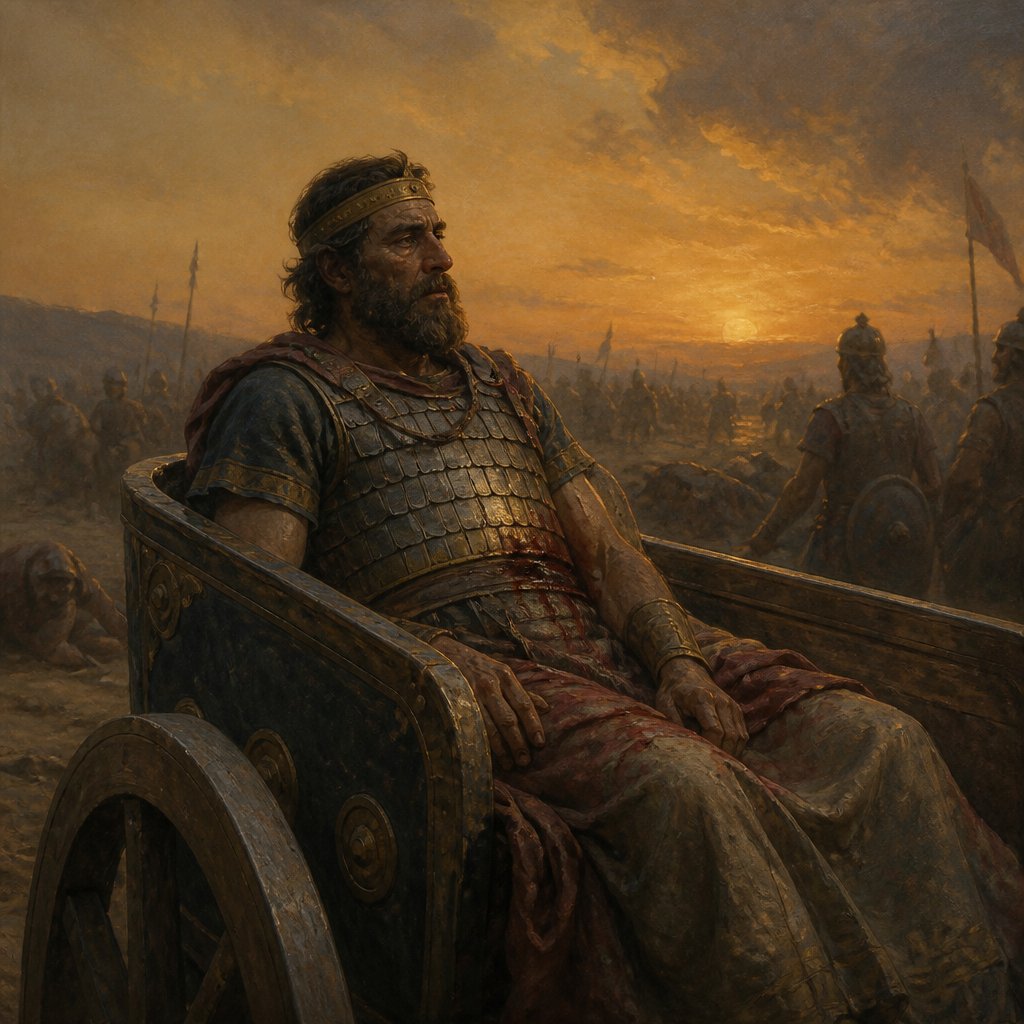
In 1 Kings 22:35, we witness a poignant moment in the life of King Ahab, whose fate is sealed by his own choices and the prophetic words spoken over him. The verse reads: "And the battle increased that day: and the king was stayed up in his chariot against the Syrians, and died at even: and the blood ran out of the wound into the midst of the chariot." This chilling account serves as a stark reminder of the weight of leadership, the consequences of disobedience, and the inevitability of divine judgment.
To understand the gravity of this verse, let’s first explore the context. King Ahab, a ruler of Israel, is known for his unfaithfulness to God. His reign is marked by idolatry, covetousness, and a general disregard for God’s laws. He sought out false prophets who flattered his ambitions instead of speaking truth. Ultimately, this led him into a dangerous alliance with King Jehoshaphat of Judah and a reckless trap during the battle against the Syrians. Before the battle, the prophet Micaiah warned Ahab of his impending doom, yet Ahab chose to turn a deaf ear to the truth. His arrogance blinded him to the reality of his spiritual and moral decline.
As the confrontation with the Syrians escalates, Ahab makes a desperate choice: he disguises himself in hopes of eluding danger while still leading his troops into battle. There is a profound irony in his disguise; in attempting to avoid the consequences of his past actions, he ultimately heads towards his demise. In life, we often attempt similar tactics—disguising our true selves, misdirecting our guilt, and ignoring divine warnings in pursuit of our own desires. But the result is much like Ahab's: we may evade the temporary consequences, but the spiritual fallout is unavoidable.
The phrase, "And the blood ran out of the wound into the midst of the chariot," paints a graphic picture of Ahab's end—his royal chariot, a symbol of his authority, becomes a vessel of his mortality and demise. This imagery strikes at the heart of our understanding of leadership and responsibility. Blood, the essence of life, pours out as a testament to the fact that disobedience to God can only lead to destruction. Ahab was not merely a victim of battle; he was a leader whose very identity had become intertwined with rebellion against the Divine. His wound was not just physical; it was a reflection of his spiritual state.
In our own lives, we must ask ourselves: What wounds are present as a result of our choices? Are we embroiled in battles of our own making? Leadership, whether in a position of power or in our personal lives, comes with great responsibility. We are called to lead with integrity, relying on the wisdom from God’s Word rather than our understanding. Just as Ahab chose to trust false prophets over God’s true messenger, we too risk our well-being when we ignore divine counsel.
This moment serves as a warning and a lesson. King Ahab’s tragic end reminds us that our actions have consequences, and spiritual blindness can ultimately destroy not only us but also those we lead. With this reflection, let us commit ourselves to seeking God’s will in all areas of life. Let our leadership be marked by humility, obedience, and a willingness to listen to godly counsel. May we never find ourselves metaphorically dressed in Ahab’s chariot, thinking we can evade the consequences of our choices while leading others into chaos and despair.
As we meditate on this verse, let us be reminded that true leadership directs others towards God— it is not about self-preservation or wearing a mask, but about walking in integrity and guiding others with compassion. Let us pray for the strength to lead well, embracing accountability, and ensuring that the only blood that flows in our midst is the cleansing blood of Christ, leading others towards His eternal victory in our lives.
Get our apps


Artwork for 1 Kings 22:35

1 Kings 22:35 - "And the battle increased that day: and the king was stayed up in his chariot against the Syrians, and died at even: and the blood ran out of the wound into the midst of the chariot."
"And the battle increased that day: and the king was stayed up in his chariot against the Syrians, and died at even: and the blood ran out of the wound into the midst of the chariot." - 1 Kings 22:35

1 Kings 18:35 - "And the water ran round about the altar; and he filled the trench also with water."

1 kings 22:19

1 Kings 8:22

1 Kings 22:47 - "There was then no king in Edom: a deputy was king."

1 Kings 22:44 - "And Jehoshaphat made peace with the king of Israel."

1 Kings 11:35 - "But I will take the kingdom out of his son's hand, and will give it unto thee, even ten tribes."

1 Kings 2:35 - "And the king put Benaiah the son of Jehoiada in his room over the host: and Zadok the priest did the king put in the room of Abiathar."

1 Kings 6:35 - "And he carved thereon cherubims and palm trees and open flowers: and covered them with gold fitted upon the carved work."

1 Kings 22:1 - "And they continued three years without war between Syria and Israel."

Psalm 35:22

1 Kings 1:22 - "¶ And, lo, while she yet talked with the king, Nathan the prophet also came in."

1 Kings 7:35 - "And in the top of the base was there a round compass of half a cubit high: and on the top of the base the ledges thereof and the borders thereof were of the same."

1 Kings 22:37 - "¶ So the king died, and was brought to Samaria; and they buried the king in Samaria."

1 Kings 22:29 - "So the king of Israel and Jehoshaphat the king of Judah went up to Ramoth-gilead."

1 Kings 22:45 - "Now the rest of the acts of Jehoshaphat, and his might that he shewed, and how he warred, are they not written in the book of the chronicles of the kings of Judah?"

1 Kings 20:35 - "¶ And a certain man of the sons of the prophets said unto his neighbour in the word of the LORD, Smite me, I pray thee. And the man refused to smite him."

1 Kings 12:22 - "But the word of God came unto Shemaiah the man of God, saying,"

"There was then no king in Edom: a deputy was king." - 1 Kings 22:47

1 Kings 22:9 - "Then the king of Israel called an officer, and said, Hasten hither Micaiah the son of Imlah."

1 Kings 22:2 - "And it came to pass in the third year, that Jehoshaphat the king of Judah came down to the king of Israel."

1 Kings 7:22 - "And upon the top of the pillars was lily work: so was the work of the pillars finished."

1 Kings 1:35 - "Then ye shall come up after him, that he may come and sit upon my throne; for he shall be king in my stead: and I have appointed him to be ruler over Israel and over Judah."

1 Kings 22:39 - "Now the rest of the acts of Ahab, and all that he did, and the ivory house which he made, and all the cities that he built, are they not written in the book of the chronicles of the kings of Israel?"

1 Kings 22:21 - "And there came forth a spirit, and stood before the LORD, and said, I will persuade him."

1 Kings 22:7 - "And Jehoshaphat said, Is there not here a prophet of the LORD besides, that we might enquire of him?"

II Kings 15:35 the high places were not removed: the people sacrificed and burned incense still in the high places.

1 Kings 22:5 - "And Jehoshaphat said unto the king of Israel, Enquire, I pray thee, at the word of the LORD to day."

1 Kings 22:41 - "¶ And Jehoshaphat the son of Asa began to reign over Judah in the fourth year of Ahab king of Israel."