The Empty Place: A Devotional Reflection on Friendship and Betrayal
“And the king sat upon his seat, as at other times, even upon a seat by the wall: and Jonathan arose, and Abner sat by Saul’s side, and David’s place was empty.” — 1 Samuel 20:25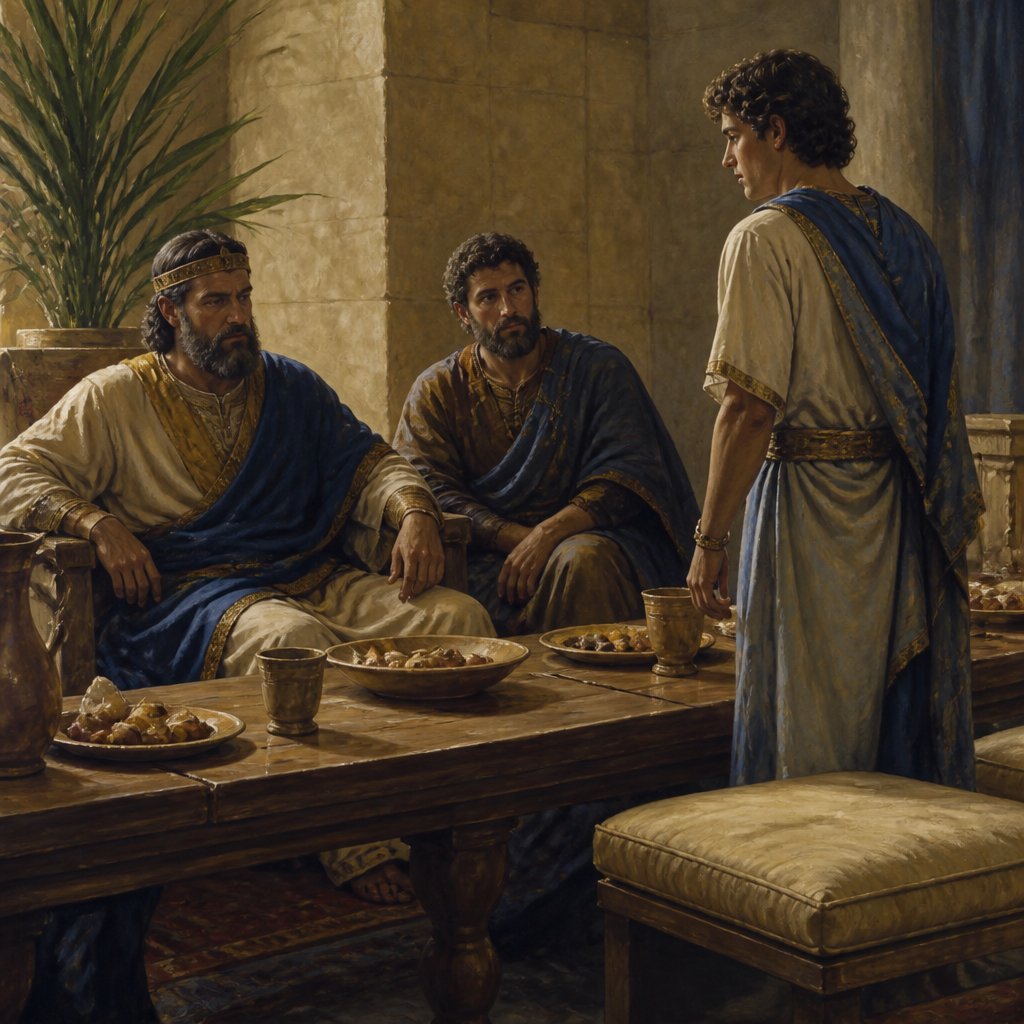
In the somber atmosphere of 1 Samuel 20:25, we are drawn into a moment laden with uncertainty and profound emotion: "And the king sat upon his seat, as at other times, even upon a seat by the wall: and Jonathan arose, and Abner sat by Saul's side, and David's place was empty."
This verse is a part of the gripping narrative of King Saul's jealousy towards David, as well as the loyal friendship between Jonathan and David. Within this single verse, we encounter the stark reality of absence, tension, and the complexities of human relationships, particularly those entwined with power, loyalty, and rivalry.
**The Context of the Scene**
To understand the depth of what is happening, we must look closely at the setting. Saul has gradually descended into madness, consumed by jealousy over David’s rising fame and the Lord’s favor upon him. Saul, seated on his throne and surrounded by his trusted advisors, represents the authority that is being threatened by David, who, although not present, casts a long shadow over the meal. The emptiness of David's seat speaks volumes: it is a reminder of what is at stake, both personally and politically.
In ancient culture, the seat at a table was a place of honor, and the absence of someone signified a rupture in fellowship. David had once been in favor, sharing meals and camaraderie with Saul's family, but now his absence foreshadows a deep betrayal and the disintegration of their relationship.
**The Role of Jonathan**
Jonathan’s action of rising from his seat adds a poignant layer to the narrative. The text says, "and Jonathan arose," signalling a moment of decision, a stirring of emotions tied to loyalty and love. Jonathan, son of Saul, found himself at a critical crossroads. He chose to honor his friendship with David over the expectations of his father, the king. In an environment rife with political entanglement, Jonathan’s loyalty stood in stark contrast to the duplicity of his father's heart.
Here, we are invited to reflect on our friendships. How often do we face situations where our loyalties are tested? Jonathan’s act of rising symbolizes a commitment to truth and integrity, even when it comes at a personal cost. He recognized the corrupting influence of his father’s anger and chose the path of allegiance to truth and love, especially towards someone who had once treated him with respect and brotherhood.
**David's Absence: A Symbol of Struggle**
David's empty seat serves as a metaphor for the struggles we face in life, particularly in our relationships with those in authority. It reminds us that sometimes, we are called to stand firm in the midst of adversity, even if it means being ostracized or misunderstood.
David’s life was one of remarkable highs and lows; his journey was laden with challenges that would test his character and faith in God. When we find ourselves in places where we too feel empty or overlooked, let us remember that God is keenly aware of those who are afflicted and abandoned. Just as God was with David in the wilderness, whether in the company of friends or alone in despair, so too is He with us in our trials.
**Conclusion: Filling the Empty Place**
As we meditate on this powerful verse, let's consider what "empty places" represent in our lives. Is it a void in our relationships? A failure of communication? A space where familiarity has turned to estrangement? Or perhaps a deeper void, a longing for connection to God and His promises?
We are encouraged to seek out and heal those broken relationships, to embrace the kind of love that Jonathan exhibited towards David, and to trust in God’s overarching plan through times of uncertainty. Let us not allow the empty places in our lives to define us but instead trust that they can become avenues for God’s grace to fill. May we be inspired to fill our own empty places with the love, truth, and courage that Jonathan displayed, creating bonds of friendship, loyalty, and faith that can withstand the trials of life.
Get our apps


Artwork for 1 Samuel 20:25

1 Samuel 20:25 - "And the king sat upon his seat, as at other times, even upon a seat by the wall: and Jonathan arose, and Abner sat by Saul's side, and David's place was empty."
"And the king sat upon his seat, as at other times, even upon a seat by the wall: and Jonathan arose, and Abner sat by Saul's side, and David's place was empty." - 1 Samuel 20:25

2 Samuel 20:25 - "And Sheva was scribe: and Zadok and Abiathar were the priests:"

1 Samuel 25:20 - "And it was so, as she rode on the ass, that she came down by the covert of the hill, and, behold, David and his men came down against her; and she met them."

"And Sheva was scribe: and Zadok and Abiathar were the priests:" - 2 Samuel 20:25

1 Samuel 1:25 - "And they slew a bullock, and brought the child to Eli."

1 Samuel 9:25 - "¶ And when they were come down from the high place into the city, Samuel communed with Saul upon the top of the house."

1 Samuel 20:27-29

1 Samuel 20:20 - "And I will shoot three arrows on the side thereof, as though I shot at a mark."

1 Samuel 25:1 - "And Samuel died; and all the Israelites were gathered together, and lamented him, and buried him in his house at Ramah. And David arose, and went down to the wilderness of Paran."

1 Samuel 28:15-20

1 Samuel 10:25 - "Then Samuel told the people the manner of the kingdom, and wrote it in a book, and laid it up before the LORD. And Samuel sent all the people away, every man to his house."

1 Samuel 14:25 - "And all they of the land came to a wood; and there was honey upon the ground."
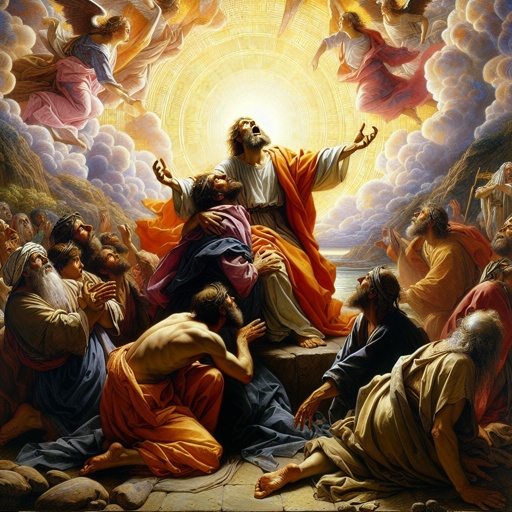
1 Samuel 20:27-30

1 Samuel 10:20 - "And when Samuel had caused all the tribes of Israel to come near, the tribe of Benjamin was taken."

1 Samuel 3:20 - "And all Israel from Dan even to Beer-sheba knew that Samuel was established to be a prophet of the LORD."

1 Samuel 25:4 - "¶ And David heard in the wilderness that Nabal did shear his sheep."

"And they slew a bullock, and brought the child to Eli." - 1 Samuel 1:25

1 Chronicles 25:20 - "The thirteenth to Shubael, he, his sons, and his brethren, were twelve:"

Nabal becomes like stone in 1 Samuel 25:37

Nabal becomes like stone in 1 Samuel 25:37

1 Samuel 25:43 - "David also took Ahinoam of Jezreel; and they were also both of them his wives."

1 Samuel 25:38 - "And it came to pass about ten days after, that the LORD smote Nabal, that he died."

1 Samuel 30:25 - "And it was so from that day forward, that he made it a statute and an ordinance for Israel unto this day."

1 Samuel 25:44 - "¶ But Saul had given Michal his daughter, David's wife, to Phalti the son of Laish, which was of Gallim."

1 Samuel 18:20 - "And Michal Saul's daughter loved David: and they told Saul, and the thing pleased him."

1 Samuel 12:25 - "But if ye shall still do wickedly, ye shall be consumed, both ye and your king."

1 Samuel 20:39 - "But the lad knew not any thing: only Jonathan and David knew the matter."

1 Samuel 1:20 - "Wherefore it came to pass, when the time was come about after Hannah had conceived, that she bare a son, and called his name Samuel, saying, Because I have asked him of the LORD."

1 Samuel 28:25 - "And she brought it before Saul, and before his servants; and they did eat. Then they rose up, and went away that night."