The Power of Compassion in the Face of Conflict
“And David said to him, Canst thou bring me down to this company? And he said, Swear unto me by God, that thou wilt neither kill me, nor deliver me into the hands of my master, and I will bring thee down to this company.” — 1 Samuel 30:15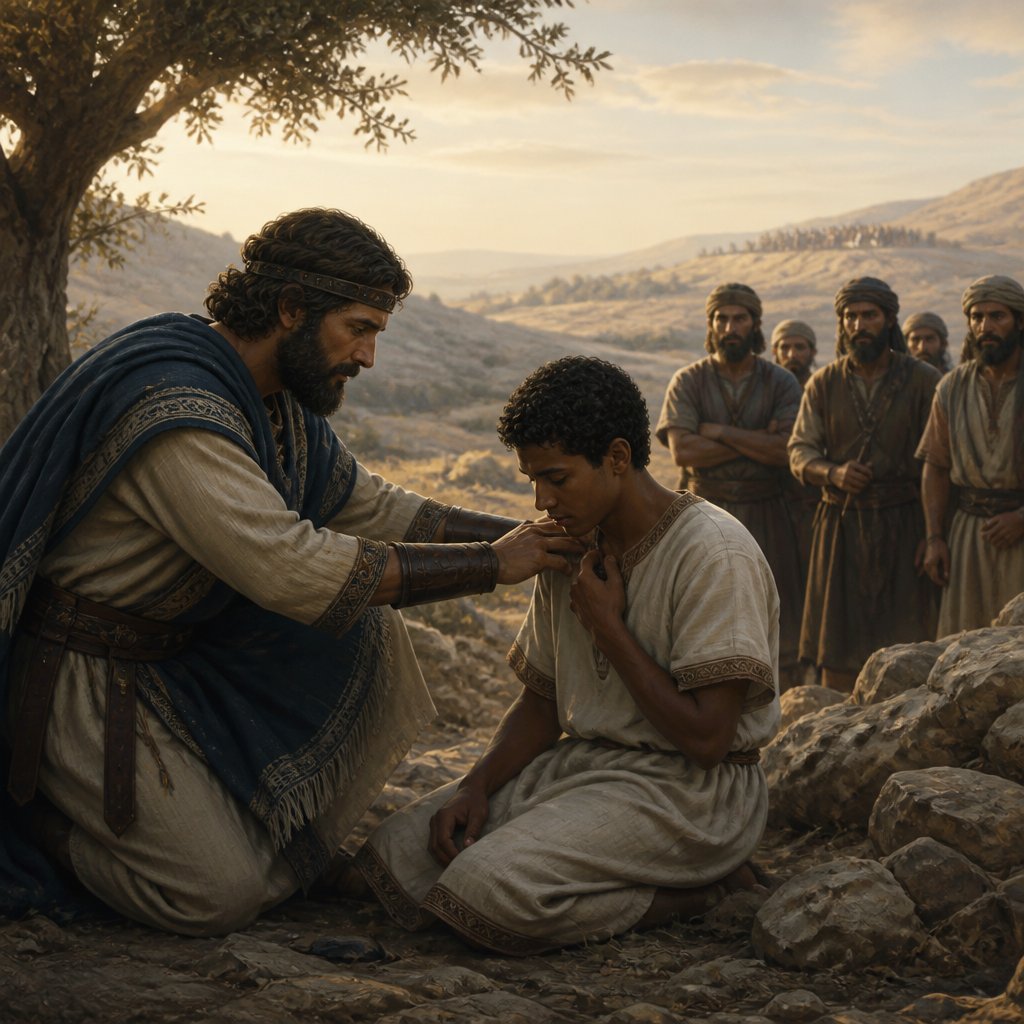
In 1 Samuel 30:15, we encounter a pivotal moment in David's tumultuous journey as he navigates the treacherous landscapes of his life. The verse reads, "And David said to him, Canst thou bring me down to this company? And he said, Swear unto me by God, that thou wilt neither kill me, nor deliver me into the hands of my master, and I will bring thee down to this company." In this passage, we find a profound illustration of mercy, vulnerability, and the complex human emotions entwined in moments of desperation.
To set the scene, David and his men had returned to Ziklag to find their homes burned and their families taken captive by the Amalekites. Overcome with grief and anger, David sought guidance from God, and among the chaos, he found strength and clarity in the Lord. Before he could mount a rescue, however, David encountered an exhausted Egyptian servant who had been left behind by the Amalekite raiders. This Egyptian becomes a critical link in David's pursuit of reclaiming what was lost.
What strikes me about this verse is the duality of human experience captured in the exchange between David and the mysterious Egyptian. Here is a servant faced with treachery from his master, left to die in the wilderness because of his weakened state. In his encounter with David, he encounters a choice: trust in the compassionate mercy of a leader who, like himself, knew hardship, or cling to the fear of retribution due to his previous allegiance.
David's inquiry, "Canst thou bring me down to this company?" reflects his desperation to restore his lost family and belongings, but it also showcases his ability to recognize the value and worth in others—even those who may be viewed as enemies. In leadership, David stands apart because he understood that true power does not come from the sword alone, but from understanding shared humanity and extending compassion even in moments of difficulty.
The Egyptian’s response is equally profound. He desires assurance, a promise from David that he would not be harmed. This reflects his vulnerability; he has already been betrayed and left behind and now stands at a crossroads where his fate lies entirely in the hands of a man he hardly knows.
Herein lies a powerful lesson for us today. How often do we find ourselves in situations where we are forced to trust others to a potentially fatal degree? How often do we find ourselves in roles where we must choose to be compassionate, even when it may not be deserved or reciprocated? In a world where mistrust abounds, and kindness is sometimes met with skepticism, David's insistence on compassion speaks volumes. A leader’s strength lies not merely in authority but in empathy and a commitment to protect those who are vulnerable, even when it is risky.
David's act of compassion yields great results; he gains an ally who not only guides him to the Amalekite camp but serves as a vessel of God's providence. In pursuing the enslaved families, David not only nurtures his leadership but also reconciles a broken sense of community. How many relationships could be restored through a simple act of kindness or mercy? How many paths of healing can be forged through empathetic engagement? While the world may teach us to be skeptical, the legacy of David encourages us to embrace our shared humanity.
In conclusion, I am reminded that as believers, we are called to practice compassion in all our dealings. We must cultivate environments of trust and understanding and recognize the power held in grace, even towards those who have wronged us. David's encounter with the Egyptian reminds us to look beyond our immediate needs and see the individuals around us—each possessing a story that is intertwined with our own. Let us embrace our role as instruments of love and mercy, bringing hope and restoration in a world crying out for connection and understanding.
Get our apps


Artwork for 1 Samuel 30:15

1 Samuel 30:15 - "And David said to him, Canst thou bring me down to this company? And he said, Swear unto me by God, that thou wilt neither kill me, nor deliver me into the hands of my master, and I will bring thee down to this company."
"And David said to him, Canst thou bring me down to this company? And he said, Swear unto me by God, that thou wilt neither kill me, nor deliver me into the hands of my master, and I will bring thee down to this company." - 1 Samuel 30:15

1.samuel 15:30

1.samuel 15:30

1 Samuel 30:18

1 Samuel 15:30 - "Then he said, I have sinned: yet honour me now, I pray thee, before the elders of my people, and before Israel, and turn again with me, that I may worship the LORD thy God."

1 Samuel 30:30 - "And to them which were in Hormah, and to them which were in Chorashan, and to them which were in Athach,"

1 Samuel 20:27-30

Exodus 28:15-30

1 Samuel 15:10 - "¶ Then came the word of the LORD unto Samuel, saying,"

1 Samuel 7:15 - "And Samuel judged Israel all the days of his life."
1 Samuel 15:31 - "So Samuel turned again after Saul; and Saul worshipped the LORD."

1 Samuel 15:34 - "¶ Then Samuel went to Ramah; and Saul went up to his house to Gibeah of Saul."

1 Corinthians 15:30 - "And why stand we in jeopardy every hour?"

1 Samuel 1:15-17

1 Samuel 3:15 - "¶ And Samuel lay until the morning, and opened the doors of the house of the LORD. And Samuel feared to shew Eli the vision."

1 Samuel 28:15

1 Samuel 15:22

1 Samuel 15:22

1 Samuel 9:15 - "¶ Now the LORD had told Samuel in his ear a day before Saul came, saying,"

1 Samuel 30:25 - "And it was so from that day forward, that he made it a statute and an ordinance for Israel unto this day."

1 Samuel 28:15-20

1 Samuel 30:28 - "And to them which were in Aroer, and to them which were in Siphmoth, and to them which were in Eshtemoa,"

1 Samuel 30:18 - "And David recovered all that the Amalekites had carried away: and David rescued his two wives."

1 Samuel 30:5 - "And David's two wives were taken captives, Ahinoam the Jezreelitess, and Abigail the wife of Nabal the Carmelite."

1 Samuel 21:10-15

1 Samuel 28:15-19

1 Samuel 15:13 - "And Samuel came to Saul: and Saul said unto him, Blessed be thou of the LORD: I have performed the commandment of the LORD."

1 Samuel 15:27 - "And as Samuel turned about to go away, he laid hold upon the skirt of his mantle, and it rent."

1 Samuel 10:15 - "And Saul's uncle said, Tell me, I pray thee, what Samuel said unto you."