Singing with Gladness: A Call to Heartfelt Worship
“Moreover Hezekiah the king and the princes commanded the Levites to sing praise unto the LORD with the words of David, and of Asaph the seer. And they sang praises with gladness, and they bowed their heads and worshipped.” — 2 Chronicles 29:30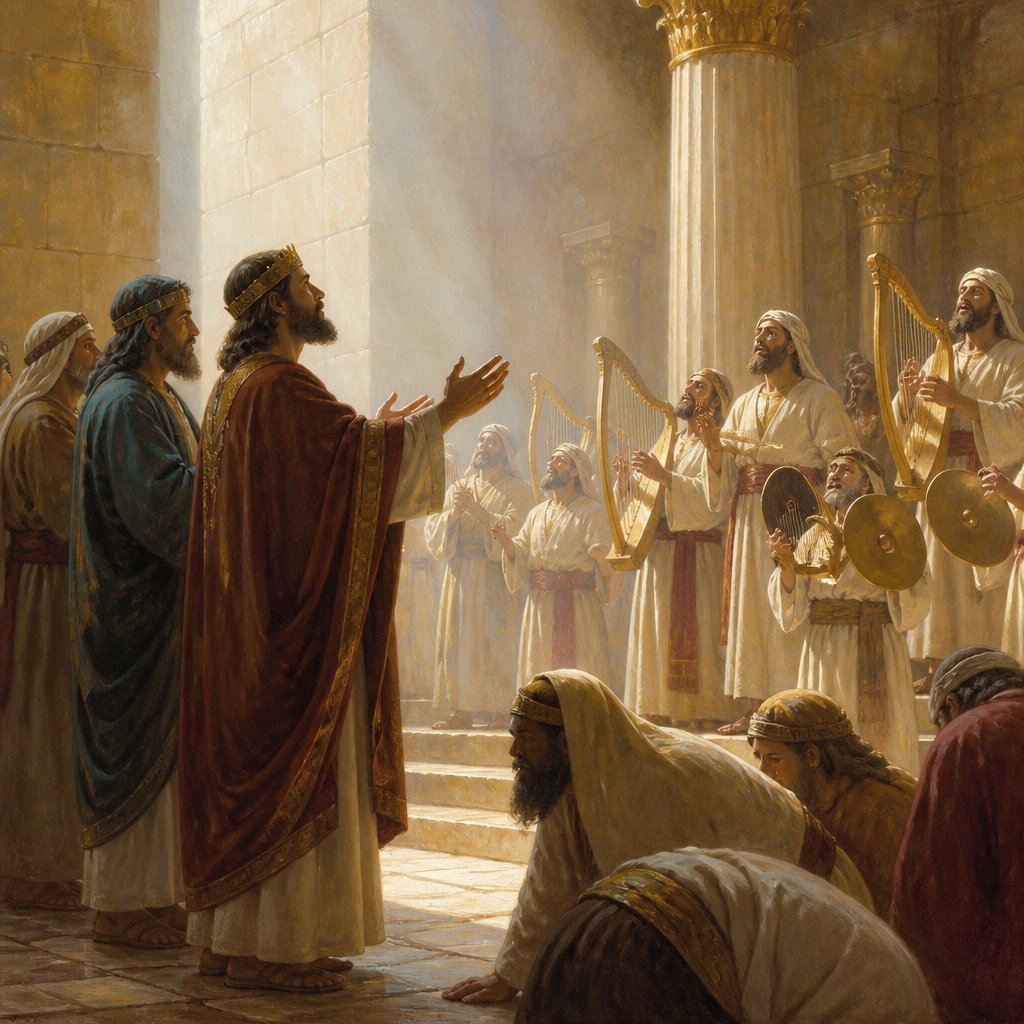
The story of King Hezekiah is one that invites us into a deeper understanding of worship and the heart of a people devoted to God. In
2 Chronicles 29:30, we read, "Moreover Hezekiah the king and the princes commanded the Levites to sing praise unto the LORD with the words of David, and of Asaph the seer. And they sang praises with gladness, and they bowed their heads and worshipped." This passage captures a moment of profound worship and renewal set within the broader narrative of Israel’s history under the reign of Hezekiah, a king who revitalized the faith and practices of his people.
To contextualize this, we must remember that Hezekiah's reign followed a dark period marked by idolatry and spiritual decay under the leadership of his father, Ahaz. The temple had fallen into disrepair, and the nation had strayed far from worshiping the one true God. However, Hezekiah, upon his ascension to the throne, prioritized restoring true worship, and a part of this involved invoking the prophetic words of David and Asaph.
This command to sing praises to the Lord functions on multiple levels. First, it reflects a deep understanding of worship as a communal act that not only honors God but also revitalizes the worshippers’ spirits. The act of singing together brings the community into unison, allowing individuals to express their shared devotion. It unites the Levites and the people in a common purpose—to glorify God. They were not just fulfilling a ritual; they were responding to the grace and mercy of God with joy and exuberance.
The phrase "with gladness" stands out, indicating the nature of their worship. Worship should never be a mere performance or an obligation; it should stem from a heart that acknowledges the goodness of God. This reiterates an important principle of worship: it is not the style or the skill of the musicians that touches God, but the attitude of the worshippers’ hearts. Genuine worship flows from joy that is rooted in the knowledge and experience of God’s faithfulness.
As we reflect upon our worship practices today, we must ask ourselves: Do we come to worship with gladness? Do we express our praise with a joyful spirit? It is easy to become caught up in the mechanics of worship, focusing more on the music, the preaching, or even the community itself rather than on the object of our worship—God. Hezekiah’s call to the Levites reminds us that worship is fundamentally about God: who He is, what He has done, and what He continues to do in our lives.
Moreover, the act of bowing their heads illustrates a posture of humility and reverence. When they bowed, they acknowledged the majesty of God and their position as His people. This dual concept of singing praise and bowing in worship highlights a balance between joy and reverence. In our own worship, can we find that balance? Are we able to express unrestrained joy while also recognizing the sovereignty and holiness of God?
In a world that often celebrates loudness and spectacle, the call to worship as seen in 2 Chronicles offers a counter-narrative. It's a reminder that worship begins with a profound awareness of God’s character and our humble response to Him. As we sing praises, let us do so with an attitude of gladness and genuine joy, bearing in mind that our worship is a reflection of our relationship with God. Just as the Levites were charged with this pivotal role, we too are called to worship God, not out of obligation but as a response to His goodness.
In conclusion, let us heed the example set by King Hezekiah and his people. Let us gather in our churches, homes, and lives with the express purpose of lifting our voices, guided by the words of Scripture and the legacy of praise established by those who came before us. Let us sing with gladness, bow with reverence, and worship our Lord wholeheartedly.
Get our apps


Artwork for 2 Chronicles 29:30

2 Chronicles 29:30 - "Moreover Hezekiah the king and the princes commanded the Levites to sing praise unto the LORD with the words of David, and of Asaph the seer. And they sang praises with gladness, and they bowed their heads and worshipped."
"Moreover Hezekiah the king and the princes commanded the Levites to sing praise unto the LORD with the words of David, and of Asaph the seer. And they sang praises with gladness, and they bowed their heads and worshipped." - 2 Chronicles 29:30

1 Chronicles 29:30 - "With all his reign and his might, and the times that went over him, and over Israel, and over all the kingdoms of the countries."

2 Chronicles 30:10

2 Chronicles 30:4 - "And the thing pleased the king and all the congregation."

2 Chronicles 30:20 - "And the LORD hearkened to Hezekiah, and healed the people."

2 Chronicles 29:29 - "And when they had made an end of offering, the king and all that were present with him bowed themselves, and worshipped."

2 Chronicles 29:26 - "And the Levites stood with the instruments of David, and the priests with the trumpets."

2 Chronicles 9:30 - "And Solomon reigned in Jerusalem over all Israel forty years."

1 Chronicles 2:30 - "And the sons of Nadab; Seled, and Appaim: but Seled died without children."

2 Chronicles 29:13 - "And of the sons of Elizaphan; Shimri, and Jeiel: and of the sons of Asaph; Zechariah, and Mattaniah:"

2 Chronicles 34:29 - "¶ Then the king sent and gathered together all the elders of Judah and Jerusalem."

2 Chronicles 29:14 - "And of the sons of Heman; Jehiel, and Shimei: and of the sons of Jeduthun; Shemaiah, and Uzziel."

2 Chronicles 30:2 - "For the king had taken counsel, and his princes, and all the congregation in Jerusalem, to keep the passover in the second month."

2 Chronicles 29:2 - "And he did that which was right in the sight of the LORD, according to all that David his father had done."

2 Chronicles 30:11 - "Nevertheless divers of Asher and Manasseh and of Zebulun humbled themselves, and came to Jerusalem."

2 Chronicles 29:33 - "And the consecrated things were six hundred oxen and three thousand sheep."

2 Chronicles 29:4 - "And he brought in the priests and the Levites, and gathered them together into the east street,"

1 Chronicles 2:29 - "And the name of the wife of Abishur was Abihail, and she bare him Ahban, and Molid."

2 Chronicles 20:30 - "So the realm of Jehoshaphat was quiet: for his God gave him rest round about."

2 Chronicles 29:20 - "¶ Then Hezekiah the king rose early, and gathered the rulers of the city, and went up to the house of the LORD."

2 Chronicles 29:36 - "And Hezekiah rejoiced, and all the people, that God had prepared the people: for the thing was done suddenly."

Matthew24:29-30

2 Chronicles 30:23 - "And the whole assembly took counsel to keep other seven days: and they kept other seven days with gladness."

2 Chronicles 30:26 - "So there was great joy in Jerusalem: for since the time of Solomon the son of David king of Israel there was not the like in Jerusalem."

2 Chronicles 30:13 - "¶ And there assembled at Jerusalem much people to keep the feast of unleavened bread in the second month, a very great congregation."

2 Chronicles 29:23 - "And they brought forth the he goats for the sin offering before the king and the congregation; and they laid their hands upon them:"

"And the LORD hearkened to Hezekiah, and healed the people." - 2 Chronicles 30:20

"And the thing pleased the king and all the congregation." - 2 Chronicles 30:4

2 Chronicles 29:9 - "For, lo, our fathers have fallen by the sword, and our sons and our daughters and our wives are in captivity for this."