Honour in Life and Legacy: Reflections on 2 Chronicles 32:33
“And Hezekiah slept with his fathers, and they buried him in the chiefest of the sepulchres of the sons of David: and all Judah and the inhabitants of Jerusalem did him honour at his death. And Manasseh his son reigned in his stead.” — 2 Chronicles 32:33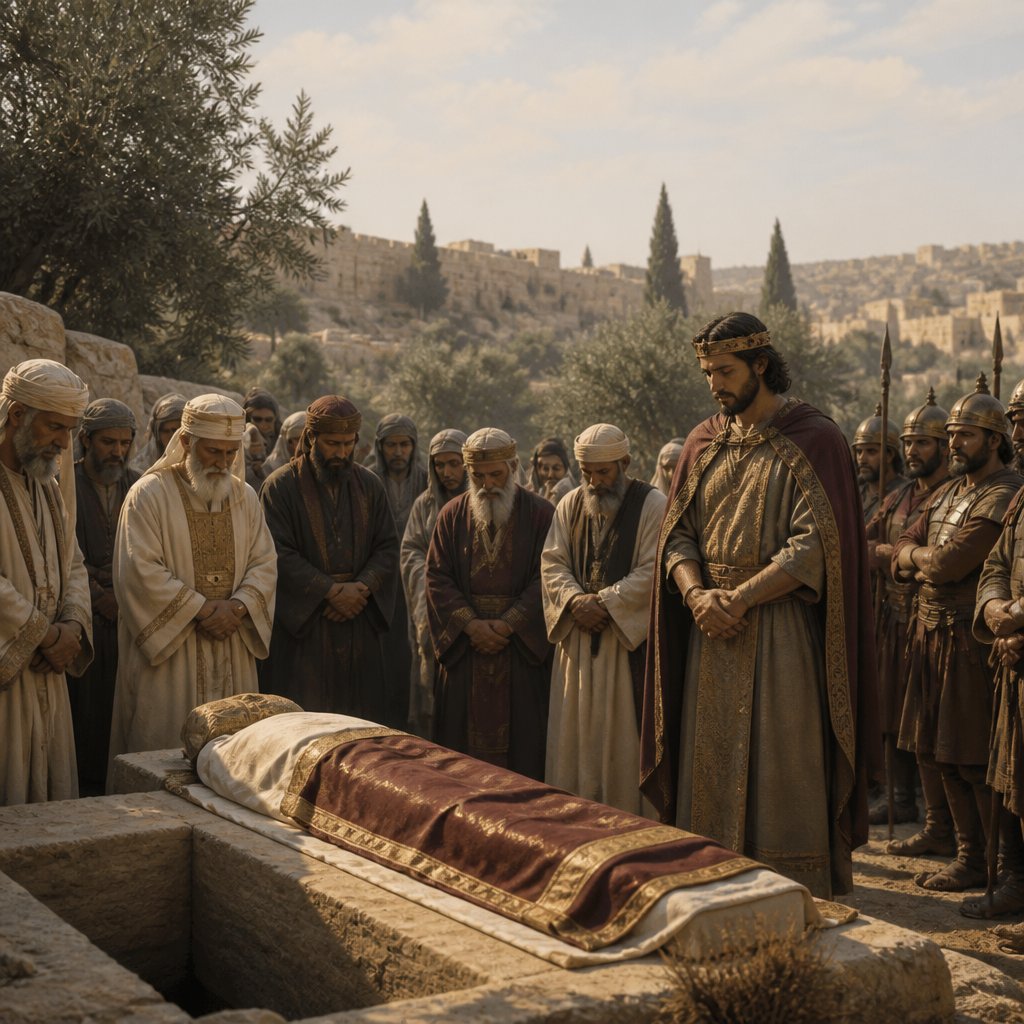
As we turn our hearts to the reflective and poignant verse found in 2 Chronicles 32:33, we are met with a moment of closure and honour: "And Hezekiah slept with his fathers, and they buried him in the chiefest of the sepulchres of the sons of David: and all Judah and the inhabitants of Jerusalem did him honour at his death. And Manasseh his son reigned in his stead." Here, in the midst of history, lies an opportunity for us to ponder the life lived by Hezekiah, its impact, and the legacy that continues to resonate through the ages.
Hezekiah, the King of Judah, is remembered as one of the most faithful and powerful kings in Israel's history. He ascended the throne during a tumultuous time, marked by idolatry, oppression, and spiritual decay. Yet, Hezekiah's reign was characterised by reform and a return to the worship of Jehovah. He spread the knowledge of the Lord throughout Judah, enforced the destruction of idols, and revitalised the temple worship, reinstating the observance of Passover and inviting all of Israel to partake in the worship of the true God.
This particular verse encapsulates the end of Hezekiah’s reign and his life’s journey. It opens with the gentle phrase, "And Hezekiah slept with his fathers," a tender biblical euphemism, signifying death not as an end, but as a return. As we reflect on death, it may often invoke sadness; however, in the biblical context, it is a transition into eternal rest among those who have preceded us. This highlights the importance of how we live, with an eventual reckoning in mind. Hezekiah may have passed from this life, but his influence continues on.
The phrase, "they buried him in the chiefest of the sepulchres of the sons of David," speaks volumes about his legacy. Sepulchres were not merely resting places; they were a sign of honour, reserved for those of notable stature and virtue. When it is said that he was laid to rest in the "chiefest of the sepulchres," it is a testament to the high regard in which he was held. His life’s work had not gone unnoticed. He had earned the respect and admiration of his people, culminating in a revered burial that echoed his years of devoted service.
“All Judah and the inhabitants of Jerusalem did him honour at his death.” Honour, in this context, speaks to the collective gratitude of a nation and reflects how leadership steeped in integrity and faith can foster a lasting legacy. It challenges us to reflect on our own lives and the impact we have on those around us. Are we living in a way that will leave a mark of honour when our time comes? What is the legacy that we hope to leave for our descendants, our community, and to God? Indeed, the measure of one's life is not found solely in achievements or accolades but is embedded in how we love, support, and guide others.
Finally, the verse closes with the transition to a new reign: "And Manasseh his son reigned in his stead." This serves as a reminder that each life is part of a larger narrative, a thread in the fabric of history. While Hezekiah's reign was marked by stability and devotion, we later see the contrasting reign of his son Manasseh, a stark turning point back to idolatry. This challenges us as a community of faith to nurture the next generations, ensuring that they carry forth the flames of devotion and integrity rather than faltering into complacency or decline.
In summary, let us honour the life of Hezekiah not only by acknowledging his accomplishments but by seeking to embody the traits he showcased: faithfulness, bravery, devotion, and integrity. Let us strive to live and love in such a way that our lives, too, will evoke honour and inspire others long after we have "slept with our fathers." May we reflect on our legacies and consciously choose to build a faith-filled future for those who will come after us, much like King Hezekiah did for his people.
Get our apps


Artwork for 2 Chronicles 32:33

2 Chronicles 32:33 - "¶ And Hezekiah slept with his fathers, and they buried him in the chiefest of the sepulchres of the sons of David: and all Judah and the inhabitants of Jerusalem did him honour at his death. And Manasseh his son reigned in his stead."
"¶ And Hezekiah slept with his fathers, and they buried him in the chiefest of the sepulchres of the sons of David: and all Judah and the inhabitants of Jerusalem did him honour at his death. And Manasseh his son reigned in his stead." - 2 Chronicles 32:33

1 Chronicles 2:33 - "And the sons of Jonathan; Peleth, and Zaza. These were the sons of Jerahmeel."

2 Chronicles 32:2 - "And when Hezekiah saw that Sennacherib was come, and that he was purposed to fight against Jerusalem,"

2 Chronicles 33:10 - "And the LORD spake to Manasseh, and to his people: but they would not hearken."

2 Chronicles 32:32 - "Now the rest of the acts of Hezekiah, and his goodness, behold, they are written in the vision of Isaiah the prophet, the son of Amoz, and in the book of the kings of Judah and Israel."

2 Chronicles 29:33 - "And the consecrated things were six hundred oxen and three thousand sheep."

Numbers 32:33

2 Chronicles 33:5 - "And he built altars for all the host of heaven in the two courts of the house of the LORD."

2 Chronicles 33:24 - "And his servants conspired against him, and slew him in his own house."

2 Chronicles 32:20 - "And for this cause Hezekiah the king, and the prophet Isaiah the son of Amoz, prayed and cried to heaven."

1 Chronicles 2:32 - "And the sons of Jada the brother of Shammai; Jether, and Jonathan: and Jether died without children."

2 Chronicles 33:2 - "But did that which was evil in the sight of the LORD, like unto the abominations of the heathen, whom the LORD had cast out before the children of Israel."

2 Chronicles 33:17 - "Nevertheless the people did sacrifice still in the high places, yet unto the LORD their God only."

2 Chronicles 32:16 - "And his servants spake yet more against the LORD God, and against his servant Hezekiah."

2 Chronicles 32:28 - "Storehouses also for the increase of corn, and wine, and oil; and stalls for all manner of beasts, and cotes for flocks."

2 Chronicles 33:21 - "¶ Amon was two and twenty years old when he began to reign, and reigned two years in Jerusalem."

2 Chronicles 20:33 - "Howbeit the high places were not taken away: for as yet the people had not prepared their hearts unto the God of their fathers."

2 Chronicles 20:32 - "And he walked in the way of Asa his father, and departed not from it, doing that which was right in the sight of the LORD."

2 Chronicles 32:10 - "Thus saith Sennacherib king of Assyria, Whereon do ye trust, that ye abide in the siege in Jerusalem?"

2 Chronicles 32:19 - "And they spake against the God of Jerusalem, as against the gods of the people of the earth, which were the work of the hands of man."

2 Chronicles 33:23 - "And humbled not himself before the LORD, as Manasseh his father had humbled himself; but Amon trespassed more and more."

2 Chronicles 33:1 - "Manasseh was twelve years old when he began to reign, and he reigned fifty and five years in Jerusalem:"

Deuteronomy 32:33 - "Their wine is the poison of dragons, and the cruel venom of asps."

2 Chronicles 33:12 - "And when he was in affliction, he besought the LORD his God, and humbled himself greatly before the God of his fathers,"

2 Chronicles 18:32 - "For it came to pass, that, when the captains of the chariots perceived that it was not the king of Israel, they turned back again from pursuing him."

2 Chronicles 33:4 - "Also he built altars in the house of the LORD, whereof the LORD had said, In Jerusalem shall my name be for ever."

2 Chronicles 33:20 - "¶ So Manasseh slept with his fathers, and they buried him in his own house: and Amon his son reigned in his stead."

2 Chronicles 33:16 - "And he repaired the altar of the LORD, and sacrificed thereon peace offerings and thank offerings, and commanded Judah to serve the LORD God of Israel."

2 Chronicles 32:7 - "Be strong and courageous, be not afraid nor dismayed for the king of Assyria, nor for all the multitude that is with him: for there be more with us than with him:"