What does 2 Chronicles 32:33 mean?
“And Hezekiah slept with his fathers, and they buried him in the chiefest of the sepulchres of the sons of David: and all Judah and the inhabitants of Jerusalem did him honour at his death. And Manasseh his son reigned in his stead.” — 2 Chronicles 32:33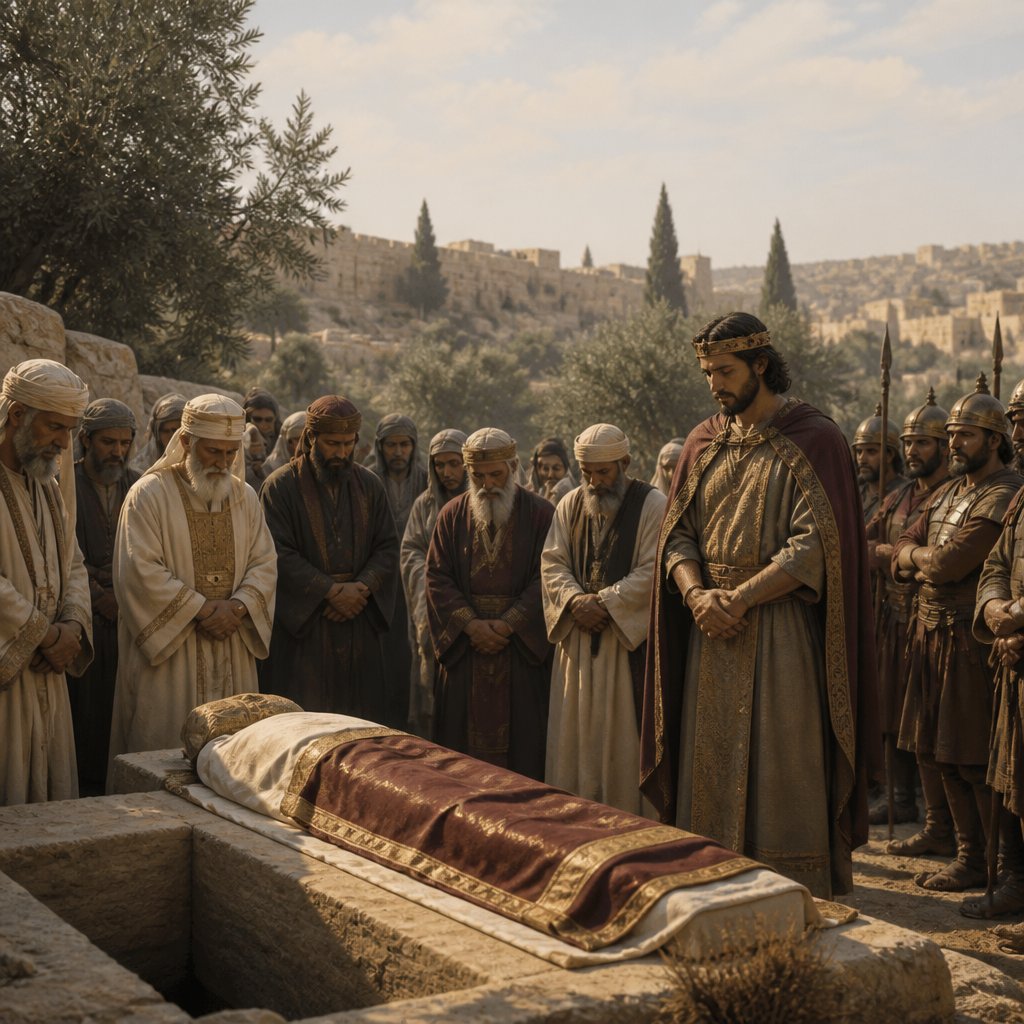
2 Chronicles 32:33 (KJV): "And Hezekiah slept with his fathers, and they buried him in the chiefest of the sepulchres of the sons of David: and all Judah and the inhabitants of Jerusalem did him honour at his death. And Manasseh his son reigned in his stead."
This verse marks the end of the reign of King Hezekiah of Judah and the beginning of the reign of his son Manasseh. However, it also encapsulates the legacy and impact of Hezekiah's rule, as well as the broader themes of succession and honor in the biblical narrative.
King Hezekiah was a ruler known for his commitment to centralizing the worship of Yahweh and for his efforts to reform Judah's religious practices. In 2 Chronicles 29-31, the preceding chapters, we see how Hezekiah ordered the purification and reopening of the temple, reinstituted the Passover celebration in Jerusalem, and implemented various social and religious reforms to restore the worship of Yahweh. These actions were a direct response to the apostasy and idolatry that had characterized Judah's previous rulers, and they served to strengthen the kingdom's relationship with Yahweh.
Because of his dedication to Yahweh, Hezekiah was favored by God, and under his leadership, Judah experienced a period of prosperity and security. The biblical text records various encounters where Hezekiah sought God's help and received divine intervention, particularly during the Assyrian siege of Jerusalem (2 Kings 18-19). Hezekiah's faith and trust in Yahweh resulted in the miraculous deliverance and salvation of the kingdom from the hands of its enemies, solidifying his reputation as a righteous and faithful king.
In 2 Chronicles 32:33, we are told of Hezekiah's death and burial in the chiefest of the sepulchres of the sons of David, a position of honor and respect. This act of burial among the royal lineage of David reflects the esteem and recognition accorded to Hezekiah by the people of Judah. Throughout his reign, he had earned the admiration and loyalty of his subjects, and this final act of honor is a testament to his legacy as a righteous and beloved king.
The verse also transitions the narrative to the reign of Hezekiah's son Manasseh. While Hezekiah is remembered for his devotion to Yahweh and his efforts to reform Judah, Manasseh's reign is characterized by a stark contrast. He is depicted as one of the most wicked kings in Judah's history, leading the kingdom into idolatry and immorality (2 Kings 21). The contrast between the two rulers serves as a cautionary tale, highlighting the consequences of straying from the path of righteousness and faithfulness.
In a broader context, 2 Chronicles 32:33 reflects the recurrent theme of succession and continuity in the biblical narrative. The succession of kings and the transfer of power from one generation to the next are recurring motifs in the history of Israel and Judah. The biblical authors use these transitions to underscore the importance of leadership, faithfulness, and obedience to God, as well as the consequences of disobedience and unfaithfulness.
Symbolically, Hezekiah's burial among the sons of David can be seen as an acknowledgment of his place within the royal lineage and his role in preserving the Davidic covenant. His reign and reforms served to honor and uphold the legacy of David, a figure deeply revered in Jewish history and theology. In this way, Hezekiah embodies the ideal of a righteous Davidic king who leads the people in faithful worship and obedience to God.
In conclusion, 2 Chronicles 32:33 encapsulates the legacy of King Hezekiah, his impact on the kingdom of Judah, and the broader themes of succession and honor in the biblical narrative. Through his dedication to Yahweh and his righteous rule, Hezekiah left a lasting impression on the people of Judah and the biblical tradition. His burial among the sons of David reflects the honor and respect accorded to him, while the transition to his son Manasseh serves as a cautionary tale about the consequences of unfaithfulness and disobedience. This verse invites readers to reflect on the legacy of leadership and the enduring impact of faithfulness in the biblical narrative.
Get our apps


Artwork for 2 Chronicles 32:33

2 Chronicles 32:33 - "¶ And Hezekiah slept with his fathers, and they buried him in the chiefest of the sepulchres of the sons of David: and all Judah and the inhabitants of Jerusalem did him honour at his death. And Manasseh his son reigned in his stead."
"¶ And Hezekiah slept with his fathers, and they buried him in the chiefest of the sepulchres of the sons of David: and all Judah and the inhabitants of Jerusalem did him honour at his death. And Manasseh his son reigned in his stead." - 2 Chronicles 32:33

1 Chronicles 2:33 - "And the sons of Jonathan; Peleth, and Zaza. These were the sons of Jerahmeel."

2 Chronicles 32:2 - "And when Hezekiah saw that Sennacherib was come, and that he was purposed to fight against Jerusalem,"

2 Chronicles 33:10 - "And the LORD spake to Manasseh, and to his people: but they would not hearken."

2 Chronicles 32:32 - "Now the rest of the acts of Hezekiah, and his goodness, behold, they are written in the vision of Isaiah the prophet, the son of Amoz, and in the book of the kings of Judah and Israel."

2 Chronicles 29:33 - "And the consecrated things were six hundred oxen and three thousand sheep."

Numbers 32:33

2 Chronicles 33:5 - "And he built altars for all the host of heaven in the two courts of the house of the LORD."

2 Chronicles 33:24 - "And his servants conspired against him, and slew him in his own house."

2 Chronicles 32:20 - "And for this cause Hezekiah the king, and the prophet Isaiah the son of Amoz, prayed and cried to heaven."

1 Chronicles 2:32 - "And the sons of Jada the brother of Shammai; Jether, and Jonathan: and Jether died without children."

2 Chronicles 33:2 - "But did that which was evil in the sight of the LORD, like unto the abominations of the heathen, whom the LORD had cast out before the children of Israel."

2 Chronicles 33:17 - "Nevertheless the people did sacrifice still in the high places, yet unto the LORD their God only."

2 Chronicles 32:16 - "And his servants spake yet more against the LORD God, and against his servant Hezekiah."

2 Chronicles 32:28 - "Storehouses also for the increase of corn, and wine, and oil; and stalls for all manner of beasts, and cotes for flocks."

2 Chronicles 33:21 - "¶ Amon was two and twenty years old when he began to reign, and reigned two years in Jerusalem."

2 Chronicles 20:33 - "Howbeit the high places were not taken away: for as yet the people had not prepared their hearts unto the God of their fathers."

2 Chronicles 20:32 - "And he walked in the way of Asa his father, and departed not from it, doing that which was right in the sight of the LORD."

2 Chronicles 32:10 - "Thus saith Sennacherib king of Assyria, Whereon do ye trust, that ye abide in the siege in Jerusalem?"

2 Chronicles 32:19 - "And they spake against the God of Jerusalem, as against the gods of the people of the earth, which were the work of the hands of man."

2 Chronicles 33:23 - "And humbled not himself before the LORD, as Manasseh his father had humbled himself; but Amon trespassed more and more."

2 Chronicles 33:1 - "Manasseh was twelve years old when he began to reign, and he reigned fifty and five years in Jerusalem:"

Deuteronomy 32:33 - "Their wine is the poison of dragons, and the cruel venom of asps."

2 Chronicles 33:12 - "And when he was in affliction, he besought the LORD his God, and humbled himself greatly before the God of his fathers,"

2 Chronicles 18:32 - "For it came to pass, that, when the captains of the chariots perceived that it was not the king of Israel, they turned back again from pursuing him."

2 Chronicles 33:4 - "Also he built altars in the house of the LORD, whereof the LORD had said, In Jerusalem shall my name be for ever."

2 Chronicles 33:20 - "¶ So Manasseh slept with his fathers, and they buried him in his own house: and Amon his son reigned in his stead."

2 Chronicles 33:16 - "And he repaired the altar of the LORD, and sacrificed thereon peace offerings and thank offerings, and commanded Judah to serve the LORD God of Israel."

2 Chronicles 32:7 - "Be strong and courageous, be not afraid nor dismayed for the king of Assyria, nor for all the multitude that is with him: for there be more with us than with him:"