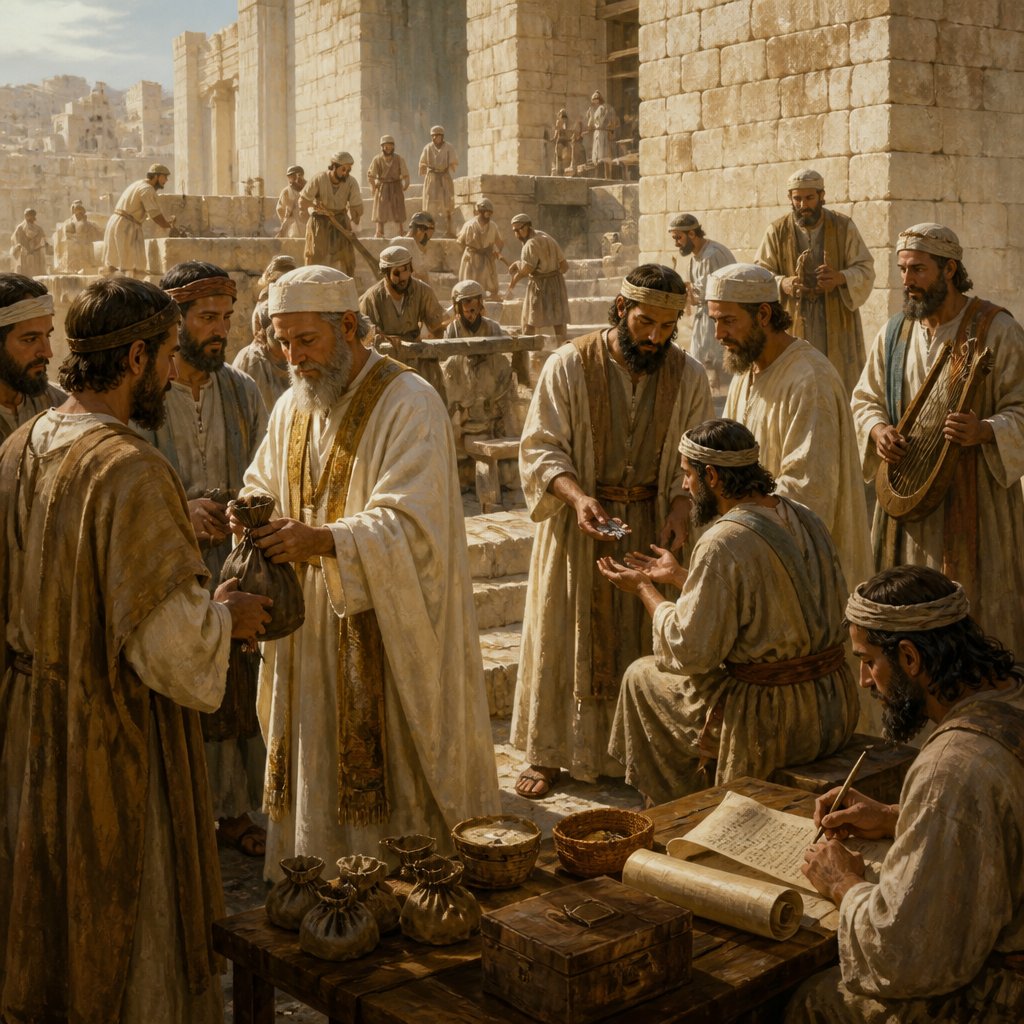
In 2 Chronicles 34:9-13, we witness a remarkable instance of restoration within the Temple of God, a narrative beautifully woven into the fabric of Israel's spiritual revival during the reign of King Josiah. As we explore these verses, we are drawn into a compelling illustration of how faithfulness in stewardship and a collective commitment to the work of God can lead to profound restoration and renewal.
The passage begins with the delivery of money that had been collected for the restoration of the House of God, signifying the heart and action of the people: "And when they came to Hilkiah the high priest, they delivered the money that was brought into the house of God..." (2 Chronicles 34:9, KJV). Here, we see an essential principle of stewardship in operation. The money was not just a token or a mere collection; it represented the dedication and sacrifices made by the Levites who had gathered it from the hearts of the people. It reflects a unified effort toward a common goal: the restoration of what had been neglected and damaged.
The act of bringing these funds to the high priest highlights the importance of placing our offerings into the right hands — those who are spiritually equipped and righteous to oversee God’s work. This step is critical; it invites divine wisdom and guidance into every restoration effort. Similarly, in our lives today, we must ensure that our resources — time, talents, and treasures — are placed into ministries and endeavors aligned with God’s purpose.
As they offered the money into the hands of the workmen charged with rebuilding the Temple, the people engaged in a physical manifestation of their faith. God desires to rebuild the broken places in our lives, but often He requires our active participation. When we commit our resources to further His work, we ignite a light that guides not only us but also those around us towards restoration. The passage states, "And they put it in the hand of the workmen that had the oversight of the house of the Lord, and they gave it to the workmen that wrought in the house of the Lord, to repair and amend the house" (2 Chronicles 34:10, KJV).
This highlights another critical aspect: the need for skilled and dedicated workers. Just as the workers were skilled in the physical construction of the Temple, we too must recognize the importance of competence in our spiritual service. The meticulous care in selecting "artificers and builders" to ensure the house of the Lord was restored reflects God’s desire for excellence in His work. Are we bringing our best to serve Him in our communities and churches, or are we providing halfhearted efforts?
Verses 12 and 13 reflect a powerful unity among the workers. "And the men did the work faithfully...and of the Levites, there were scribes, and officers, and porters" (2 Chronicles 34:12-13, KJV). Everyone had a role. This is an essential reminder that in the body of Christ, each member has a unique part to play in the larger work of God’s kingdom.
The faithful execution of their tasks ensured that every aspect of the Temple was addressed; they worked together harmoniously. This principle speaks volumes to us as His followers. Each of us is called to contribute to the work of God, not only out of obligation but as a joyful expression of our faith.
Moreover, the results of their labor illustrate God’s favor and blessings when we commit to His work. The restoration of the Temple signifies God's heart to restore and dwell among His people. When we contribute faithfully to His purposes, He responds with renewal. It is through our stewardship, dedication, and collaborative efforts that God can work wonders in our lives and the lives of others.
In closing, let us reflect on our responsibilities as stewards in God’s kingdom. Are we faithfully giving our resources? Are we engaging with skill and commitment to the community of believers? As we endeavor to rebuild the spiritual foundations in ourselves and those around us, let us do so with the understanding that our work is a divine calling, one that draws God's presence and power into the very fabric of our existence.
Get our apps


Artwork for 2 Chronicles 34:9-13

2 Chronicles 34:9-13 - "Then they went to Hilkiah the high priest and gave him the money that had been brought into the temple of God, which the Levites who were the gatekeepers had collected from the people of Manasseh, Ephraim and the entire remnant of Israel and from all the people of Judah and Benjamin and the inhabitants of Jerusalem. They handed it over to the men appointed to supervise the work on the Lord’s temple. These men paid the workers who repaired and restored the temple. They also gave money to the carpenters and builders to purchase dressed stone, and timber for joists and beams for the buildings that the kings of Judah had allowed to fall into ruin. The workers labored faithfully. Over them to direct them were Jahath and Obadiah, Levites descended from Merari, and Zechariah and Meshullam, descendants of Kohath. The Levites—all who were skilled in playing musical instruments— had charge of the laborers and supervised all the workers from job to job. Some of the Levites were secretaries, scribes and gatekeepers."
"Then they went to Hilkiah the high priest and gave him the money that had been brought into the temple of God, which the Levites who were the gatekeepers had collected from the people of Manasseh, Ephraim and the entire remnant of Israel and from all the people of Judah and Benjamin and the inhabitants of Jerusalem. They handed it over to the men appointed to supervise the work on the Lord’s temple. These men paid the workers who repaired and restored the temple. They also gave money to the carpenters and builders to purchase dressed stone, and timber for joists and beams for the buildings that the kings of Judah had allowed to fall into ruin. The workers labored faithfully. Over them to direct them were Jahath and Obadiah, Levites descended from Merari, and Zechariah and Meshullam, descendants of Kohath. The Levites—all who were skilled in playing musical instruments— had charge of the laborers and supervised all the workers from job to job. Some of the Levites were secretaries, scribes and gatekeepers." - 2 Chronicles 34:9-13

2 Chronicles 34:13 - "Also they were over the bearers of burdens, and were overseers of all that wrought the work in any manner of service: and of the Levites there were scribes, and officers, and porters."

2 Chronicles 9:13 - "¶ Now the weight of gold that came to Solomon in one year was six hundred and threescore and six talents of gold;"

2 Chronicles 34:19

2 Chronicles 34:19

1 Chronicles 9:34 - "These chief fathers of the Levites were chief throughout their generations; these dwelt at Jerusalem."
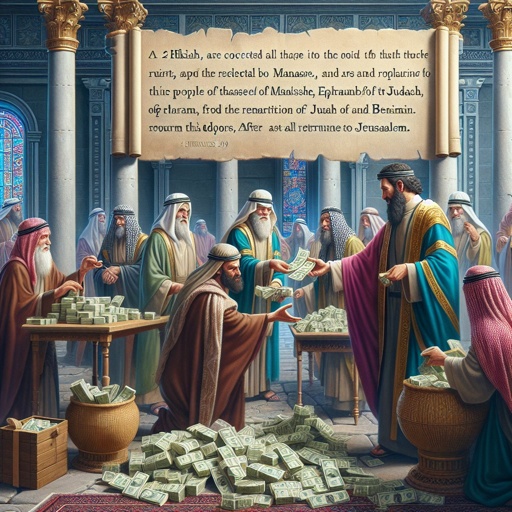
2 Chronicles 34:9 - "And when they came to Hilkiah the high priest, they delivered the money that was brought into the house of God, which the Levites that kept the doors had gathered of the hand of Manasseh and Ephraim, and of all the remnant of Israel, and of all Judah and Benjamin; and they returned to Jerusalem."

2 kings 9:34-36

2 Chronicles 34:29 - "¶ Then the king sent and gathered together all the elders of Judah and Jerusalem."

2 Chronicles 34:5 - "And he burnt the bones of the priests upon their altars, and cleansed Judah and Jerusalem."

2 Chronicles 34:19 - "And it came to pass, when the king had heard the words of the law, that he rent his clothes."

1 Chronicles 2:34 - "¶ Now Sheshan had no sons, but daughters. And Sheshan had a servant, an Egyptian, whose name was Jarha."

2 Chronicles 34:2 - "And he did that which was right in the sight of the LORD, and walked in the ways of David his father, and declined neither to the right hand, nor to the left."

2 Chronicles 34:17 - "And they have gathered together the money that was found in the house of the LORD, and have delivered it into the hand of the overseers, and to the hand of the workmen."

2 Chronicles 34:6 - "And so did he in the cities of Manasseh, and Ephraim, and Simeon, even unto Naphtali, with their mattocks round about."

2 Chronicles 34:1 - "Josiah was eight years old when he began to reign, and he reigned in Jerusalem one and thirty years."

2 Chronicles 6:13

"These chief fathers of the Levites were chief throughout their generations; these dwelt at Jerusalem." - 1 Chronicles 9:34

2 chronicles 13:12

2 Chronicles 34:23 - "¶ And she answered them, Thus saith the LORD God of Israel, Tell ye the man that sent you to me,"

2 Chronicles 34:10 - "And they put it in the hand of the workmen that had the oversight of the house of the LORD, and they gave it to the workmen that wrought in the house of the LORD, to repair and amend the house:"

2 Chronicles 34:14 - "¶ And when they brought out the money that was brought into the house of the LORD, Hilkiah the priest found a book of the law of the LORD given by Moses."

2 Chronicles 34:18 - "Then Shaphan the scribe told the king, saying, Hilkiah the priest hath given me a book. And Shaphan read it before the king."

2 Kings 10:34 - "Now the rest of the acts of Jehu, and all that he did, and all his might, are they not written in the book of the chronicles of the kings of Israel?"

2 Corinthians 1:3-4

2 Chronicles 18:9

2 Chronicles 21:9

2 Chronicles 18:9

2 Chronicles 34:20 - "And the king commanded Hilkiah, and Ahikam the son of Shaphan, and Abdon the son of Micah, and Shaphan the scribe, and Asaiah a servant of the king's, saying,"