The Altar of Sacrifice: A Call to Divine Worship
“Moreover he made an altar of brass, twenty cubits the length thereof, and twenty cubits the breadth thereof, and ten cubits the height thereof.” — 2 Chronicles 4:1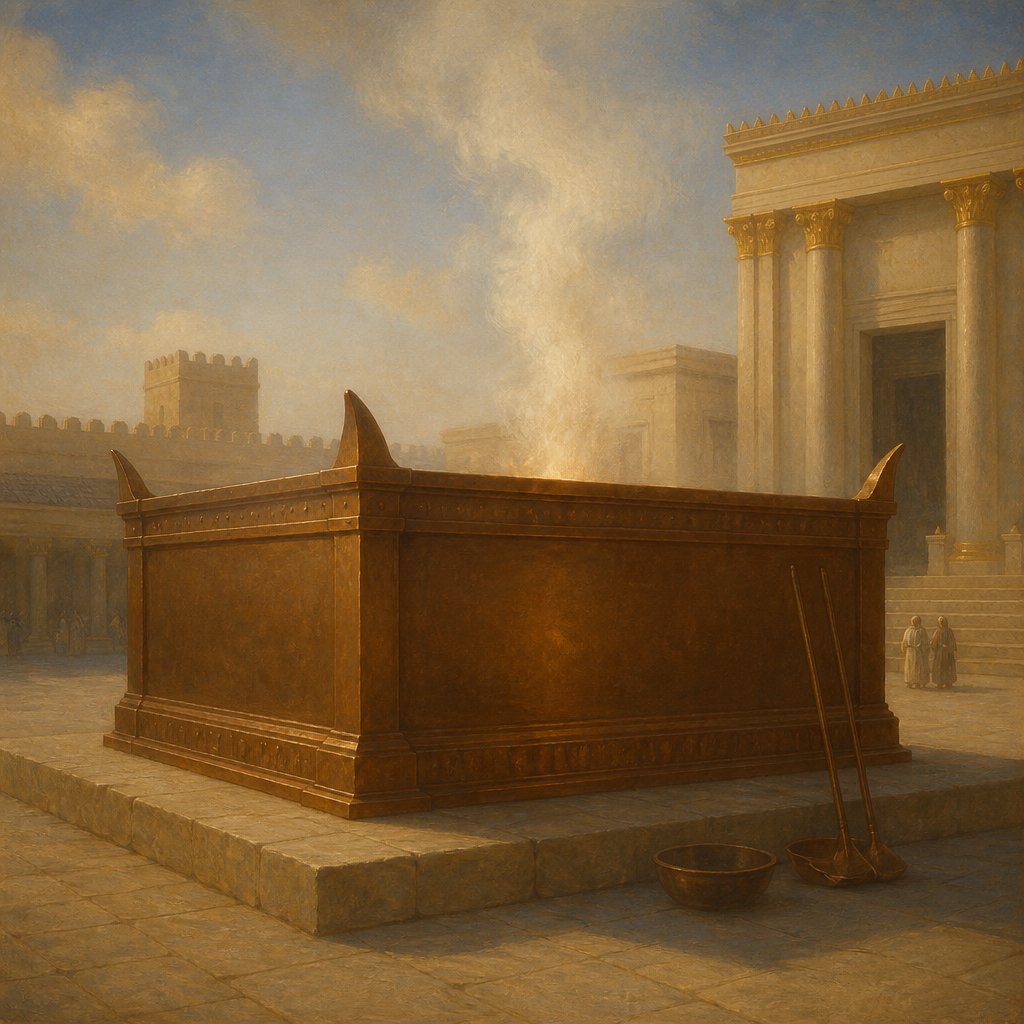
As we ponder the remarkable work of Solomon in building the temple, we are struck by the intricate details and immense significance of the altar mentioned in 2 Chronicles 4:1. The verse declares, ‘Moreover he made an altar of brass, twenty cubits the length thereof, and twenty cubits the breadth thereof, and ten cubits the height thereof.’ In this single verse lies a deep well of truth about worship, sacrifice, and the heart of God.
The specification of the altar's dimensions—twenty cubits long, twenty cubits wide, and ten cubits high—captures our attention immediately. A cubit, an ancient unit of measurement, generally ranged from about 18 inches to 22 inches, giving us an altar that was substantial in size, roughly around 30 feet on each side and 15 feet high. This grand structure was not merely a functional place for sacrifices; it was designed to be a focal point of the worship experience and a representation of God's holiness, majesty, and the seriousness of sin.
In the biblical context, an altar is a sacred space—essentially a meeting point between humanity and divinity. It symbolizes sacrifice, a critical element of worship within the Old Testament covenant. When the people brought their sacrifices to this bronze altar, they did more than perform religious rituals; they engaged in a solemn act of atonement and redemptive worship. Each animal offered was a representation of the cost of sin, a tangible reminder that reconciliation with God requires a price.
One might wonder about the choice of brass for the construction of the altar. Brass often embodies strength and durability, suggesting that the sacrifices made upon it are not just transient acts but are eternally significant in God’s divine plan. Here, we see a foreshadowing of Christ—the ultimate sacrifice who would come generations later. Just as the altar requires the offering of a life, so too did Christ offer His own life, fulfilling the sacrificial system represented by that altar of brass.
As we reflect on the dimensions of the altar—its length and breadth—we are drawn to consider the expansiveness of God’s love and grace. The twenty-cubit width and length remind us that His arms are open wide, inviting us into a relationship that exceeds our expectations. The call to worship is a call to approach this altar, to reach out in faith, knowing that it is on this sacred ground where we find forgiveness and restoration. In our own lives, we must consider the altars we build: are they altars of pride, materialism, or insecurity, or do we set aside moments to step into God’s presence for genuine worship?
Furthermore, the height of the altar speaks to us of elevation in our worship. Worship is not merely to be a horizontal experience where we gather amongst ourselves; it should elevate us toward a higher understanding of who God is and our place in His grand narrative. We need to cultivate a sacred atmosphere of worship that invites the manifestation of God’s presence and power into our midst—a place where heaven and earth converge.
As members of the New Testament church, the challenge before us remains the same. What sacrifices are we willing to bring to our modern altars? Romans 12:1 encourages us to present our bodies as living sacrifices, holy and acceptable, which is our reasonable service. The spirit of sacrifice should not wane in the age of grace, but rather take on new life. What steps can we take today to create an altar of sincerity, authenticity, and love in our worship lives?
In a world where distractions abound, may we cultivate an altar within our hearts, where we lay down our burdens, sins, and offerings before the Lord. Let us remember that the altar of sacrifice is not just a place of death; it is a place where we encounter the living God, a nexus of hope, resilience, and transformed lives. Let us approach His throne of grace with confidence, continually offering our lives as sacrifices of worship.
May we, like Solomon, build altars—not of brass, but of hearts fully surrendered to the One who loves us most.
Get our apps


Artwork for 2 Chronicles 4:1

2 Chronicles 4:1 - "Moreover he made an altar of brass, twenty cubits the length thereof, and twenty cubits the breadth thereof, and ten cubits the height thereof."
"Moreover he made an altar of brass, twenty cubits the length thereof, and twenty cubits the breadth thereof, and ten cubits the height thereof." - 2 Chronicles 4:1

2 Chronicles 4:22

1 Chronicles 4:2 - "And Reaiah the son of Shobal begat Jahath; and Jahath begat Ahumai, and Lahad. These are the families of the Zorathites."

1 Chronicles 4:1 - "The sons of Judah; Pharez, Hezron, and Carmi, and Hur, and Shobal."

1 Chronicles 2:4 - "And Tamar his daughter in law bare him Pharez and Zerah. All the sons of Judah were five."

1 Chronicles 1:4 - "Noah, Shem, Ham, and Japheth."
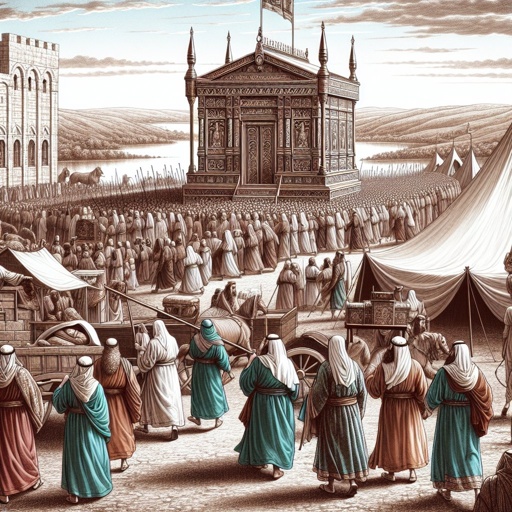
2 Chronicles 1:4 - "But the ark of God had David brought up from Kirjath-jearim to the place which David had prepared for it: for he had pitched a tent for it at Jerusalem."

"The sons of Judah; Pharez, Hezron, and Carmi, and Hur, and Shobal." - 1 Chronicles 4:1

1 Chronicles 4 : 10

2 Chronicles 4:15 - "One sea, and twelve oxen under it."

1 Chronicles 4:29 - "And at Bilhah, and at Ezem, and at Tolad,"

1 Chronicles 4:30 - "And at Bethuel, and at Hormah, and at Ziklag,"

1 Chronicles 8:4 - "And Abishua, and Naaman, and Ahoah,"

2 Chronicles 30:4 - "And the thing pleased the king and all the congregation."

1 Chronicles 15:4 - "And David assembled the children of Aaron, and the Levites:"

2 Chronicles 7:4 - "¶ Then the king and all the people offered sacrifices before the LORD."

1 Chronicles 4:34 - "And Meshobab, and Jamlech, and Joshah the son of Amaziah,"

1 Chronicles 1:2 - "Kenan, Mahalaleel, Jered,"

"One sea, and twelve oxen under it." - 2 Chronicles 4:15

2 Chronicles 4:14 - "He made also bases, and lavers made he upon the bases;"

2 Chronicles 4:21 - "And the flowers, and the lamps, and the tongs, made he of gold, and that perfect gold;"

1 Chronicles 4:28 - "And they dwelt at Beer-sheba, and Moladah, and Hazar-shual,"

1 Chronicles 4:16 - "And the sons of Jehaleleel; Ziph, and Ziphah, Tiria, and Asareel."

1 Chronicles 4:7 - "And the sons of Helah were, Zereth, and Jezoar, and Ethnan."

2 Chronicles 24:4 - "¶ And it came to pass after this, that Joash was minded to repair the house of the LORD."

2 Chronicles 5:4 - "And all the elders of Israel came; and the Levites took up the ark."

1 Chronicles 6:4 - "¶ Eleazar begat Phinehas, Phinehas begat Abishua,"

1 Chronicles 4:4 - "And Penuel the father of Gedor, and Ezer the father of Hushah. These are the sons of Hur, the firstborn of Ephratah, the father of Beth-lehem."

2 Chronicles 29:4 - "And he brought in the priests and the Levites, and gathered them together into the east street,"