A Call to Purity: The Purging of Idolatry in 2 Kings 10:25
“And it came to pass, as soon as he had made an end of offering the burnt offering, that Jehu said to the guard and to the captains, Go in, and slay them; let none come forth. And they smote them with the edge of the sword; and the guard and the captains cast them out, and went to the city of the house of Baal.” — 2 Kings 10:25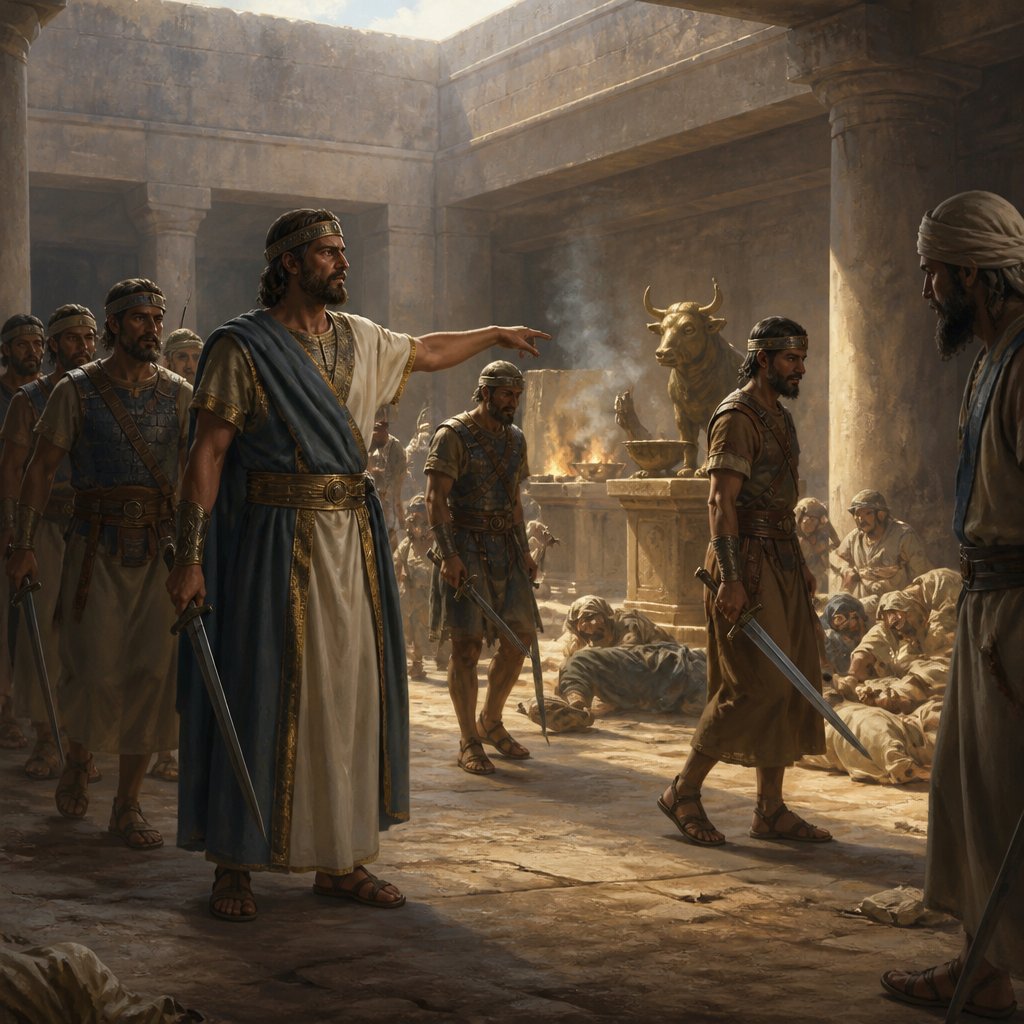
In the narrative of 2 Kings 10:25, we witness a pivotal moment in the history of Israel, where King Jehu takes a decisive stand against idolatry and the worship of Baal. This verse encapsulates a scene of grim determination and righteous judgment: "And it came to pass, as soon as he had made an end of offering the burnt offering, that Jehu said to the guard and to the captains, Go in, and slay them; let none come forth. And they smote them with the edge of the sword; and the guard and the captains cast them out, and went to the city of the house of Baal." (2 Kings 10:25 KJV).
To fully grasp the weight of this moment, we must delve into the context surrounding Jehu’s actions. Jehu, anointed by the prophet Elisha, was tasked with eliminating Ahab’s lineage and eradicating the worship of Baal from Israel. His reform was not merely political; it was a spiritual and moral obligation to cleanse the nation from the corruption that idol worship had brought. We see here a man ardently fulfilling his divine calling, embodying the zeal for the Lord that is sometimes demanded of us in our own spiritual battles.
In the ancient world, the worship of Baal was prevalent and deeply ingrained in society, leading the people of Israel away from their covenant with Yahweh. Jehu's actions can be seen as a desperate and necessary measure to restore true worship and holiness among God’s people. It serves as a sobering reminder of the lengths to which we may need to go to protect our hearts and the hearts of our communities from the false gods that seek to draw us away from God.
This passage forces us to confront our own lives and the idols that may lurk within our hearts. An idol is not merely a statue or representation but anything that occupies the space that only God should fill. In modern contexts, these idols could be materialism, power, relationships, or even our own desires. Jehu's command to slay the prophets of Baal signifies our need to decisively confront and eradicate these hindrances in our lives. Just as he refused to allow any of the worshippers of Baal to survive, we too are called to recognize that no small sin or little idol can coexist with our desire to pursue holiness and relationship with God.
As we reflect on this verse, let us consider what it means to offer a "burnt offering" to God, as Jehu did before ordering the judgment. This act symbolizes complete surrender and dedication to God. In our lives, this may manifest as a commitment to prayer, reading Scripture, or serving others, emphasizing that our first act every day should be one of devotion to God—humbly asking Him to reveal any areas in our lives that are misaligned with His will.
Moreover, the teamwork of the guard and captains highlights the importance of unity in our spiritual battles. We are not called to stand alone; we must rely on the support and guidance of fellow believers. The church is designed to be a community that spurs one another on, helping to guard against the influence of secularism and sin, working together just as the guards acted to purge the house of Baal.
May our hearts and minds be stirred by Jehu's fervent resolve. As we face our own forms of idolatry, let us be vigilant and unyielding in our commitment to God’s ways. Let us pray for the strength to eliminate distractions and dependencies that hinder our relationship with Christ. The story of Jehu serves as a powerful reminder of God’s desire for purity and authenticity in worship, compelling us to examine whether we are devoted to the Almighty or distracted by the allure of lesser gods. In doing so, we can ensure that we are aligned with the heart of God, ready to boldly live in truth and faithfulness.
Get our apps


Artwork for 2 Kings 10:25

2 Kings 10:25 - "And it came to pass, as soon as he had made an end of offering the burnt offering, that Jehu said to the guard and to the captains, Go in, and slay them; let none come forth. And they smote them with the edge of the sword; and the guard and the captains cast them out, and went to the city of the house of Baal."
"And it came to pass, as soon as he had made an end of offering the burnt offering, that Jehu said to the guard and to the captains, Go in, and slay them; let none come forth. And they smote them with the edge of the sword; and the guard and the captains cast them out, and went to the city of the house of Baal." - 2 Kings 10:25

2 Kings 25:10 - "And all the army of the Chaldees, that were with the captain of the guard, brake down the walls of Jerusalem round about."

2 Kings 25:2 - "And the city was besieged unto the eleventh year of king Zedekiah."

"And all the army of the Chaldees, that were with the captain of the guard, brake down the walls of Jerusalem round about." - 2 Kings 25:10

2 Kings 21:25 - "Now the rest of the acts of Amon which he did, are they not written in the book of the chronicles of the kings of Judah?"

2 Kings 25:28 - "And he spake kindly to him, and set his throne above the throne of the kings that were with him in Babylon;"

2 Kings 2:25 - "And he went from thence to mount Carmel, and from thence he returned to Samaria."

2 Kings 25:12 - "But the captain of the guard left of the poor of the land to be vinedressers and husbandmen."

1 Kings 10:25 - "And they brought every man his present, vessels of silver, and vessels of gold, and garments, and armour, and spices, horses, and mules, a rate year by year."

Proverbs 25:2 - "It is the glory of God to conceal a thing: but the honour of kings is to search out a matter."

2 Kings 25:20 - "And Nebuzar-adan captain of the guard took these, and brought them to the king of Babylon to Riblah:"
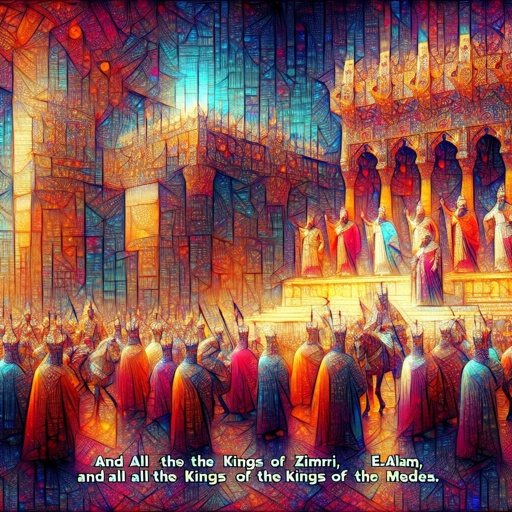
Jeremiah 25:25 - "And all the kings of Zimri, and all the kings of Elam, and all the kings of the Medes,"

"And the city was besieged unto the eleventh year of king Zedekiah." - 2 Kings 25:2

2 Kings 25:3 - "And on the ninth day of the fourth month the famine prevailed in the city, and there was no bread for the people of the land."

2 Kings 25:6 - "So they took the king, and brought him up to the king of Babylon to Riblah; and they gave judgment upon him."

2 Kings 25:14 - "And the pots, and the shovels, and the snuffers, and the spoons, and all the vessels of brass wherewith they ministered, took they away."

2 Kings 25:1 show King Nebuchadnezzar in war zone

2 Kings 25:1 show King Nebuchadnezzar and the army and the Temple

1 Kings 2:25 - "And king Solomon sent by the hand of Benaiah the son of Jehoiada; and he fell upon him that he died."

2 Kings 3:10 - "And the king of Israel said, Alas! that the LORD hath called these three kings together, to deliver them into the hand of Moab!"

2 Kings 25:18 - "¶ And the captain of the guard took Seraiah the chief priest, and Zephaniah the second priest, and the three keepers of the door:"

2 Chronicles 25:26 - "Now the rest of the acts of Amaziah, first and last, behold, are they not written in the book of the kings of Judah and Israel?"

2 Kings 25:15 - "And the firepans, and the bowls, and such things as were of gold, in gold, and of silver, in silver, the captain of the guard took away."

2 Kings 10:28 - "Thus Jehu destroyed Baal out of Israel."

Jehoiachin is released from Babylonian jail 2 kings 25: 27

2 Kings 8:25 - "¶ In the twelfth year of Joram the son of Ahab king of Israel did Ahaziah the son of Jehoram king of Judah begin to reign."

2 Kings 21:10 - "¶ And the LORD spake by his servants the prophets, saying,"

2 Kings 10:4 - "But they were exceedingly afraid, and said, Behold, two kings stood not before him: how then shall we stand?"

2 Kings 25:26 - "And all the people, both small and great, and the captains of the armies, arose, and came to Egypt: for they were afraid of the Chaldees."